Airbus Helicopters has activated the “Helicopter 0” ground test bed for the Tiger MkIII Mid-Life Upgrade, signaling the transition to full-system integration as France and Spain advance a connectivity-driven modernization of their attack helicopter fleets rather than pursuing an immediate replacement.
On December 22, 2025, Airbus Helicopters announced via LinkedIn that the Tiger Mid-Life Upgrade (MLU) program has entered a new phase with the activation of its “Helicopter 0” ground test bed. This milestone signals that the Tiger MkIII retrofit for France and Spain is moving beyond the design stage into full-system integration, with dedicated test assets now in place. Rather than pursuing an immediate replacement, the MLU aims to preserve the operational relevance of the existing Tiger attack helicopter fleet as European land forces increasingly prioritize connectivity, precision strike, and manned–unmanned teaming.
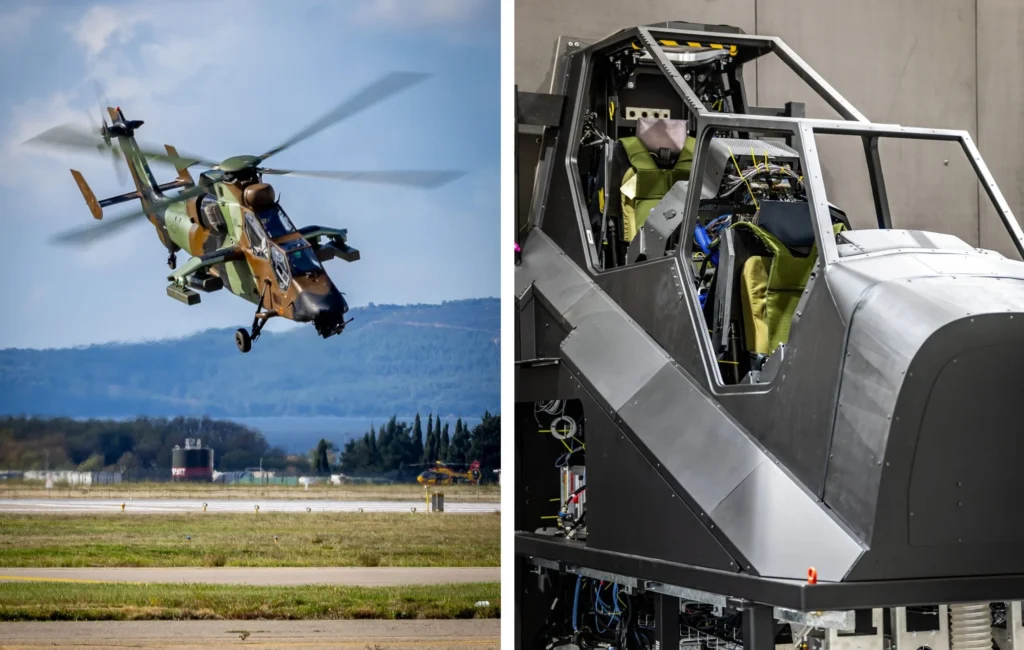
The “Helicopter 0” installation is a high-fidelity ground rig that replicates the Tiger cockpit and onboard systems without the propulsion chain. It is designed to integrate and validate the MkIII upgrades in a controlled environment, including new avionics, an updated mission system, enhanced sensors, modernized communications, and expanded weapons integration. Airbus highlights a new data link capable of interfacing with uncrewed aerial systems, underscoring the program’s focus on closer cooperation between crewed helicopters and drones. The ground test bed allows early identification of integration risks, software maturation, and refinement of human–machine interfaces before flight testing begins.
The current progress builds on a contract awarded in March 2022 by OCCAR to Airbus Helicopters on behalf of the French and Spanish defense procurement agencies (DGA and DGAM). The program reflects lessons learned from more than two decades of Tiger operations, particularly in areas such as availability, interoperability, and technological obsolescence. The MkIII upgrade strategy concentrates on renewing the aircraft’s digital and mission architecture, where aging occurs most rapidly, rather than addressing the airframe as the primary limitation.
Airbus also confirmed that all three Tiger helicopters designated as flying prototypes for the MkIII upgrade have now been delivered. A French Army Tiger has recently arrived at the Marignane facility, joining a Spanish Army aircraft and a second French Tiger received in 2024. These aircraft will support the flight-test campaign, translating ground-test validation into airborne demonstrations, with the first flying prototype expected in 2026. The combination of a full-cockpit ground rig and multiple flight-test aircraft is intended to reduce program risk and avoid late-stage integration issues.
Operationally, the value of the Tiger MLU lies in improved data processing, decision-making, and information sharing rather than any single subsystem. A modernized cockpit and mission system are expected to reduce crew workload, shorten sensor-to-shooter timelines, and enhance coordination with ground forces and other air assets. The integration of drone-capable data links positions the Tiger to operate as part of a wider combined-arms network, using unmanned systems to extend surveillance, support targeting, and reduce risk in contested environments.
From an industrial perspective, Airbus plans to establish a final assembly line for the Tiger MLU in Albacete, Spain, with construction expected to begin in early 2026. This facility will operate alongside the Marignane site in France to support the serial upgrade of 60 aircraft—42 for France and 18 for Spain. The dual-site approach strengthens industrial cooperation, sustains skilled workforces in both countries, and ensures long-term support capacity for the Tiger fleet.
Together, the activation of the “Helicopter 0” ground test bed, the consolidation of flying prototypes at Marignane, and preparations for the Albacete assembly line indicate that the Tiger MkIII program is entering its most critical engineering phase. If ground integration and flight testing progress as planned toward 2026, France and Spain will be well positioned to field a more connected and network-capable Tiger, aligned with future operational requirements and supported by a shared European industrial base.
About The Author