Airbus and Saab are engaging in discussions to co-develop an unmanned combat aircraft designed to operate alongside current-generation fighters such as the Eurofighter Typhoon and Gripen E, as the Franco-German-Spanish SCAF program continues to face delays and internal disagreements.
Airbus and Saab have held preliminary discussions on the joint development of an unmanned combat aircraft, company executives told Reuters at a recent European defense industry event.
The talks underline growing interest in advanced drone systems and reflect evolving partnerships within Europe’s highly fragmented defense sector.
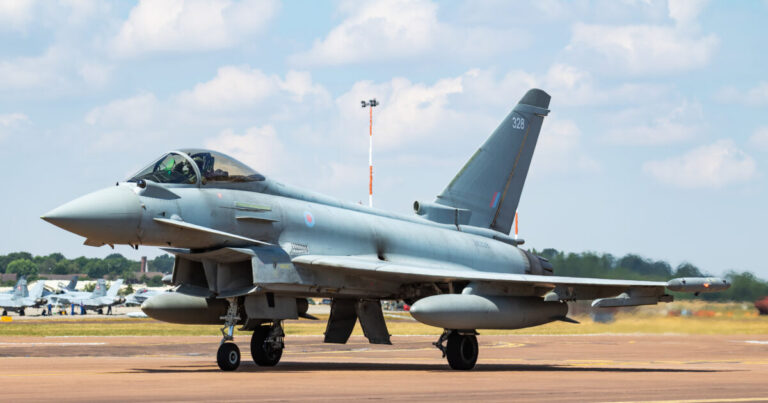
The concept under consideration involves unmanned aircraft designed to operate alongside existing manned fighters, including the Airbus-backed Eurofighter Typhoon and Saab’s Gripen E.
According to Reuters, the initiative could become more significant if the trilateral Future Combat Air System (SCAF)—a €100 billion Franco-German-Spanish next-generation fighter program—continues to suffer from delays and internal disputes. Industry sources suggest that progress in Airbus–Saab discussions could encourage wider European airpower cooperation outside the SCAF framework.
Responding to questions about contingency planning should SCAF falter, Saab CEO Micael Johansson said the two companies already cooperate closely, notably through Saab’s Arexis electronic warfare system used on German Eurofighters.
“We have also discussed the possibility of cooperating in the unmanned aircraft domain to complement our existing fighter platforms,” Johansson said, adding that Saab is engaged with multiple partners and that no formal decisions have been taken. “It remains a potential opportunity,” he noted during the Brussels forum.
Airbus CEO Guillaume Faury confirmed the discussions, highlighting longstanding collaboration between Airbus and Saab in electronics and missile systems.
“We see promising opportunities to extend that cooperation into unmanned aircraft,” Faury said. “This dialogue is ongoing and independent of SCAF. The discussions are taking place directly between Airbus and Saab, separate from other program considerations.”
Both companies are focusing on next-generation unmanned systems—often referred to as Collaborative Combat Aircraft (CCA) or Loyal Wingmen—designed to accompany piloted fighters and operate in heavily contested airspace.
Meanwhile, defense ministers from France, Germany, and Spain are due to meet on December 11 to review the state of the SCAF program. Reuters cited industry sources saying senior figures from Airbus, Saab, and the UK’s BAE Systems—a key partner in the UK–Japan-led Global Combat Air Programme (GCAP)—have remained in frequent contact.
Launched more than eight years ago, SCAF has repeatedly faced schedule setbacks and disagreements among partner nations and industry stakeholders.
Johansson declined to directly comment on Saab’s position in relation to tensions within SCAF, stressing, “We are not talking about Sweden replacing anyone or anything.”
Historically, Sweden pursued an independent fighter path with Gripen, France developed the Rafale, while a multinational consortium led by the UK—alongside Germany, Spain, and Italy—produced the Eurofighter.
In the current generation, France, Germany, and Spain remain aligned on SCAF, while the UK has partnered with Japan under GCAP, which remains open to additional members. Sweden has yet to settle on its long-term strategy, having initially aligned with the UK before launching its own research into a potential Gripen successor. Political decisions are expected by 2030, though Johansson indicated outcomes could emerge earlier, possibly around 2028.
“I don’t rule out any form of partnership in the future,” Johansson said. “That could be one option, but preserving original equipment manufacturer capability in the fighter domain is crucial—why would you give that up?”
About The Author