Austal Defence Australia wins AUD 1.029 billion contract to build 18 medium landing craft for the Australian Army, enhancing heavy-lift capabilities across contested littoral regions.
Austal Defence Australia announced on December 18, 2025, that it has secured a 1.029 billion AUD Design and Build contract to deliver 18 Landing Craft Medium (LCM) vessels for the Australian Army under the Strategic Shipbuilding Agreement. Construction of the first steel hull is scheduled to begin in 2026 at Henderson, Western Australia, with deliveries continuing through 2032. The program establishes a sustained production run aimed at enhancing Australia’s capability to move heavy combat power across contested littoral environments.
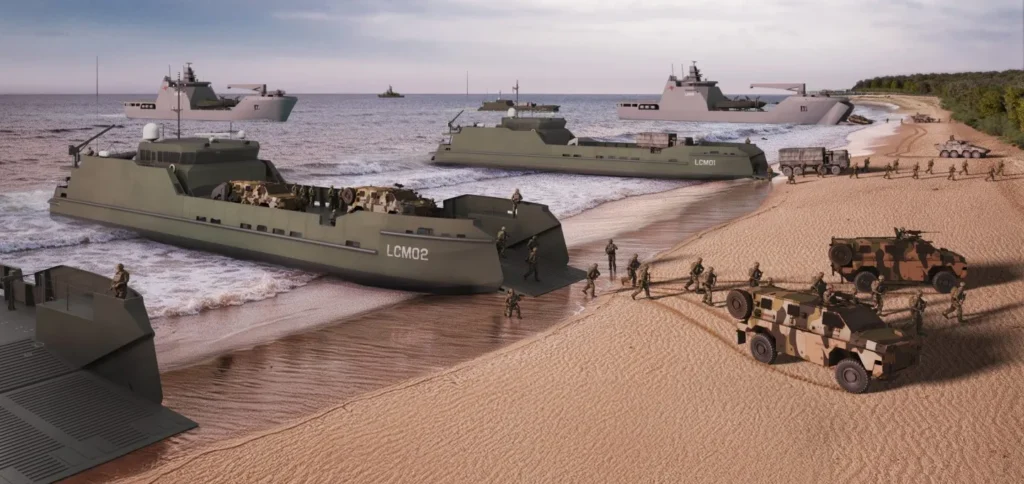
Austal’s statement provides limited configuration details but confirms two key technical aspects. First, the vessels will be built in steel, a choice supporting repeated beaching, heavy vehicle loads, and higher abrasion and impact tolerance than lighter alloys, making them suitable for harsh littoral operations. Second, the class will be able to carry loads up to 80 tonnes, allowing a single sortie to transport Australia’s heaviest tactical assets, including Abrams tanks, recovery vehicles, protected mobility trucks, and bulky engineer equipment that smaller landing craft cannot handle in one trip.
Canberra’s public messaging clarifies the intended operational use. In July 2024, Defence Industry Minister Pat Conroy described the medium landing craft as part of a new littoral fleet to deploy and sustain modernized land forces across the region, explicitly tied to a strategy of denial. Government statements suggested the medium craft could carry up to 90 tonnes, including combinations like four HIMARS, a main battle tank, or an infantry fighting vehicle with Bushmasters, with a projected range of up to 2,000 nautical miles when operating alongside future heavy landing craft. The difference between the earlier 90-tonne figure and Austal’s 80-tonne contract specification likely reflects design maturation definitions, but the tactical purpose remains the same: transporting significant combat power by sea independently of fixed ports.
The program will replace the Army’s aging LCM 8 fleet, vessels that have served for decades but lack the endurance, payload flexibility, and survivability required for contemporary operations. Early design concepts envisioned roughly 50-meter class craft with true blue-water capability, carrying 80 tonnes over 2,000 nautical miles while operating at Sea State 4 with fuel reserves. Even if Austal’s final design evolves from these briefings, the core requirement is clear: Australia is acquiring not just ship-to-shore connectors, but a versatile coastal and archipelagic lift tool capable of repositioning and sustaining land forces in contested littorals.
Compared with current capabilities, this represents a major step forward. The Royal Australian Navy’s LCM-1E landing craft, built by Navantia for Canberra-class amphibious ships, is a fast and sophisticated connector optimized for rapid offload, featuring over-the-horizon navigation, twin waterjets, and speeds over 20 knots when unladen. However, its endurance is limited to tactical hops rather than long coastal transits. Meanwhile, smaller LCVPs transport light vehicles and troops, and HMAS Choules can embark older craft for disaster relief or lift operations, but this fleet does not provide the Army with a purpose-built, heavy, long-range littoral shuttle. Upgrades to LCM-1E craft to carry Abrams tanks and heavy trucks highlight both the operational demand and the limits of the current fleet.
Strategically, the program addresses Australia’s vast northern approaches, long internal sea lines, and an Indo-Pacific security environment where bases and ports may be threatened or unavailable. It complements the broader Henderson industrial strategy, where medium landing craft sit alongside a planned 100-meter class heavy landing craft program designed to transport high payloads over inter-theater distances. In wartime logic, heavy landing craft will form the logistics backbone, while the new medium landing craft distributes loads from ship to shore, shore to shore, and along Australia’s coastline, providing commanders with flexible options when airlift is limited or ports are denied.
About The Author