As the war between Iran and the U.S.–Israel coalition enters its tenth day, Washington is rapidly expanding its long-range strike capabilities. The arrival of B-52 strategic bombers in the United Kingdom signals preparations for sustained heavy air operations across the Middle East.
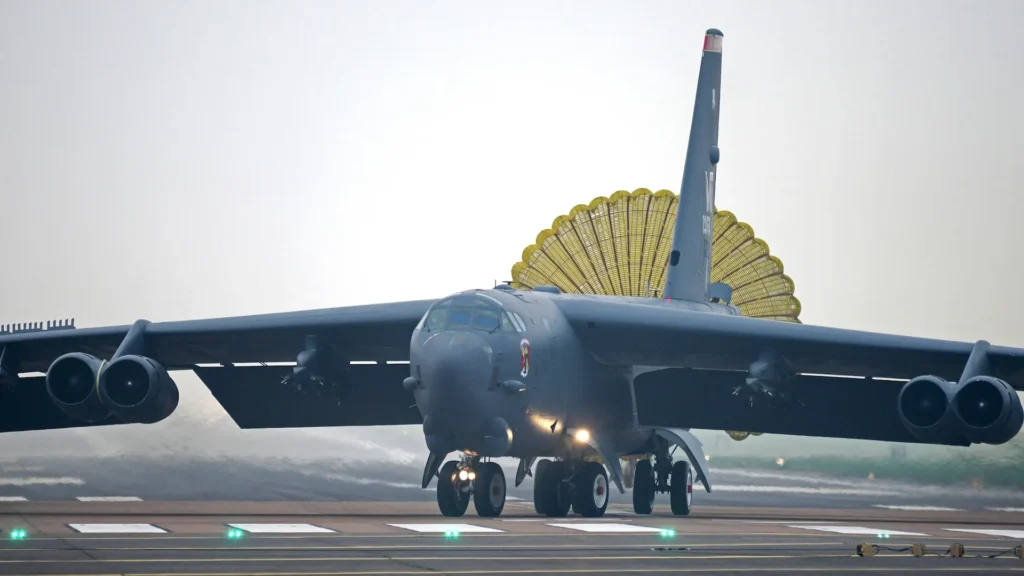
The conflict between Iran and the combined forces of the United States and Israel has now entered its tenth day, with missile barrages, drone strikes, and air attacks continuing to shake the Middle East. As the fighting intensifies, Washington has taken another major step to strengthen its strike capabilities by deploying strategic bombers to Europe.
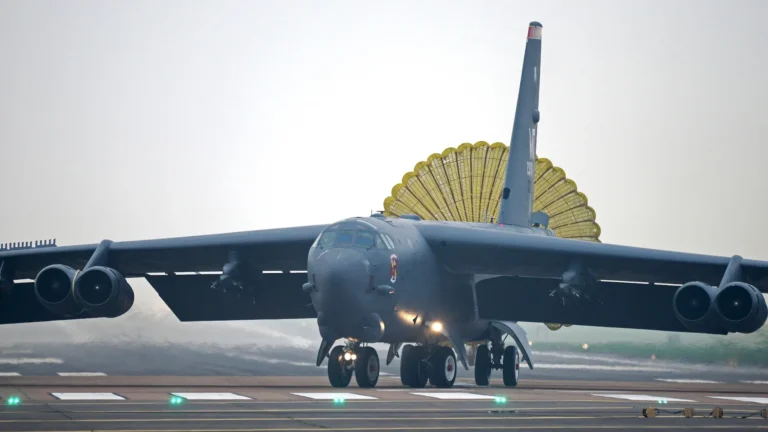
Three U.S. Air Force B-52H Stratofortress bombers have arrived at RAF Fairford in the United Kingdom, significantly expanding America’s long-range strike posture against Iranian targets. The aircraft belong to the 5th Bomb Wing from Minot Air Force Base in North Dakota, one of the Air Force’s most experienced strategic bomber units.
The arrival of these aircraft highlights how the United States is positioning its forces for a sustained air campaign that could continue for weeks if the conflict escalates further.
Growing Bomber Presence in Europe
The deployment of the B-52s is part of a larger buildup of U.S. bomber forces at RAF Fairford. Earlier in the week, the base also received B-1B Lancer bombers, with one arriving on Friday followed by two more on Saturday.
RAF Fairford has long served as a key forward operating location for American bombers in Europe. Its location allows U.S. aircraft to launch missions toward the Middle East, Eastern Europe, or North Africa without the extremely long transit times required for flights originating from the United States.
Military analysts say this forward positioning could dramatically increase the number of strike missions that American bombers can conduct against Iranian targets.
Strategic Role of Diego Garcia
While Britain is now hosting a growing bomber force, another critical location remains the U.S. base on Diego Garcia in the Indian Ocean.
Recent satellite imagery reviewed by analysts shows no bomber aircraft currently stationed there. However, the island continues to receive a steady flow of heavy transport aircraft, aerial refueling tankers, and several F-16 fighter jets.
The continued buildup suggests that Diego Garcia may still play an important logistical role in the ongoing campaign. The remote island base has historically been used by the United States to launch long-range bombing missions across the Middle East.
Long-Range Cruise Missile Strikes
American B-52 bombers have already conducted missions against Iranian targets earlier in the conflict. These aircraft launched AGM-158 JASSM stealth cruise missiles, a precision-guided weapon designed to strike heavily defended targets from long distances.
These missiles allow bombers to attack without entering hostile airspace. In recent operations, the weapons were likely fired from positions over Iraq or other friendly regional airspace, keeping the aircraft far away from Iranian air defense systems.
Such standoff attacks are considered one of the safest ways to strike hardened targets while minimizing risk to the aircraft and crews.
Preparing for Higher Tempo Air Operations
Forward deploying bombers to locations such as RAF Fairford or Diego Garcia offers significant operational advantages. When aircraft fly directly from the United States, missions can last more than 30 hours and place enormous strain on both crews and aircraft.
Operating from Europe or the Indian Ocean dramatically reduces travel time, allowing bombers to conduct more sorties while also reducing mechanical wear on the fleet.
This shift becomes even more important if the United States decides to move beyond long-range missile strikes and conduct direct bombing missions over Iran. Such operations would require aircraft to enter or approach contested airspace, making shorter mission durations and faster turnaround times crucial.
The Next Phase of the Air War
The deployment of additional bombers suggests that Washington is preparing for a prolonged conflict rather than a short series of retaliatory strikes.
If air superiority can be established over parts of Iran, U.S. bomber aircraft such as the B-52 and B-1 could begin carrying out more direct attacks against military infrastructure, missile bases, and command facilities.
For now, the expanding bomber presence in Europe serves as a clear signal: the United States is positioning itself to maintain heavy and sustained pressure on Iranian targets as the conflict continues to unfold.
About The Author