Bangladesh has formalized its intent to pursue the Eurofighter Typhoon, signing a Letter of Intent with Italy’s Leonardo as part of its Forces Goal 2030 drive to acquire a Western multirole combat aircraft.
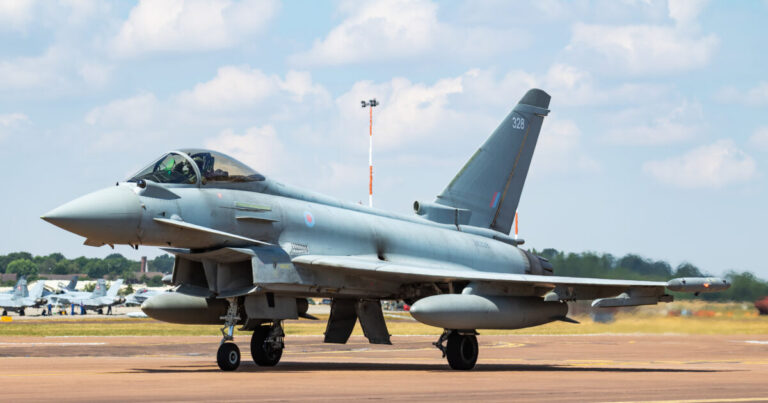
On December 9, 2025, the Bangladesh Air Force signed a Letter of Intent (LOI) with Italy’s Leonardo in Dhaka for the potential acquisition of Eurofighter Typhoon multirole fighter jets. The move represents an initial step toward replacing older, Chinese-origin combat aircraft with a modern European platform under Bangladesh’s Forces Goal 2030 modernization strategy. The LOI also suggests a declining emphasis on the Chinese-made J-10 and signals a possible long-term transition toward Western military aviation technology.
The signing ceremony took place at Air Force Headquarters in Dhaka and was attended by Air Chief Marshal Hasan Mahmood Khan, Italy’s Ambassador to Bangladesh Antonio Alessandro, senior officials from the Armed Forces Division, and representatives from Leonardo. Under the LOI, Leonardo is designated as the lead industrial partner, with potential aircraft assembly planned in Turin, Italy. The Typhoon is expected to enter frontline service as part of Forces Goal 2030, opening the way for the introduction of a new Western fighter capability within the Bangladesh Air Force inventory.
The agreement follows several years of technical assessments by the Bangladesh Air Force. Earlier in 2025, Bangladeshi pilots and engineers traveled to Turin to evaluate the ISPA 6 instrumented Eurofighter, which was equipped with the Captor-E active electronically scanned array (AESA) radar and the P3Eb upgrade package. These evaluations indicate that Bangladesh is considering aircraft standards comparable to the Typhoon Tranche 4 configuration, featuring upgraded sensors, avionics, and mission systems.
The exact number of aircraft has not yet been finalized, although planning discussions have referenced a requirement for approximately 10 Eurofighter Typhoons within a broader mixed fleet. The Typhoon is expected to replace aging J-7 fighters and portions of the MiG-29 fleet. This transition would require the introduction of Western weapons and support systems, as existing Russian and Chinese munitions are not compatible, necessitating major changes to logistics, training, and combat support infrastructure.
Bangladesh’s fighter replacement effort has followed a lengthy and complex procurement path. In 2017, Dhaka opened a closed tender for Russian MiG-35 or Su-30 aircraft, later cancelled due to financial constraints, sanctions concerns, and integration challenges. In 2021, the Air Force allocated roughly 25,200 crore taka (around €2.5 billion) for 16 Western multirole fighters and sought initial funding in the 2021–2022 budget. These plans stalled amid the COVID-19 pandemic and political changes, with authorities later confirming that no Rafale contract had been signed. Parallel discussions reportedly explored a mixed fleet concept that included Chinese J-10CE fighters, Eurofighter Typhoons, and Pakistan-produced JF-17 Block III aircraft.
The Typhoon LOI aligns with the wider Forces Goal 2030 framework, which aims to strengthen Bangladesh’s military across land, sea, and air. The Air Force has already expanded its command structure, activated new bases in Cox’s Bazar and Dhaka, and is developing additional facilities in Barishal and Sylhet, along with a dedicated maritime air support operations center. Recent acquisitions include F-7BGI fighters, Yak-130 trainers, C-130J transports, Mi-171Sh helicopters, AW139 maritime helicopters, K-8W trainers, L-410 aircraft, and advanced radar and surface-to-air missile systems. Despite modernization efforts, accidents involving aging aircraft have highlighted the urgency of fleet renewal.
Originally conceived during the Cold War, the Eurofighter Typhoon emerged from a multinational requirement issued in 1983 by the United Kingdom, Germany, Italy, and Spain. The program matured through the creation of the Eurofighter consortium and successive production tranches that introduced incremental upgrades in avionics, sensors, and weapons integration. By 2025, more than 570 aircraft have been produced and delivered to multiple users across Europe and the Middle East.
The Typhoon’s twin-engine, canard-delta design delivers high agility, strong energy performance, and advanced situational awareness. Powered by two Eurojet EJ200 engines, the aircraft can reach speeds close to Mach 2 and supports a wide range of air-to-air and air-to-ground weapons, including Meteor, AMRAAM, IRIS-T, Paveway, Brimstone, and Storm Shadow. Its modular architecture allows customization to national requirements, an important factor for Bangladesh as it considers integrating Western weapons, data links, and mission systems for the first time.
About The Author