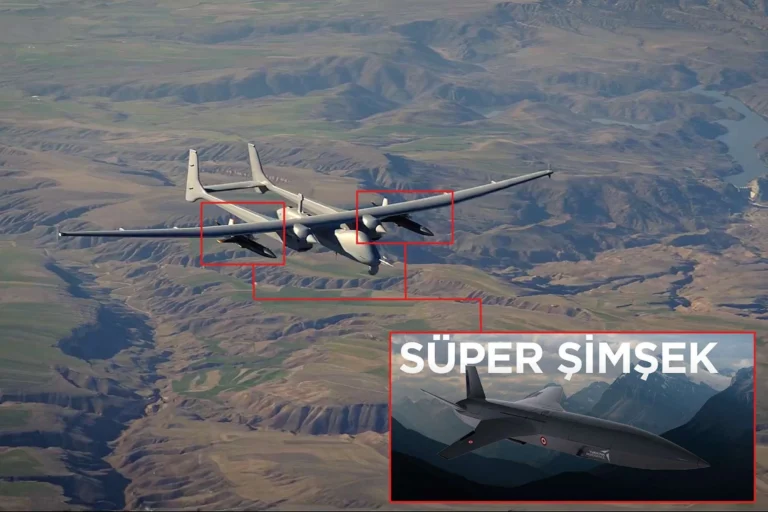
On November 29, 2025, the landscape of unmanned aerial warfare took a distinct turn toward the future when Baykar officially showcased a successful operational test of its Bayraktar Kalkan VTOL UAV acting as a mothership. In a demonstration that feels less like a traditional flight test and more like a glimpse into next-generation combat doctrine, the Kalkan successfully deployed a Skydagger FPV drone while in mid-flight. This wasn’t just a technical proof-of-concept; it was a clear signal that the tactical lessons learned from the grinding conflicts in Ukraine and the South Caucasus are being rapidly synthesized into deployable technologies. The ability to launch a high-speed, agile attack drone from a long-endurance surveillance platform effectively rewrites the engagement rules for modern infantry and artillery support, marking a significant leap for armed forces looking to modernize their layered unmanned systems.
To understand why this is such a pivotal moment, one has to look at the platform itself. The Bayraktar Kalkan is a vertical-takeoff-and-landing aircraft, a sophisticated derivative of Baykar’s DİHA family, designed to operate where traditional runways simply don’t exist. With a wingspan stretching five meters and a fuselage around 1.5 meters long, it sits in a sweet spot of tactical utility. Its hybrid propulsion system is a marvel of flexibility, utilizing four electric motors to lift off vertically like a helicopter before a gasoline engine kicks in to power fixed-wing cruise flight. This allows the aircraft to operate from a confined 20 by 20-meter patch of dirt, the deck of a ship, or a clearing in a dense forest, removing the need for catapults or landing strips. Once airborne, it offers the endurance of a much larger plane, capable of staying aloft for up to eight hours and climbing above 14,000 feet, all while beaming data back over a range that can exceed 100 kilometers.
However, the recent test campaign transformed the Kalkan from a passive observer into an active combat delivery system. During the demonstration, the UAV carried a Skydagger 7 FPV kamikaze drone—a compact, aggressive system designed for precision strikes. The test was twofold: first, a controlled release to prove the FPV drone could separate cleanly from the carrier, stabilize itself in the chaotic airflow, and land safely. The second phase was the lethal application, where the drone was released and immediately transitioned into a dive-attack profile against a fixed target. This capability solves one of the biggest limitations of small FPV drones, which is their battery life. By hitching a ride on the Kalkan, the FPV drone effectively inherits the range and altitude of its carrier, allowing it to be released fresh and fully charged deep behind enemy lines, far beyond where a ground-launched operator could ever hope to reach.
The partnership with Skydagger Drones is equally noteworthy. This isn’t a theoretical startup; Skydagger has already cemented itself as a serious player, particularly after fulfilling a major contract for Kosovo in October 2025, delivering thousands of units ahead of schedule. Their drones, which come in various sizes with payloads ranging from 2 to 5 kilograms, are built for speed and impact, hitting velocities of up to 140 km/h. When you combine Skydagger’s cheap, expendable lethality with Baykar’s sophisticated, long-endurance infrastructure, you get a “hunter-killer” team that is difficult to defend against. The Kalkan can loiter high above the reach of short-range air defenses, identify a target with its electro-optical sensors, and then drop a munition that closes the distance in seconds.
From a tactical perspective, this concept of operations offers profound advantages. Ground-launched FPVs are often hindered by terrain; a hill, a building, or the curvature of the earth can break the radio link or block the flight path. An air-launched FPV, however, starts its mission from the sky, maintaining a clear line of sight to the target and bypassing ground-level obstacles entirely. It also keeps the human operators safer. Instead of creeping to the front lines to get within range, operators can control the engagement from a secure location far to the rear, using the Kalkan as a relay. This method allows for “over-the-horizon” strikes where the carrier vehicle acts as a localized satellite, spotting targets and coordinating attacks in real-time.
Strategically, this test underscores Türkiye’s continued ascent as a drone superpower. It highlights a shift away from relying solely on large, expensive platforms toward a distributed architecture where “motherships” deploy swarms of cheaper, expendable assets. This mirrors a global trend where militaries are seeking cost-effective ways to overwhelm enemy air defenses. For NATO allies and neighboring regions, particularly in the Balkans where Turkish technology is already being integrated, this demonstrates a maturing capability to conduct complex operations in contested airspace. The Kalkan test proves that the era of drone-on-drone deployment is no longer just science fiction or battlefield improvisation—it is now a standardized, industrial capability ready for export and operational use. As Baykar continues to refine these systems, the line between reconnaissance and strike capabilities blurs, creating a new paradigm where every surveillance drone is a potential carrier for a precision strike.
About The Author