SynMax’s Theia maritime awareness platform tracked three newly built Shuiqiao-class landing barges as they transited from the Pearl River Estuary to Nansan Island between January 11 and 15, where they conducted sea trials and training activities. One of the vessels was observed deploying directly onto a beach, underscoring China’s expanding logistics and amphibious support capabilities in the South China Sea.
China has transferred three newly constructed Shuiqiao-class Landing Platform Utility barges—often described as invasion barges—from the Pearl River Estuary into the South China Sea between January 11 and 15, 2026. The movement was identified through fresh imagery and vessel-tracking data released by SynMax’s maritime domain awareness platform, Theia.
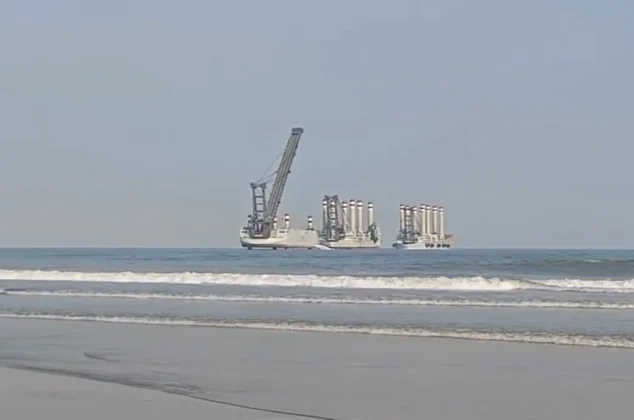
According to Theia, the second production batch includes three self-propelled jack-up barges featuring different configurations: an eight-leg 185-meter variant, a six-leg 128-meter variant, and a four-leg 108-meter variant. These vessels were first detected on January 11 transiting waters near Shenzhen before heading south. By January 12, all three had arrived at Nansan Island, where they began what analysts assessed as sea trials and operational training.
All barges in the Shuiqiao class are equipped with deployable roadway systems that can be lowered to create temporary docks or improvised logistics nodes. Their design allows rapid establishment of coastal infrastructure, enabling amphibious forces to offload vehicles, heavy equipment, and supplies directly in shallow or undeveloped areas.
On January 15, Theia observed one of the barges positioned directly on a beach at Nansan Island, approximately 26 kilometers southeast of Zhanjiang. The tracking was maintained using Theia’s sensor-fusion architecture, which combines electro-optical satellite imagery, synthetic aperture radar, and automatic identification system data across a monitored area exceeding 30 million square kilometers.
SynMax noted that it has been monitoring the Shuiqiao program since December 2024, when the first batch of LPUs departed Guangzhou Shipyard. Those initial vessels conducted sea trials near the Wanshan Archipelago and later took part in amphibious exercises off Zhanjiang in February 2025.
The Shuiqiao class is built as a modular, multi-leg support platform using jack-up technology that allows the barges to elevate themselves above the water once deployed. This provides stability for operating extendable roadways, effectively transforming the platforms into temporary piers capable of supporting heavy vehicles, cargo transfer, and logistics staging.
The recent deployment to Nansan Island follows sustained activity along China’s southern coastline over the past two years, including expanded maritime infrastructure development and frequent movements of auxiliary logistics platforms. Previous tracking has highlighted repeated operations around Guangzhou, the Wanshan Archipelago, and areas close to major naval facilities in Guangdong Province.
Chinese shipyards have continued to introduce improved variants of the Shuiqiao class, with increased payload capacity, longer roadways, and enhanced lift systems. The second batch identified in January 2026 represents the widest range of leg configurations observed so far, underlining ongoing refinement of the design.
The simultaneous presence of all three new barges at Nansan Island between January 12 and 15 strengthens assessments that China is enhancing its capability to establish temporary logistics hubs, create improvised landing points, and sustain dispersed maritime and amphibious operations across the South China Sea.
About The Author