China publicly revealed its Hurricane 3000 high-power microwave weapon during a nationally televised military parade in January 2025, marking a rare public display of a directed-energy system intended to counter drone swarms. The unveiling underscores Beijing’s increasing emphasis on low-cost, high-volume air defense solutions as unmanned threats continue to transform modern warfare.
China has publicly unveiled a new vehicle-mounted high-power microwave weapon, designated the Hurricane 3000, during a nationally televised military parade in January 2026. Footage broadcast by Chinese state media marked one of the rare occasions in which the People’s Liberation Army openly displayed a directed-energy weapon, signaling that counter-drone microwave systems are now considered an operational element of China’s air defense structure rather than an experimental capability.
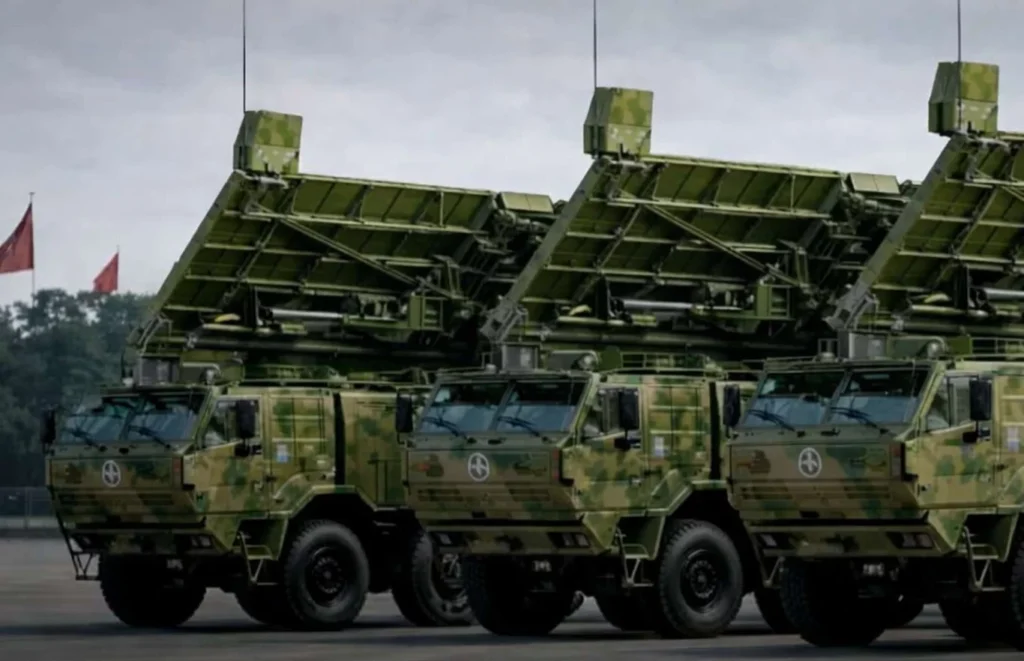
The Hurricane 3000 is assessed to be a vehicle-based high-power microwave system capable of emitting concentrated electromagnetic energy to disrupt, disable, or permanently damage the electronic systems of hostile drones at ranges reported to reach up to three kilometers. Instead of relying on missiles or gun-based interceptors, the system uses intense microwave pulses to overwhelm flight control electronics, sensors, navigation units, and communication links. Analysts believe the weapon operates through rapid, repeated bursts rather than a continuous beam, enabling it to engage multiple targets in quick succession and making it especially effective against coordinated drone swarms.
Visually, the system features a large directional emitter mounted on a stabilized platform, supported by onboard power generation and cooling equipment housed within the vehicle. Observers assess that the Hurricane 3000 operates in the high-gigahertz frequency range, designed to exploit known vulnerabilities in both commercial and military electronic components. The lack of visible interceptors or radar-guided launch systems suggests the weapon is likely integrated into a wider air defense network, receiving target data from external radars, electro-optical sensors, or command-and-control vehicles.
From an operational standpoint, the Hurricane 3000 offers clear advantages on modern battlefields increasingly dominated by low-cost drones used for surveillance, targeting, and strike missions. Traditional air defense systems face economic challenges when countering large numbers of small unmanned aircraft, where the cost of interceptors often exceeds the value of the targets. A microwave-based system shifts this balance by allowing repeated engagements at very low per-use cost, constrained mainly by power supply and maintenance requirements, while also reducing logistical burdens by eliminating the need for missile resupply.
Tactically, the Hurricane 3000 could be deployed to defend high-value assets such as command centers, air defense sites, logistics areas, and maneuvering ground units. Its ability to neutralize drones without generating debris or secondary explosions is particularly valuable in dense or urban environments and near friendly forces. However, its reliance on line-of-sight engagement and potential limitations caused by terrain suggest it would be most effective as part of a layered air defense network rather than as a standalone solution.
The emergence of the Hurricane 3000 appears to reflect more than a decade of Chinese research into directed-energy technologies. Chinese defense research institutions have previously published studies on high-power microwave generation, compact energy systems, and electromagnetic protection. While Beijing has not released detailed testing data, the system’s public appearance indicates it has likely undergone extensive trials and integration within PLA ground units, and possibly naval forces.
In comparison with Western systems, the Hurricane 3000 occupies a similar role to US-developed microwave-based counter-drone systems such as THOR and the US Army’s IFPC-HPM prototype. While many Western programs remain in testing or limited deployment phases, China’s decision to display the Hurricane 3000 in a major parade suggests confidence in its operational readiness. However, details regarding its level of integration with advanced command-and-control networks remain unclear.
In a potential Taiwan contingency, the Hurricane 3000 could provide the PLA with a valuable capability to suppress Taiwanese and allied drone reconnaissance and strike systems. If deployed alongside amphibious assault units, coastal defense forces, or on large landing ships, the system could help establish localized zones of drone denial. This would reduce enemy situational awareness and targeting effectiveness during the early stages of an operation, improving the survivability of Chinese forces operating across the Taiwan Strait.
About The Author