On 14 January 2026, Chinese state media released new technical data on the People’s Liberation Army Navy’s next-generation Type 096 Tang-Class ballistic missile submarine. If verified, the information indicates a significant enhancement of China’s sea-based nuclear deterrent, reducing long-standing capability gaps with the United States and Russia.
Chinese state media on January 14, 2026, provided the clearest public view yet of the People’s Liberation Army Navy’s Type 096 Tang-Class ballistic missile submarine, widely regarded as the future backbone of China’s sea-based nuclear deterrent. While Beijing has not officially confirmed technical details, the disclosed information suggests a substantially larger, quieter, and more heavily armed submarine than the current Type 094 Jin-Class, signaling a shift toward continuous, survivable nuclear patrols.
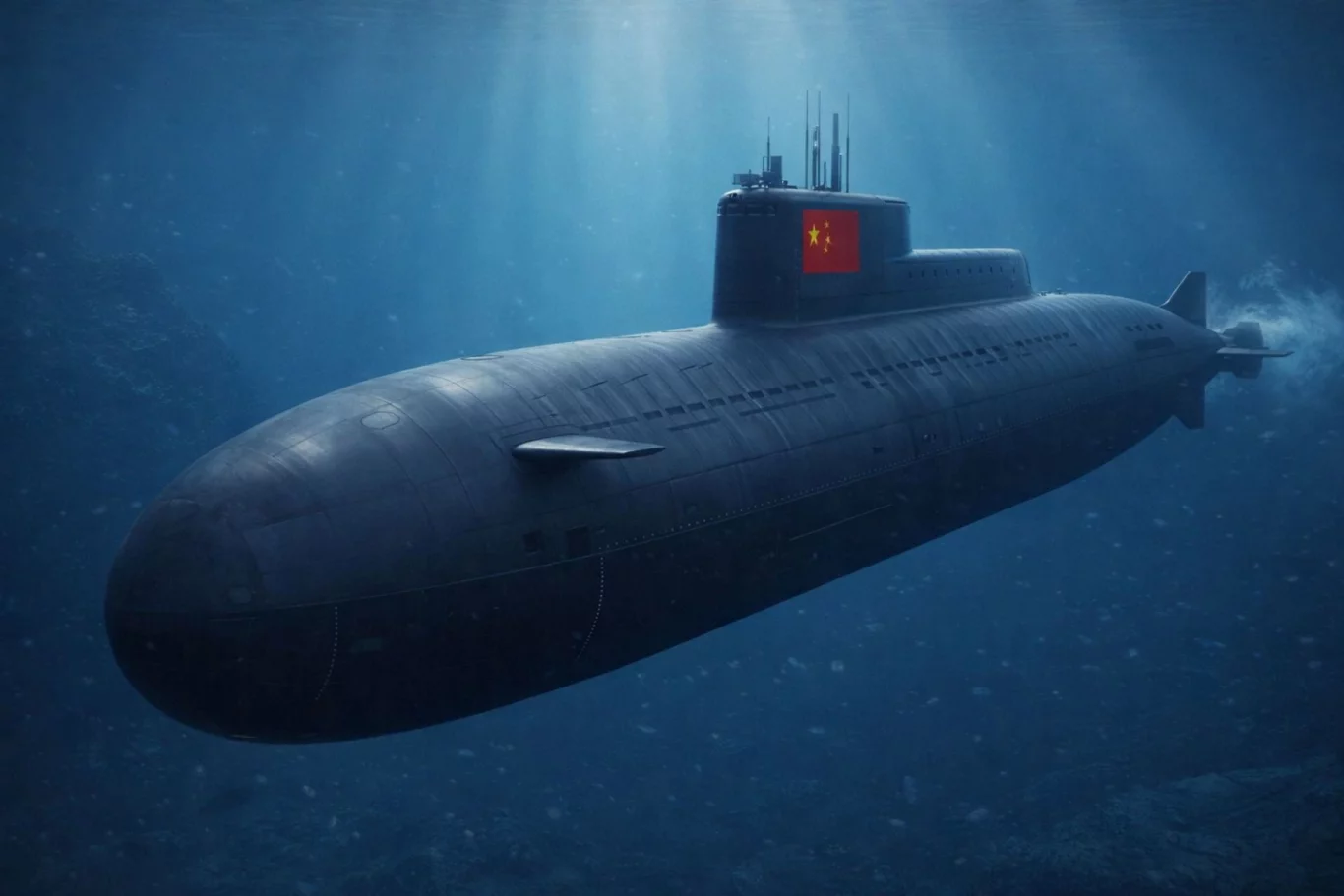
Leaked figures indicate a submerged displacement of 15,000 to 20,000 tons, placing the Type 096 in the same strategic weight class as the U.S. Navy’s Ohio-class and future Columbia-class SSBNs. The larger size addresses previous limitations in reactor efficiency and internal volume, allowing for the integration of advanced quieting technologies, including raft-mounted machinery, enhanced hull isolation, and a propulsion system optimized for sustained low-noise operation.
Acoustic performance is a key feature of the Tang-Class. Chinese sources suggest a noise signature between 95 and 100 decibels, a significant improvement over earlier SSBNs that were considered vulnerable to detection by U.S. and allied forces. This is thought to result from horizontal isolation rafts and pump-jet propulsion, technologies that were challenging for China to implement in prior classes. Some analysts speculate that Russian expertise in quiet propulsion and vibration control may have accelerated the development, drawing parallels with Russia’s Borei-class SSBNs.
The Type 096 also represents a leap forward in sensor capability. Reported sonar detection ranges approach 300 miles, reflecting improvements in onboard arrays, data processing, and long-baseline passive detection techniques. While performance depends on ocean conditions, these capabilities align with China’s broader investment in undersea situational awareness and layered sensor networks to protect strategic submarines in defended patrol zones.
Strategically, the Tang-Class carries between 16 and 24 JL-3 submarine-launched ballistic missiles, up from the 12-tube configuration of the Jin-Class. Each JL-3 missile reportedly has a range of around 14,000 kilometers and can carry six to ten multiple independently targetable reentry vehicle warheads. This allows a single submarine to deliver a nuclear payload comparable to several land-based units while remaining concealed underwater. The JL-3’s range enables strikes on the continental United States from patrol areas within the South China Sea or Bohai Gulf, avoiding heavily monitored chokepoints.
The Type 096 directly addresses long-standing weaknesses in China’s sea-based deterrent. Earlier SSBNs were too noisy to conduct credible patrols beyond coastal bastions. The Tang-Class appears designed to maintain a continuous at-sea deterrence posture, similar to the U.S. Navy’s Ohio-class and planned Columbia-class. Leaked research also suggests the submarine may feature an ice-strengthened hull, raising the potential for Arctic deployments that would further complicate U.S. anti-submarine planning.
Despite these advances, the Type 096 may not fully match the acoustic refinement of the newest Western designs. Features such as the missile compartment hump may impose hydrodynamic penalties, and Chinese reactor technology is assessed to lag behind the most advanced Western monoblock designs. Even so, the gap between U.S. and Chinese undersea capabilities is narrowing in a strategically significant way.
For the U.S. Navy, these developments have major implications. American undersea strategy relies on attack submarines, fixed sensors, and airborne assets to track adversary ballistic missile submarines. A quieter Chinese SSBN force equipped with long-range, high-MIRV missiles capable of operating beyond the first island chain would stretch U.S. tracking assets across multiple theaters amid rising submarine demand.
Overall, the leaked specifications suggest that the Type 096 Tang-Class is more than an incremental upgrade—it is central to China’s transition toward a survivable, globally relevant sea-based nuclear deterrent. In any future strategic confrontation, the covert presence of one or more Tang-Class submarines could become a decisive factor influencing escalation and strategic leverage.
About The Author