On December 4, 2025, China deployed more than 100 naval and coast guard vessels across the East and South China Seas, a move analysts say demonstrates Beijing’s increasing capability to conduct coordinated maritime operations that constrain regional military responses.
China carried out its largest maritime surge in the East and South China Seas, according to a Reuters summary of intelligence reports on December 4, 2025. Analysts noted that the operation involved over 100 naval and coast guard vessels moving across multiple sectors nearly simultaneously, reflecting a level of coordination that U.S. officials are monitoring as a sign of advanced fleet integration. While China’s precise intent was not specified, the scale and cohesion of the operation were unusually significant for regional observers.
The deployment of over 100 vessels coincides with China’s rapidly expanding fleet, capable of projecting power across multiple flashpoints. The combination of large-scale maritime maneuvers and advances in aircraft carriers, amphibious ships, and submarines represents a growing strategic challenge, particularly to Taiwan.
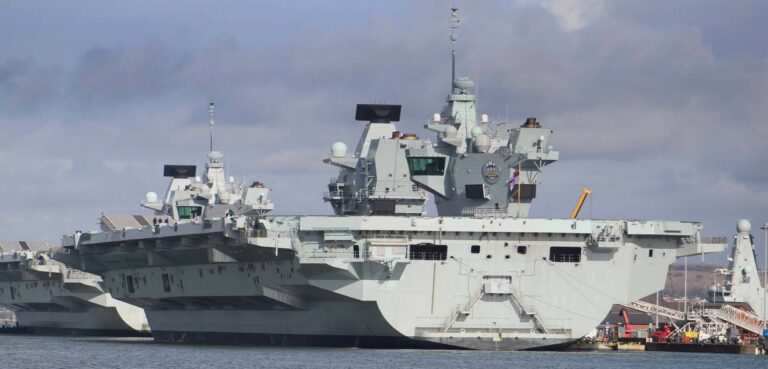
This surge comes as the People’s Liberation Army Navy (PLAN) accelerates the development of its aircraft carrier force. In May 2024, China’s newest carrier, Fujian, began sea trials and continued extensive testing throughout 2024 and 2025. Equipped with an electromagnetic catapult system and arresting gear, Fujian will be able to launch heavier, longer-range aircraft, including next-generation fighters and electronic-warfare platforms. Once fully operational, expected in late 2025 or 2026, Fujian will significantly expand the PLAN’s strike and surveillance reach around Taiwan.
Meanwhile, the PLAN’s first carrier, Liaoning, completed a year-long refit in 2024, while the second carrier, Shandong, continued large-scale training cycles. Deployments of these carriers in the South China Sea, the Philippine Sea, and near Taiwan demonstrate increasingly sustained flight operations, simulating blockades, encirclement drills, or air-denial scenarios.
A fourth, larger carrier is reportedly under construction, signaling China’s intent to field a multi-carrier force capable of applying continuous pressure on Taiwan from multiple directions—a critical capability for any high-intensity contingency aimed at isolating or coercing the island.
China is also rapidly expanding its amphibious assault capabilities. Several Type-075 large-deck assault ships are now operational, with the larger Type-076 class under construction. Satellite imagery suggests Type-076 could exceed the size of U.S. LHDs and may feature electromagnetic catapults for launching fixed-wing drones. If confirmed, this hybrid amphibious-aviation platform would enable rapid island seizures, coordinated surveillance operations, and suppression of coastal defenses, directly affecting Taiwan’s security environment.
The PLAN is strengthening its surface escort forces, with carrier groups increasingly supported by Type-055 cruisers—large warships optimized for air defense and command functions—and Type-052D destroyers, which focus on anti-air and anti-submarine warfare. These vessels, with advanced sensors and long-range missile systems, enhance China’s ability to enforce maritime exclusion zones or defend carrier and amphibious strike groups in a regional crisis.
Submarine modernization further complicates Taiwan’s defense planning. The forthcoming Type-096 ballistic missile submarines and Type-095 attack submarines, along with variants equipped with vertical launch systems, enhance China’s capability to threaten Taiwanese ports, naval bases, and sea lines of communication. While unconfirmed reports of a submarine incident in Wuhan persist, ongoing construction reflects China’s continued investment in undersea warfare capabilities.
The threat to Taiwan is amplified by the recent 100-ship deployment. Massed formations near the Taiwan Strait could simulate blockades, saturate approaches, and strain Taiwan’s operational readiness. Large coast guard groupings provide China with gray-zone tools, forcing Taiwan to respond without clear escalation thresholds and gradually normalizing a coercive maritime presence, complicating U.S. and allied support.
China’s growing maritime power also increases risks for the United States in key corridors required to support Taiwan in a crisis. Surveillance encounters, vessel shadowing, and mass maritime operations could delay U.S. response. Japan faces increased difficulty defending the Ryukyu Islands and vital air routes necessary for reinforcing Taiwan.
The Philippines is also affected, as Chinese forces operating in the Bashi Channel and northern Luzon corridor could hinder allied access to Taiwan while heightening tensions in the South China Sea. China’s 100-ship surge, combined with rapid naval modernization, marks a strategic shift: Beijing is moving toward a persistent, multi-theater maritime presence aimed at pressuring Taiwan, shaping regional decision-making, and challenging U.S. contingency planning in East Asian waters.
About The Author