For years, aviation enthusiasts and defense analysts have been tracking whispers about China’s next-generation unmanned combat aerial vehicles (UCAVs). Now, one of the most anticipated platforms in Beijing’s growing drone arsenal has finally broken cover — not in a polished state media reel, but in a grainy, unofficial photo snapped from below as it soared through Chinese skies.
The CH-7 stealth UAV, a massive flying-wing drone developed by the China Aerospace Science and Technology Corporation (CASC), was photographed in flight for the first time on November 11, 2025. The image, which quickly spread across Chinese social media before being analyzed by renowned military aviation expert Andreas Rupprecht, reveals a surprising new detail: canted vertical stabilizers — a feature never seen on previous official models, concepts, or mockups.
A Stealth Drone That Keeps Evolving
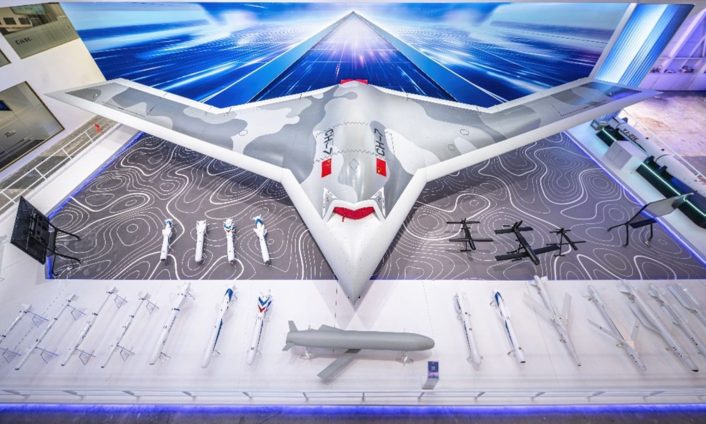
Until now, every public glimpse of the CH-7 — from airshow scale models to factory rollout videos — showed a sleek, tailless flying-wing design reminiscent of the U.S. Northrop Grumman X-47B or the secretive RQ-180. But this new image tells a different story.
“The aircraft clearly shows two pairs of canted vertical stabilizers attached via visible mounting joints,” Rupprecht noted in his analysis. “This suggests the control surfaces may be modular — detachable depending on mission requirements.”
That kind of adaptability would allow the CH-7 to toggle between maximum stealth (no vertical tails = lower radar cross-section) and enhanced controllability during complex maneuvers or adverse weather. It’s a smart design choice that reflects real-world operational flexibility — something China has increasingly prioritized in its fifth- and sixth-generation aerospace programs.
Not the First Flight — But the First Public Sighting
While this marks the first confirmed visual evidence of the CH-7 airborne, experts believe the drone has been flying under wraps for months, if not longer.
Back in November 2024, official CASC footage showed a yellow-primered CH-7 taxiing at high speed, complete with pitot tubes on the wing leading edges — a telltale sign of a prototype in active flight testing. Those same pitot tubes are faintly visible in the new inflight image, suggesting this could be the same airframe or a sister prototype from the same test batch.
Adding to the intrigue: a prominent nose landing gear door and a large dorsal antenna array above the engine intake. That antenna farm? It’s packed with SATCOM, SATNAV, data links, and electronic warfare sensors — all critical for long-range, networked operations over contested maritime domains.
From Strategic Strike Platform to Tactical ISR Powerhouse
When the CH-7 first debuted at the 2018 Zhuhai Airshow, it was billed as a deep-strike stealth UCAV — a drone capable of penetrating enemy air defenses and delivering precision strikes on high-value targets. Early scale models even showed internal weapons bays loaded with air-to-ground munitions.
But according to Cao Ran, a CASC official quoted by Global Times in 2024:
“The original CH-7 was designed as a strategic armed reconnaissance UAV. Six years later, it has evolved into an advanced tactical platform capable of diverse missions based on modern warfare needs and client demands.”
This shift aligns with China’s broader UAV strategy: building multi-role, export-friendly platforms that can dominate both battlefield intelligence and limited strike roles — much like the MQ-9 Reaper, but with stealth and longer endurance.
How Does CH-7 Compare to Other Chinese UCAVs?
The CH-7 isn’t flying solo. It’s part of a rapidly expanding family of high-end Chinese drones:
| Drone | Role | Status | Key Features |
|---|---|---|---|
| GJ-11 | Stealth UCAV | In PLAAF service | Sharp-edged flying wing, internal weapons |
| GJ-21 | Naval variant | Carrier-compatible | Arrestor hook, EMALS launch capable |
| CH-5 / CH-9 | Medium-altitude strike | Export success | Armed with KD-21 air-launched ballistic missile |
| CH-7 | High-altitude ISR/Strike | Flight testing | Modular tails, extreme stealth, SATCOM-heavy |
Like its siblings, the CH-7 is powered by a single turbofan engine buried deep in the airframe with a low-observable exhaust. Its cranked-kite wing planform and blended wing-body design scream low radar signature — perfect for maritime reconnaissance, early warning, and ELINT (electronic intelligence) missions over the South China Sea or Western Pacific.
Was This the Mystery Drone at the Radar Test Site
In August 2024, satellite imagery revealed a large flying-wing UCAV model at a known Chinese radar cross-section (RCS) test facility. Many speculated it was an early CH-7 prototype.
But Rupprecht cautions against jumping to conclusions:
“The test model had different wing sweep angles and shorter canted tail sections. The proportions don’t fully match. Still, data from those RCS tests likely influenced the final CH-7 design.”
So while not identical, the two programs are almost certainly related — another sign of how methodically China iterates its stealth technology.
Will We See CH-7 at Zhuhai 2026?
Despite high expectations, the CH-7 did not appear in flying form at the 2024 Zhuhai Airshow earlier this month. Only static scale models were displayed — some armed with smart bombs, others configured for pure ISR.
But with flight testing now visibly underway, many expect a full unveiling at the 2026 show — possibly alongside operational GJ-11s or even the long-rumored H-20 stealth bomber.
Until then, every leaked photo, every blurry video will be scrutinized. Because in China’s military aviation world, what you don’t see officially is often already in the air.
The Bigger Picture: China’s Drone Dominance Strategy
Make no mistake — the CH-7 isn’t just another drone. It’s a symbol of China’s ambition to challenge U.S. air dominance in the Indo-Pacific through asymmetric, networked, unmanned systems.
With the People’s Liberation Army Air Force (PLAAF) and PLA Navy both investing heavily in stealth UCAVs, carrier-launched drones, and AI-enabled swarming, platforms like the CH-7 are the tip of the spear.
And unlike Western programs bogged down by bureaucracy, China’s aerospace industry moves fast. From concept to flight in under seven years? That’s the new normal in Beijing.
About The Author