In a significant development for naval powers worldwide, China’s ambitious shipbuilding program has taken another leap forward with the maiden sea trial of its first Type 076 amphibious assault ship, the Sichuan. This monumental vessel, which recently returned to the Hudong-Zhonghua shipyard in Shanghai after a successful three-day initial outing, represents a bold new direction in naval design, blending traditional amphibious capabilities with cutting-edge drone carrier functionalities. The announcement, made by the Chinese state-owned Xinhua News Agency on November 16, 2025, arrives less than two weeks after the commissioning of the Fujian, an EM catapult-equipped aircraft carrier, signaling a deliberate and rapid expansion of China’s flattop fleet on two distinct but equally potent tracks.
The speed and efficiency of the Sichuan‘s construction timeline are nothing short of remarkable. Initial hull sections for the vessel began to take shape in October 2023, and the ship itself was officially launched on December 27, 2024. In just over a year, the shipyard managed to progress from the initial block assembly to conducting a complex first sea trial that rigorously tested the ship’s stability and power systems in the East China Sea. Chinese reports emphasize that critical mooring trials and hardware installations were meticulously completed before the ship even set sail, allowing the PLA Navy to seamlessly transition into at-sea validation of its propulsion, power distribution, and navigation systems. This accelerated construction cycle would be incredibly challenging, if not impossible, to replicate in most Western shipyards, and it has already become a point of discussion and analysis among naval architects and defense strategists globally.
The Sichuan itself is far from a conventional amphibious assault ship, leaning more towards the characteristics of a light aircraft carrier. With a full-load displacement estimated at around 50,000 tons, the vessel boasts an imposing hull approximately 252.3 meters in length and 45 meters abeam. Its expansive flight deck, spanning over 13,500 square meters, makes it larger than many legacy fleet carriers. The ship features an innovative twin-island layout, with the navigation bridge positioned forward and the aviation command center and sensor masts located aft. A defining feature is its 116-meter electromagnetic catapult, strategically placed along the port edge of the deck. Notably, this catapult is even longer than the unit installed on the larger aircraft carrier Fujian. Further supporting fixed-wing operations are three sets of arresting gear and two sizable deck-edge elevators, transforming the Sichuan into what Chinese media openly describes as a “drone carrier,” specifically optimized for the deployment and recovery of unmanned air wings.
Below its impressive flight deck, the Sichuan exemplifies the PLA Navy’s embrace of integrated electric propulsion. The vessel is powered by two 21 MW gas turbines and six 6 MW diesel generators, all feeding into an electric drive system. This advanced configuration not only provides highly efficient cruising capabilities but also generates the immense electrical margin absolutely essential for powering electromagnetic catapults, sophisticated sensors, and potentially future high-energy weapons. Its sensor suite closely mirrors that found on the latest Type 054B frigates, featuring an E/F-band phased-array radar on the forward mast complemented by an I-band air-search radar aft, surrounded by a dense array of electronic warfare (EW) and TACAN antennas. Surprisingly robust for an amphibious hull, the ship’s defensive armament includes three 24-cell HQ-10 missile launchers, three H/PJ-11 30 mm Close-In Weapon Systems (CIWS), and multi-tube decoy launchers, providing a formidable layered close-in shield against incoming missiles and drones. Beneath the flight deck, a floodable well deck is designed to accommodate at least two Type 726A LCACs (Landing Craft Air Cushion), alongside extensive vehicle stowage and accommodations for approximately 1,000 marines, firmly anchoring its more traditional amphibious role.
The truly groundbreaking aspect of the Type 076 lies in its focus on unmanned aviation. Both Chinese official outlets and Western analysts widely anticipate the ship to operate advanced stealthy GJ-11 Unmanned Combat Aerial Vehicles (UCAVs) and long-endurance WZ-7 reconnaissance drones. These platforms, typically possessing wingspans of around 12–14 meters and internal payloads of approximately two tons, are specifically optimized for deep-penetration Intelligence, Surveillance, and Reconnaissance (ISR) missions and precision strikes. Recent academic work from both U.S. and PLA sources unequivocally highlights that such unmanned systems are central to Beijing’s evolving concept of “intelligentized warfare.” In this doctrine, AI-enabled unmanned platforms are envisioned as providing the crucial sensing backbone and the initial wave of strike mass for complex joint campaigns. Viewed through this lens, the Sichuan is far more than just a prestige vessel; it represents a critical testbed for the large-deck UCAV operations that Chinese military planners deem essential for future conflicts, particularly across the Taiwan Strait and within the wider first island chain.
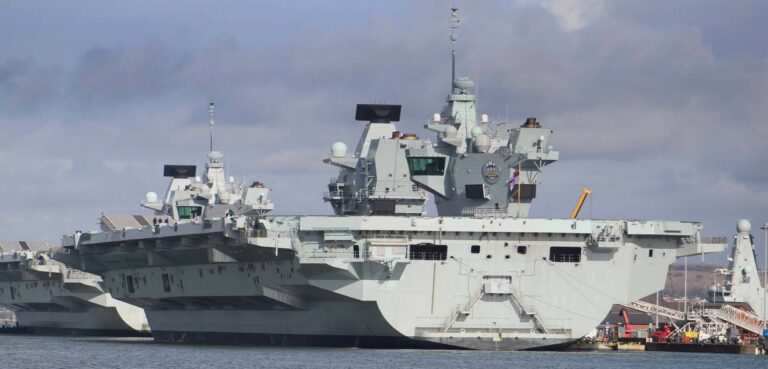
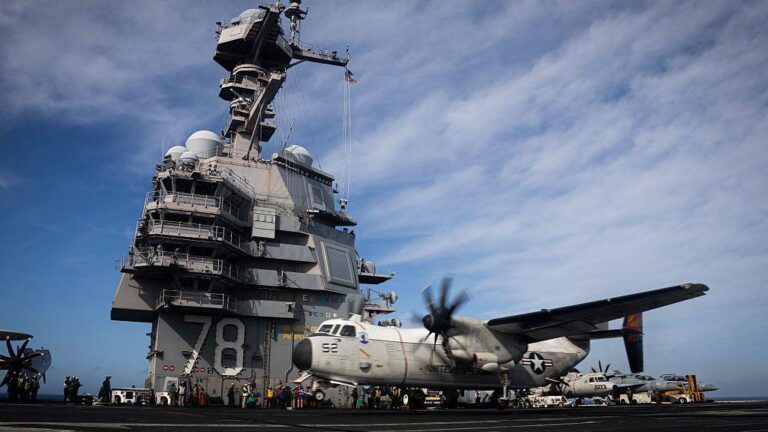
Globally, the Sichuan stands in a class of its own. While U.S. America-class LHAs and Wasp-class LHDs, displacing roughly 45,000 and 40,500 tons respectively, are capable of operating significant STOVL (Short Take-Off and Vertical Landing) fighter and helicopter groups, they rely on ski-jump or straight-deck short take-off operations without catapults. Similarly, Japan’s Izumo-class, Turkey’s Anadolu, and even Iran’s converted drone carrier all represent creative adaptations for F-35B or MALE UAVs. However, none of these platforms integrates a carrier-style electromagnetic launch and arrestor system on an amphibious hull. The Type 076 therefore holds the unique distinction of being the world’s first ship to seamlessly blend a large well deck and marine lift capabilities with a catapult-equipped, fixed-wing drone flight deck.
For the PLA Navy, this new class is designed to complement, rather than replace, its existing and rapidly expanding amphibious force. China has already commissioned at least four Type 075 LHAs and continues to expand its Type 071 LPD (Landing Platform Dock) fleet, providing a broad and robust base for helicopter-centric and surface-connector lift capabilities. At a strategic level, the U.S.-China Military Power Report assesses that the PLA Navy already fields over 370 battle-force ships and is projected to reach approximately 395 by 2025 and an astounding 435 by 2030. Much of this growth is concentrated in large surface combatants and aviation-capable units. Within this context, the Sichuan provides Beijing with an aviation-heavy amphibious flagship, designed to seamlessly knit together drones, helicopters, LCACs, and escorts into a single, cohesive, and networked landing force.
The Taiwan scenario is where the true significance of the Sichuan becomes most apparent. Analysts widely describe the vessel as a key asset for unmanned operations in a high-threat environment. Recent regional reporting further underscores that such ships would be central to any Chinese attempt to project power across the Taiwan Strait, even as Taiwan’s increasingly sophisticated missile defenses make large-deck amphibious movements inherently risky. Operationally, a Type 076 would likely operate at a standoff distance of 150–300 kilometers offshore, utilizing its GJ-11s and other UAVs to assist in suppressing coastal air defenses, hunting mobile missile launchers, cueing long-range anti-ship missiles, and providing persistent ISR for Type 055 destroyers and land-based rocket forces. In later phases of an operation, its helicopters and LCACs could support follow-on echelons once less exposed lodgments were secured by Type 075/071 groups. However, the ship’s high visibility and significant value would undoubtedly make it a priority target for Taiwanese and potentially U.S. anti-ship weapons. Regional outlets suggest that the PLA Navy is working towards a delivery window around the end of 2026, a demanding schedule that will necessitate intensive combat-system integration, extensive aviation trials, and thorough crew work-ups.
About The Author