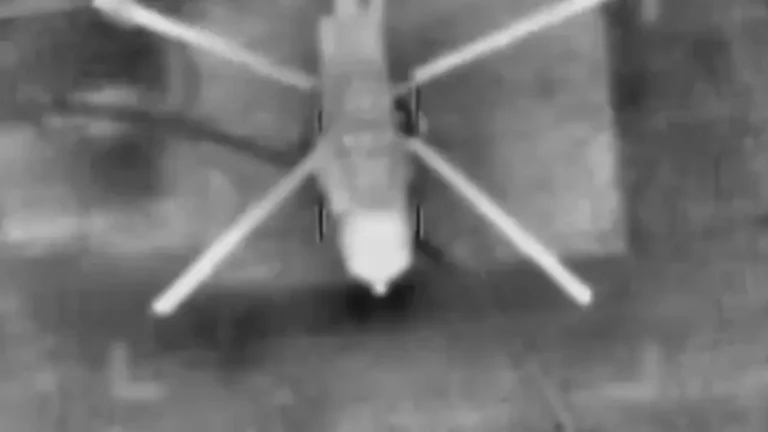
New images circulating on Chinese social media on December 8 show Z-10ME attack helicopters armed with what appear to be CM-502KG precision-strike missiles, suggesting a shift within the PLA Ground Force toward longer-range engagement capabilities that could complicate regional threat planning.
On December 8, newly surfaced images on Chinese social media showed Z-10ME attack helicopters operating with a previously unreported air-to-surface missile loadout. The aircraft, believed to be assigned to the PLA Ground Force’s 76th Army Aviation Brigade, were seen carrying green missiles that closely match the size and configuration of the CM-502KG. This marks the strongest public indication to date that the CM-502KG missile family is being integrated onto China’s primary attack helicopter, expanding the Z-10ME’s effective engagement range. The development points to a gradual shift within PLA army aviation away from exclusively short-range anti-armor weapons toward longer-range precision-strike capabilities.
The CM-502KG is marketed as a lightweight, short-range precision weapon suitable for medium and large unmanned aerial vehicles as well as manned aircraft. With a reported weight of around 40 kilograms and a length of approximately 1.49 meters, the missile can be carried in multiple rounds on a single hardpoint, making it well suited for platforms like the Z-10ME without significantly reducing payload capacity or endurance. The weapon combines inertial and satellite navigation with a data link and modular seeker options, including television, uncooled imaging infrared, and semi-active laser guidance. Its advertised effective range reaches up to roughly 25 kilometers, with a reported circular error probable of one to three meters when using a terminal seeker, emphasizing precision strikes against point targets rather than area effects.
Chinese sources indicate that the CM-502KG can be equipped with different warhead types, including blast-fragmentation warheads for soft targets and semi-armor-piercing variants for vehicles, hardened positions, or small surface vessels. Although the warhead weighs only about 11 kilograms, the combination of accuracy, modular guidance, and standoff distance makes the missile effective against high-value targets such as radar systems, missile launchers, parked aircraft, logistics facilities, and fast attack craft in littoral environments. Recent imagery suggests that Z-10ME helicopters can carry multiple CM-502KG missiles on specialized launch racks, complementing or partially replacing legacy laser-guided missiles like the KD-9/10, which are generally assessed to have shorter effective ranges of around eight kilometers. This shift reflects a broader move toward beyond-line-of-sight engagement options rather than a simple upgrade within the same guidance category.
From an operational perspective, equipping army aviation units with CM-502KG-class weapons significantly improves the PLA’s stand-off strike capability. Z-10ME helicopters can potentially engage targets from behind terrain cover and beyond the reach of many short-range air defense systems, particularly when supported by unmanned aircraft, ground reconnaissance elements, or networked command-and-control assets. This approach aligns with China’s broader emphasis on integrating sensors and shooters across domains, allowing helicopters to function as nodes within a wider kill chain rather than operating solely at the forward edge of the battlefield.
The integration may also carry export implications. The Z-10ME has been promoted for international markets across Asia, the Middle East, and Africa, and demonstrated compatibility with a domestically produced precision-strike missile strengthens China’s ability to offer a complete aircraft-and-weapons package. For countries seeking relatively affordable stand-off attack capabilities and facing limitations on Western arms procurement, a Z-10ME armed with CM-502KG missiles could become a competitive alternative in regional defense markets.
Overall, imagery of the Z-10ME equipped with what appears to be the CM-502KG missile underscores a notable step in the modernization of China’s army aviation forces. By combining an established attack helicopter with a modular, beyond-line-of-sight precision weapon, the PLA is incrementally enhancing its ability to conduct coordinated strikes against high-value tactical targets while reducing exposure to dense air-defense environments.
About The Author