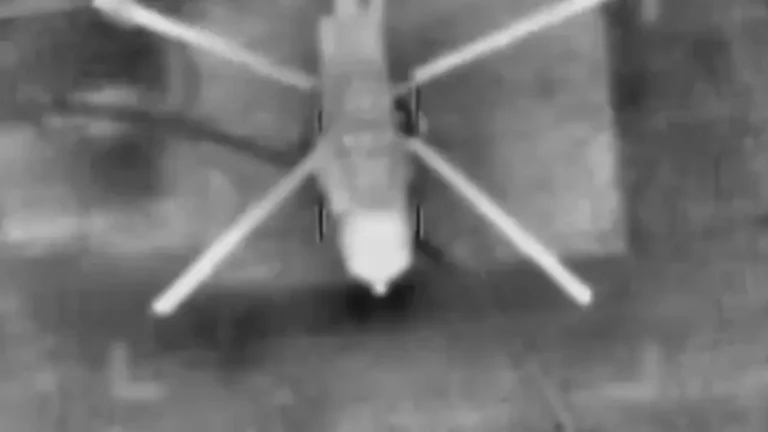
At EDEX 2025, Egypt unveiled a series of new defense cooperation agreements, including a deal with China’s Norinco to co-produce the Hamza-2 armed drone, the expansion of aviation and defense manufacturing partnerships with UAE companies, and measures to boost indigenous production capacity across facilities operated by the Arab Organization for Industrialization (AOI).
On December 1, 2025, Egypt’s Arab Organization for Industrialization (AOI) signed a series of co-production, manufacturing, and industrial cooperation agreements at EDEX 2025 aimed at strengthening the country’s aerospace and defense industrial base. The deals cover joint production of the Hamza-2 armed drone with China’s Norinco, expanded aviation maintenance and manufacturing activities, and new industrial investments involving Chinese and Emirati partners. Collectively, the agreements are intended to increase domestic UAV assembly, enhance technology transfer, and build long-term production capacity across AOI facilities.
During the opening day of the exhibition in New Cairo, AOI formalized an agreement with Norinco to co-produce the Hamza-2 armed drone, alongside several additional arrangements with companies from the United Arab Emirates and the UAE-based Chinese firm Al Qalaa Red Flag. These agreements focus on local production of unmanned aerial vehicles derived from the Chinese ASN-209 reconnaissance drone, expanded technology localization, and the establishment of new manufacturing, maintenance, and logistics activities across AOI’s aerospace and defense factories. AOI presented the signings as part of a broader strategy to deepen domestic industrial capabilities across aircraft, engines, and maintenance sectors.
Under the agreement between AOI’s Aircraft Factory and Norinco, a joint production framework has been established for the Hamza-2 drone, which was displayed at the signing ceremony as a scale model fitted with guided weapons on underwing hardpoints. AOI Chairman Major General Mokhtar Abdel Latif stated that the deal supports AOI’s objective of building sustainable industrial partnerships with international firms and increasing the proportion of locally produced components. Norinco described the arrangement as an extension of its ongoing cooperation with AOI, with the program focusing on airframe assembly in Egypt, integration of mission systems, and the creation of a production line capable of meeting national requirements and potentially supporting future exports.
The Hamza-2 is reported to be derived from the Chinese ASN-209 tactical UAV, a system Egypt has assembled locally for more than a decade. The ASN-209 is a medium-altitude, medium-endurance platform designed for reconnaissance, surveillance, target acquisition, battle damage assessment, and artillery fire correction in day and night conditions. Its system architecture includes the air vehicle, avionics, mission payloads, data links, a ground control station, and launch and recovery equipment. The Hamza-2 advances this lineage by incorporating guided weapons, allowing the platform to conduct both intelligence and strike missions, although detailed production schedules and quantities have not been disclosed.
The ASN-209 features a twin-boom, pusher-propeller configuration suited for land-based operations, with a length of approximately 4.27 meters, a wingspan of about 7.5 meters, and a maximum take-off weight of roughly 320 kilograms. The drone can carry a payload of around 50 kilograms and has a reported endurance of up to 10 hours, a radius of action of approximately 200 kilometers, and a service ceiling near 5,000 meters. It supports a wide range of payloads, including electro-optical and infrared sensors, synthetic aperture radar, electronic intelligence and warfare systems, and communications relay equipment. Launch is conducted using rocket assistance, with parachute recovery, enabling deployment without runways and supporting mobile, vehicle-mounted operations.
In parallel with the UAV agreement, AOI signed seven additional agreements with the UAE’s Abu Dhabi Aviation Group covering manufacturing, maintenance, logistics, marketing, and technical support for both civilian and military aviation. These arrangements involve cooperation between AOI’s Aircraft, Engine, and Helwan factories and several Abu Dhabi Aviation subsidiaries, including Maximus Air, Global Aerospace Logistics, and the Advanced Military Maintenance, Repair, and Overhaul Centre. AOI also signed a separate agreement with Al Qalaa Red Flag to explore investments in new production lines aimed at expanding defense manufacturing output, promoting technology transfer, and supporting exports to regional and African markets.
The agreements were announced during EDEX 2025 in New Cairo, an exhibition attended by President Abdel Fattah El Sisi and featuring participation from more than 450 companies representing over 100 countries. Within the same forum, AOI also expanded talks with France’s Dassault Aviation regarding potential local manufacturing of Rafale fighter jet components. Together, the co-production of the Hamza-2 drone, expanded cooperation with Emirati aviation firms, and new industrial investment initiatives underline Egypt’s efforts to develop a resilient, diversified defense manufacturing base capable of meeting long-term national needs and selective export ambitions.
About The Author