On December 9, 2025, General Atomics Europe unveiled a near-term European version of its Gambit unmanned combat aircraft in Germany, aligning it with the U.S. Air Force’s Collaborative Combat Aircraft initiative and offering European air forces a flight-proven, autonomous, and industrially sovereign combat solution before 2030.
On December 9, 2025, General Atomics Europe and General Atomics Aeronautical Systems unveiled in Germany what they describe as a near‑term European variant of the Gambit‑series unmanned combat aircraft. The industry preview at Oberpfaffenhofen Special Airport carried a clear message for European air forces: the collaborative combat aircraft era is no longer theoretical. A flight‑proven, politically workable path now exists for countries seeking credible combat mass before 2030. The Gambit family provides a tested foundation already linked to the U.S. Air Force’s CCA Increment 1 program, built to integrate European mission systems, payloads, and industrial participation on accelerated timelines.

At the core of the pitch is a deliberately divided design authority: an American-developed platform tied to the U.S. CCA effort paired with European mission systems and industrial contributions. The company briefed German and European firms on the aircraft’s architecture, integration pathways, datalinks, and software interfaces—signaling a commitment to treat Europe not as a customer, but as a co‑developer with sovereign payload control. GA‑ASI CEO Linden P. Blue framed the approach as pragmatic for urgent timelines, while GA Europe CEO Harald Robl emphasized Oberpfaffenhofen’s strength in modification and testing as the integration hub.
The Gambit concept is a modular family built around a shared Gambit Core—landing gear, baseline avionics, and chassis—that accounts for roughly 70% of total cost. From this common base, variants swap wings, fuselages, and propulsion systems to optimize endurance, signature, and maneuverability. Gambit 1 is configured for long‑endurance sensing, Gambit 2 introduces air‑to‑air weapon capability, Gambit 3 is optimized for advanced adversary training, and Gambit 4 adopts a tailless low‑observable design for combat reconnaissance.
For Europe, the most relevant thread is the U.S. Air Force‑linked version already flying as the YFQ‑42A. The aircraft features a low‑observable profile, an internal weapons bay, and multi‑role air‑to‑air and air‑to‑ground capability. Its autonomy core has been trained for over five years using the jet‑powered MQ‑20 Avenger testbed—an advantage for European air arms that are not only seeking platforms but also mature autonomy behaviors, formation tactics, and human‑machine interfaces that are difficult to validate in peacetime.
Operationally, the Gambit architecture aligns with critical gaps in European fighter forces: magazine depth, forward sensing, and the ability to accept attrition in the opening minutes of high‑end conflict. A mixed package could push sensor‑heavy Gambit 1 variants forward to detect emitters, hold Gambit 2 shooters for counter‑air ambushes, and commit strike‑configured aircraft for suppression of enemy air defenses, electronic attack, or deep strike. GA‑ASI has also showcased modular architecture, signature reduction in the strike‑oriented Gambit 6, and an open autonomy/communications architecture built on Waveform X and software‑defined radios for cross‑service integration.
General Atomics is pursuing European customers for reasons beyond sales. Europe is investing heavily in rearmament, with the ReArm Europe Plan Readiness 2030 aiming to mobilize up to €800 billion—including SAFE loans designed to accelerate joint procurement of priority systems such as drones. European requirements are also converging with the U.S. Air Force’s CCA logic, which targets at least 1,000 CCAs and is openly exploring international partnerships and possible Foreign Military Sales. Additionally, GA believes it can address sovereignty concerns by assembling and missionizing aircraft in Europe through its German subsidiary, describing the model as a transatlantic teamed program.
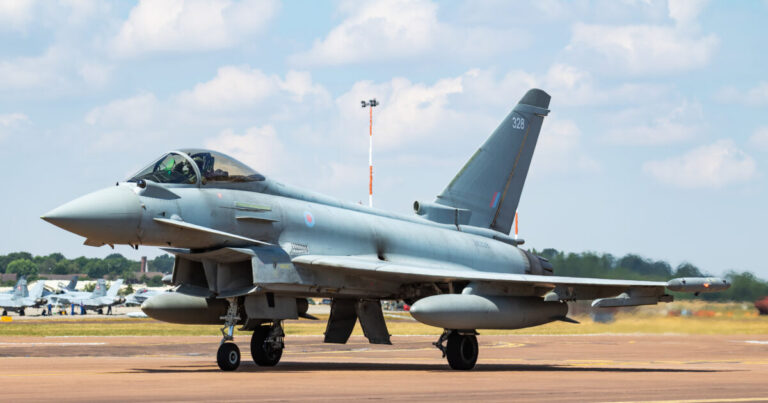
In practical terms, a European‑missionized Gambit would immediately serve as a NATO‑interoperable force multiplier for fighter fleets such as the F‑35A, Eurofighter, Rafale, and Gripen—all of which face shortages in aircraft and missiles for sustained conflict. CCAs provide a way to extend sensors, complicate enemy targeting, and push weapons into contested environments while preserving manned assets. Politically, Europe is shifting toward continent‑wide drone initiatives, including a proposed European Drone Defence Initiative and Eastern Flank Watch, making unmanned mass a measure of readiness. In this context, a European Gambit variant is being positioned not as an imported American drone, but as an urgently deliverable European combat capability built on U.S.‑proven foundations.
About The Author