Indonesia is reviewing a revised plan to rejoin the KF-21 fighter program, focusing on the potential purchase of 16 KF-21 Block II jets after high-level talks in Jakarta on January 7, 2026.
On January 8, 2026, Janes reported that Indonesia is reviewing a revised plan to revive its participation in the South Korean KF-21 fighter program, with a potential acquisition of 16 KF-21 Block II aircraft. The proposal was discussed during closed meetings at Indonesia’s Ministry of Defence in Jakarta on January 7, 2026, involving Indonesian officials, Korea Aerospace Industries (KAI), and PT Dirgantara Indonesia.
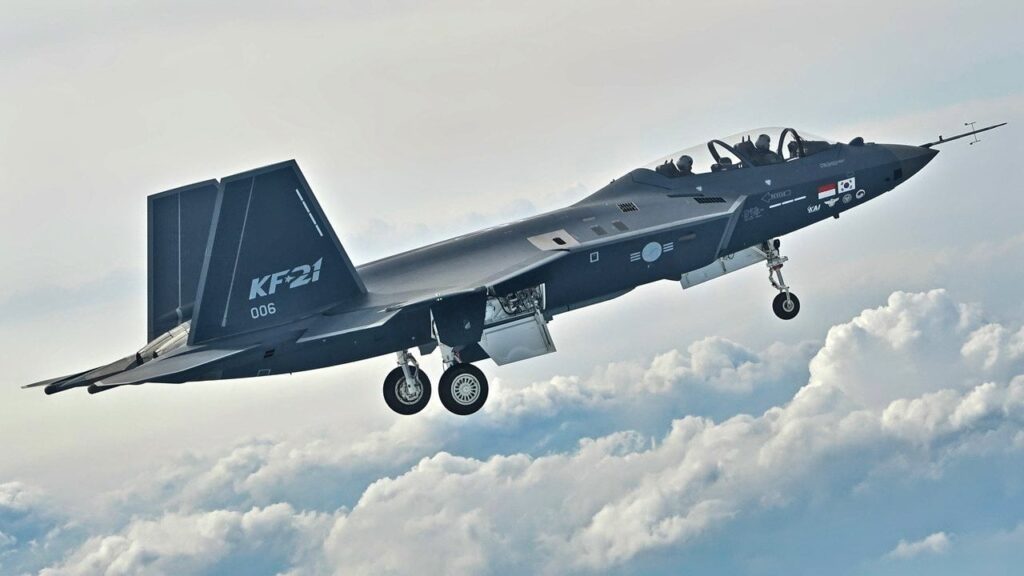
Indonesia is taking concrete steps to restore its long-stalled involvement in the KF-21 program by focusing on a smaller, squadron-sized acquisition of 16 Block II jets. This marks a recalibration of earlier commitments, which had envisioned significantly larger numbers but became difficult to sustain due to repeated delays in cost-sharing payments. The renewed interest was symbolically highlighted by the display of a KF-21 model at Indo Defence 2025, signaling that Indonesia has not abandoned the program despite years of uncertainty.
The closed meeting on January 7, 2026, was chaired by Indonesia’s Air Commodore Jon Ginting, head of Programme and Evaluation at the Defence Logistics Agency, and included representatives from KAI and PT Dirgantara Indonesia. Discussions focused on the possibility that South Korea could extend an export credit facility through the Export-Import Bank of Korea, providing a financial structure capable of supporting both Indonesia’s remaining program obligations and the acquisition of new jets. Specific figures, repayment terms, and the division between legacy obligations and new procurement were not disclosed, leaving key financial parameters unresolved.
These talks follow a proposal raised by Indonesian President Prabowo Subianto in October 2025 during a private discussion with South Korean President Lee Jae-myung at the Asia-Pacific Economic Cooperation Summit. The plan under review envisions allocating part of a South Korean export credit facility to fund 16 Block II airframes, corresponding to a full operational squadron for the Indonesian Air Force. However, uncertainty remains regarding how this revised plan would affect Indonesia’s earlier commitment to procure up to 48 KF-21s and its larger program stake.
The KF-21 Boramae program is structured around phased block development. Block I focuses on air superiority, Block II introduces multirole capability including air-to-ground and anti-ship weapons, and Block III is planned as a future stealth-oriented version with an internal weapons bay and reduced radar signature. The KF-21 prototype first flew on July 19, 2022, with serial production beginning in July 2024. Deliveries to the South Korean Air Force of the initial 40 Block I aircraft are expected in March 2026, with Block II production planned to follow after Block I maturation.
The KF-21 Boramae is a twin-engine fighter capable of Mach 1.8, with a combat radius exceeding 1,000 km, powered by two General Electric F414-GE-400K turbofan engines assembled under license in South Korea. The aircraft’s sensors include a domestically developed AESA radar, infrared search-and-track system, and integrated electronic warfare suite. Block II armament will expand to include a broader range of air-to-ground and anti-ship weapons, complementing the air-to-air focus of Block I.
Looking further ahead, the program plans a transition toward indigenous propulsion through the Advanced Aviation Engine Development Project, running from 2027 to 2040 with a projected budget of around $3.4 billion. The goal is to achieve 16,000 lb of military thrust and approximately 24,000 lb with afterburner, surpassing the output of the current F414 engines. Block I and Block II aircraft will continue using the F414, while Block III is expected to be designed around the domestically developed engine. Block II readiness is targeted for early 2027, aligning with Indonesia’s focus on this variant as the most feasible option for near-term procurement.
About The Author