Iranian Foreign Minister Abbas Araghchi stated that unexploded munitions, potentially including GBU‑57 Massive Ordnance Penetrator bombs, remain at nuclear facilities hit by the United States in June 2025, posing safety risks for inspections.
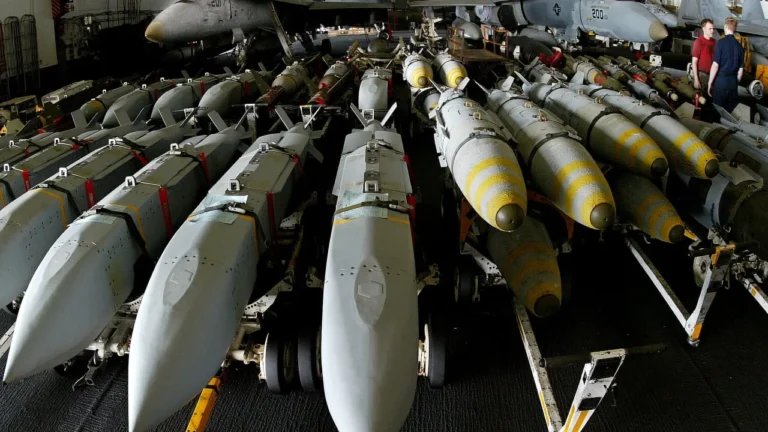
As reported by Middle East Monitor on February 8, 2026, Iran said unexploded bombs remain at nuclear facilities struck by the United States in June 2025, creating safety risks that prevent inspections. Foreign Minister Abbas Araghchi stated that inspections can only proceed after agreements on safety, security, and access protocols, noting that no established international framework exists for inspecting bombed nuclear sites. He added that the U.S. used fourteen GBU‑57 Massive Ordnance Penetrator bunker‑buster bombs during the strikes.
Iran said unexploded munitions at the affected nuclear facilities present a serious physical hazard, complicating any inspection efforts. Araghchi emphasized that the absence of legal procedures for visiting bombed nuclear sites makes the situation unprecedented and requires a dedicated protocol before inspections can occur. Iran remains in communication with the International Atomic Energy Agency (IAEA) on the matter.
Araghchi also stated that he asked the IAEA Director General whether any formal legal process exists for inspecting nuclear facilities targeted by airstrikes and was told none is in place. He reiterated that safety, security, and technical access issues must be resolved first, including the presence of unexploded bombs. He added that Iran continues discussions with the agency while expressing distrust toward the United States and uncertainty over ongoing Iran–US talks.
The nuclear strikes occurred during a 12‑day conflict in June 2025 that Iran describes as an Israeli-led operation supported by the United States. Iranian officials said the campaign targeted military bases, nuclear facilities, and civilian infrastructure and included the killing of military commanders and nuclear scientists. Iran responded with missile and drone attacks on Israeli military and intelligence sites, marking a period of direct confrontation.
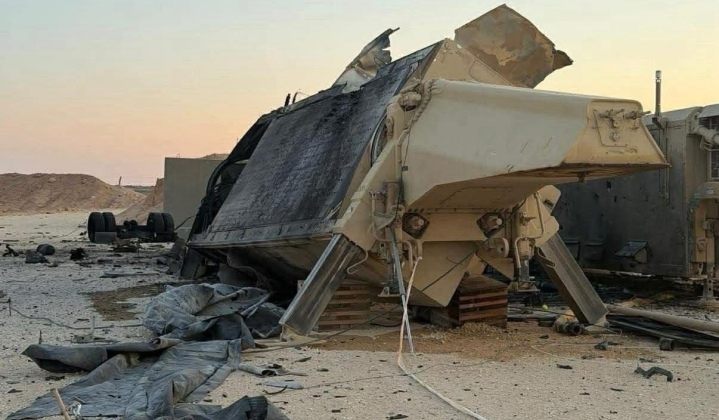
During the conflict, the United States carried out strikes on three major Iranian nuclear facilities—Fordow, Natanz, and Isfahan—before announcing a ceasefire. These sites play key roles in uranium enrichment and nuclear development. Iranian authorities acknowledged damage but said nuclear material had been relocated beforehand and that no immediate radiological threat was posed to nearby populations. However, structural damage and unexploded ordnance remained after the ceasefire.
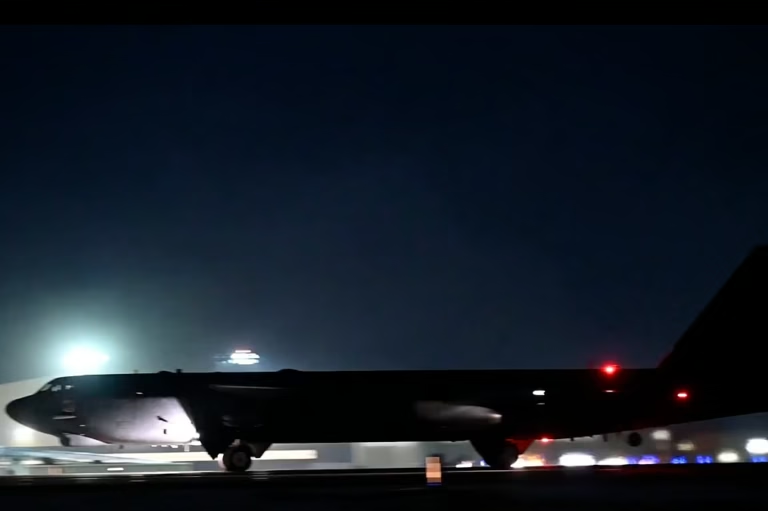
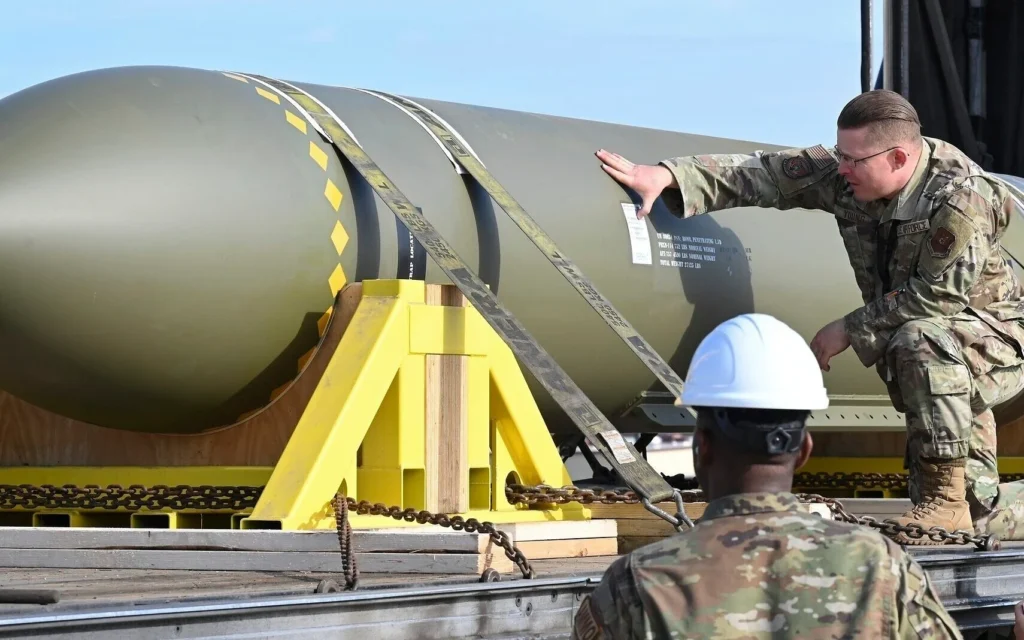
The U.S. strikes involved GBU‑57 Massive Ordnance Penetrator bunker‑buster bombs delivered by B‑2 strategic bombers, each weighing about 13,600 kilograms and designed to penetrate deep underground before detonation. Tomahawk cruise missiles were also used against nuclear-related infrastructure. The GBU‑57 features a hardened steel casing, GPS‑ and inertial‑guided navigation, and a delayed fuze designed to detonate after penetrating reinforced structures.
During Operation Midnight Hammer, several GBU‑57 bombs were used against underground nuclear sites, targeting tunnels, underground halls, and internal infrastructure rather than surface buildings. Their penetration relies on kinetic energy and structural strength. Some bombs were reportedly aimed at ventilation shafts and access points. If a fuze fails or impact conditions disrupt detonation, unexploded munitions can remain embedded underground or within collapsed structures.
Recovered unexploded GBU‑57 bombs, if safely neutralized, could provide Iran with an opportunity to examine modern bunker‑penetrating weapon design. Analysts could study casing thickness, materials, structural reinforcement, guidance electronics, navigation systems, and fuze mechanisms to better understand penetration performance and survivability.
However, reverse engineering such a weapon would be technically difficult. The GBU‑57 relies on advanced metallurgy, precision manufacturing, controlled explosives, and specialized testing infrastructure. Replicating its performance would require comparable industrial capacity and a delivery platform capable of carrying a payload exceeding 13 tonnes. More realistically, analysis of any recovered ordnance could inform defensive measures, such as improving tunnel depth, layout, and structural reinforcement. Iran has not indicated any intent to replicate the weapon, and recovery alone would not provide operational capability.
About The Author