After transmitting an early-morning distress signal on March 4, 2026, the Iranian Navy frigate IRIS Dena went down south of Sri Lanka, with officials suggesting a possible submarine strike.
Sri Lanka’s Foreign Minister Vijitha Herath stated that the Iranian Navy frigate IRIS Dena sank roughly 40 kilometers south of Sri Lanka near Galle after transmitting a distress signal at dawn on March 4, 2026. Sri Lankan naval and air units immediately launched a search-and-rescue operation, recovering 32 severely injured sailors and transporting them to a hospital in southern Sri Lanka. Officials indicated that a submarine attack was one possible cause, though no confirmation was provided and the origin of any attack remained unclear. Search efforts continued for the remaining crew members.
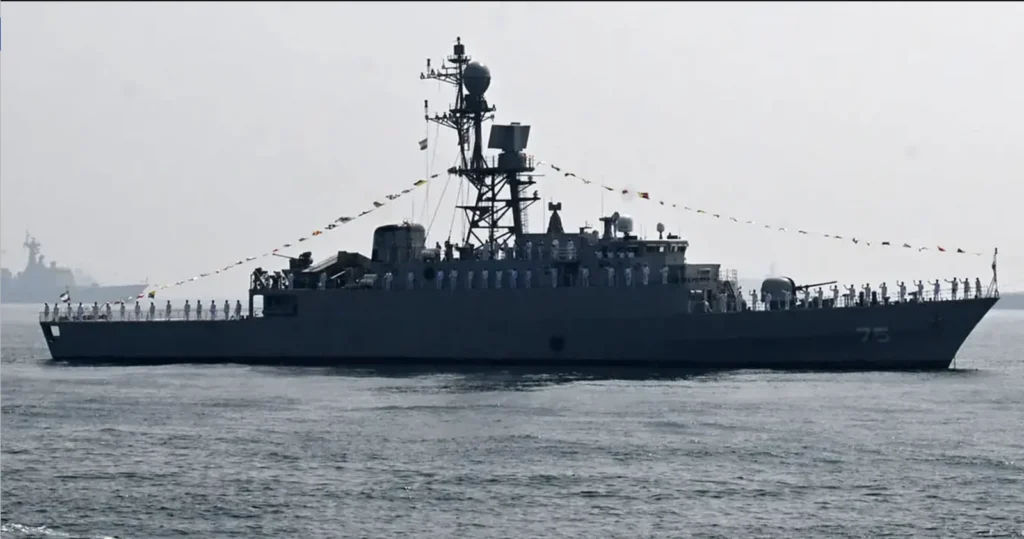
At the time of the emergency, the frigate reportedly carried around 180 personnel. Two Sri Lankan Navy ships and an aircraft were dispatched to the scene, with additional support from the Sri Lankan Air Force. Survivors were evacuated from the water and taken to the main hospital in Galle, where security was tightened as the wounded arrived. Authorities emphasized that the rescue operation took place within Sri Lanka’s designated search-and-rescue zone in the Indian Ocean and was conducted under international maritime obligations.
During a parliamentary session, an opposition lawmaker questioned whether the sinking might be linked to ongoing tensions involving the United States and Israel, but the government did not provide further clarification. The fate of the missing sailors remained uncertain as maritime patrols continued scanning the surrounding waters.
Prior to the incident, IRIS Dena had taken part in the International Fleet Review 2026 hosted in Visakhapatnam, where multiple navies gathered for ceremonial and operational events. The vessel arrived in India in February 2026 and later docked after the main fleet review ceremony on February 18. Iran’s naval commander Shahram Irani attended the event and met with India’s Chief of the Naval Staff Dinesh K Tripathi. The Iranian delegation also participated in associated naval engagements and discussions.
The frigate further joined MILAN 2026, a multinational maritime exercise conducted alongside the fleet review. Activities included harbor exchanges and coordinated sea drills among participating navies. Although the U.S. Navy destroyer USS Pinckney had been expected to attend, it withdrew due to operational requirements. Instead, a U.S. Navy P-8 maritime patrol aircraft took part in the exercise.
IRIS Dena, bearing pennant number 75, belonged to Iran’s Southern Fleet and was named after Mount Dena. Constructed at naval facilities in Bandar Abbas, the ship was laid down in 2012, launched in 2015, and commissioned in 2021. Measuring approximately 95 meters in length with a displacement of around 1,500 tonnes, the frigate was powered by four diesel engines capable of producing a combined output sufficient for speeds up to 30 knots. The vessel featured a helipad suitable for operating a Bell 212 anti-submarine helicopter.
The ship was equipped with the Asr three-dimensional radar system and electronic warfare suites. Its armament included a 76 mm naval gun, a 40 mm anti-aircraft cannon, 20 mm guns, anti-ship missiles from the Noor or C-802 family, Sayad-2 surface-to-air missiles, and triple 324 mm torpedo launchers for anti-submarine warfare. Defensive countermeasures included chaff dispensers, and the radar system reportedly provided coverage up to 300 kilometers.
IRIS Dena was part of the Moudge-class frigate program, a series of domestically produced Iranian warships designed to replace older vessels such as the Alvand class. Ships in this class typically displace about 1,500 tonnes, reach speeds near 30 knots, and integrate indigenous radar and weapons systems. Other vessels in the class include Jamaran, Damavand, and Sahand. Notably, Damavand was severely damaged after running aground near Bandar-Anzali in 2018.
Moudge-class frigates have been used for patrol duties, escort operations, and extended deployments beyond Iran’s immediate waters. Between 2022 and 2023, IRIS Dena, accompanied by the support ship IRIS Makran, completed a global voyage covering more than 65,000 kilometers, visiting ports such as Jakarta, Rio de Janeiro, and Cape Town before returning to Bandar Abbas after roughly eight months at sea.
The loss of IRIS Dena occurred shortly after the vessel concluded its participation in naval events in India and began its return transit through the Indian Ocean, marking a dramatic end to what had recently been a high-profile international deployment.
About The Author