Viral Video of Israeli Strike on Iranian Helicopter Sparks Debate: Real Target or Clever Decoy?
A dramatic video circulating across social media has ignited a heated debate among military analysts and online observers after it appeared to show an Israeli airstrike destroying an Iranian helicopter. The footage, which spread rapidly online on March 4, reportedly shows a missile hitting what looks like a helicopter parked on the ground.
However, almost immediately after the clip went viral, a new theory emerged: what if the helicopter was never real in the first place?
Some commentators suggested the target might actually be a painted decoy designed to trick Israeli targeting systems. The claim sparked widespread discussion online, with experts and viewers examining every frame of the footage to determine whether the strike hit an actual aircraft or a cleverly disguised fake.
So far, neither Israeli nor Iranian officials have officially confirmed the details of the incident, leaving the mystery unresolved.
The Decoy Theory
According to several online reports, Iran may have used a classic military deception tactic. The theory claims that Iranian forces painted life-sized helicopter images on the ground to mislead enemy surveillance systems and weapons.
If that were true, it would represent a surprisingly effective strategy.
Modern precision weapons can be extremely expensive. Depending on the type used, an Israeli missile can cost anywhere between $40,000 and $3 million. In comparison, creating a painted decoy on the ground would cost almost nothing.
Military strategists have long used such tricks to force enemies into wasting valuable ammunition and resources. If a cheap decoy can trigger a costly strike, the attacking force loses both money and operational capability.
Supporters of the decoy theory pointed out that in the video the helicopter’s rotor blades do not appear to move after the explosion, which they argue could suggest the aircraft was only painted onto the ground.
But others quickly challenged that conclusion.
Evidence Suggesting the Helicopter Was Real
A closer look at the footage has led many analysts to believe the helicopter might actually be genuine.
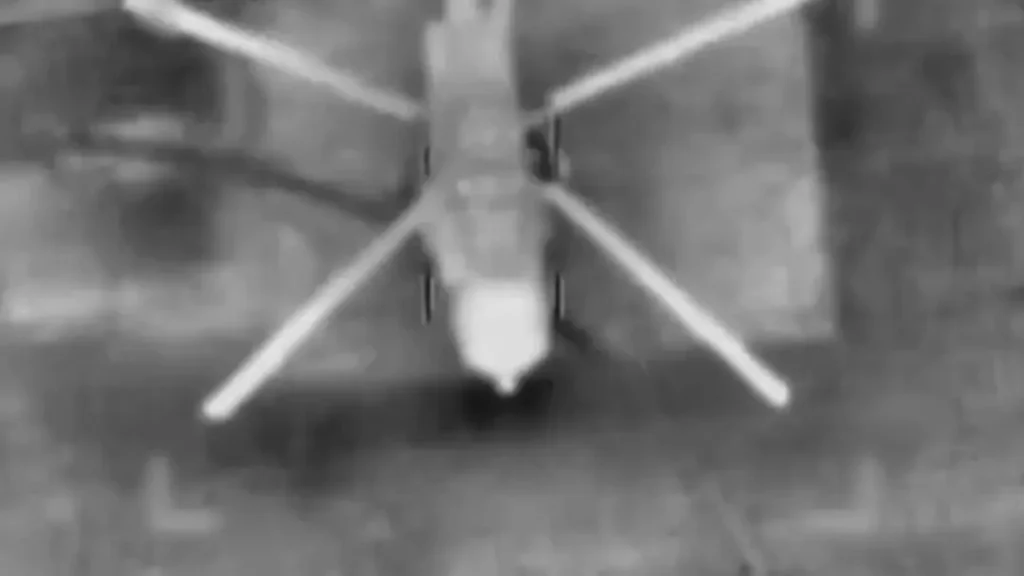
One key detail involves the smoke pattern after the impact. In several frames of the video, smoke can be seen moving underneath the helicopter’s rotor blades. If the helicopter were simply a flat image painted on the ground, this would not be possible.
Another important clue involves thermal imagery. Some observers noted that the video appears to show a realistic heat signature and shadow pattern around the helicopter. Reproducing such a thermal effect with a simple painted image would be extremely difficult.
On the social media platform X, the military news page Status-6 shared the footage with the caption suggesting that Israel may have struck a decoy of an Iranian Mil Mi-17 helicopter.
However, a community note added beneath the post argued the opposite. It stated that the thermal signature visible in the video would be “difficult to impossible” to fake with a simple painting.
Comparison With Other Strike Footage
The debate intensified when another user posted a clearer video showing a missile striking the fuselage of a helicopter on the ground.
In that footage, the helicopter’s rotor blades remain mostly intact even after the impact. This observation suggests that rotors not moving after a strike does not necessarily mean the aircraft was fake.
Instead, it may simply indicate the helicopter was stationary at the moment it was hit.
Because of this comparison, many analysts now believe the viral footage likely shows a real helicopter being targeted rather than a painted decoy.
Israeli Military’s Original Claim
The video was originally posted by the official social media account of the Israel Defense Forces (IDF). In its initial statement accompanying the clip, the IDF said the strike had “neutralized Iranian soldiers operating air defense systems.”
However, the post did not specifically mention the destruction of a helicopter.
After speculation about the decoy theory began spreading online, the IDF has not released any additional clarification or updated statement regarding the incident.
This silence has only fueled further speculation.
Decoys Are a Classic Military Strategy
Whether the helicopter was real or not, the discussion highlights an important aspect of modern warfare: military deception.
Decoys have been used by armed forces for decades to confuse enemy reconnaissance and waste their firepower.
One famous example occurred during World War II when Allied forces used fake equipment as part of deception operations leading up to the D-Day invasion. The British military placed dummy landing craft and inflatable tanks in strategic locations to mislead German intelligence and divert potential attacks away from real forces.
Even today, armies frequently deploy fake vehicles, missile launchers, and radar systems to confuse surveillance drones and satellites.

The Mystery Remains
For now, the truth behind the viral strike video remains uncertain.
The footage may show a real Israeli strike on an Iranian helicopter, or it could reveal a clever deception tactic designed to drain enemy resources. Without official confirmation from either side, analysts can only study the available evidence.
But one thing is clear: in modern warfare, information, perception, and deception are just as powerful as missiles and bombs.
And sometimes, even a single viral video can trigger a global debate about what really happened on the battlefield.
About The Author