Japan’s Ministry of Defense said a Russian Navy Vishnya-class intelligence-gathering ship passed through the contiguous zones near Yonaguni and Miyako Islands between January 13 and 15 before proceeding into the Pacific Ocean, with the Maritime Self-Defense Force maintaining continuous surveillance using the destroyer Ikazuchi and P-1 and P-3C patrol aircraft.
Japan’s Ministry of Defense has confirmed that a Russian Navy Vishnya-class intelligence-gathering ship entered the contiguous zones near Yonaguni Island and Miyako Island between January 13 and January 15, before continuing its transit into the Pacific Ocean.
According to Japan’s Joint Staff Office, the vessel, identified by hull number 535, was first detected moving northeast through the contiguous zone surrounding Yonaguni Island and later passed through waters that included the contiguous zone of Miyako Island. The ministry stated that the ship was closely monitored throughout its passage by the Japan Maritime Self-Defense Force.
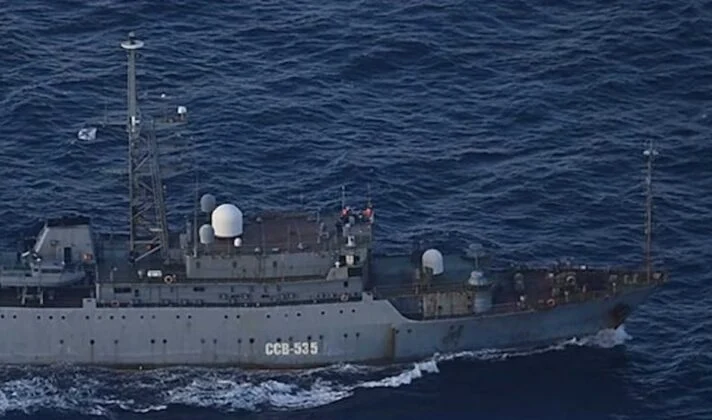
Surveillance operations were conducted by the MSDF destroyer Ikazuchi, assigned to the 1st Escort Division, supported by P-1 maritime patrol aircraft from the 1st Air Patrol Squadron and P-3C aircraft from the 5th Air Patrol Squadron. These assets maintained continuous tracking of the Russian vessel as it transited the area.
The Vishnya-class is a Russian naval intelligence platform specifically designed for signals and communications collection. Vessels of this class are fitted with extensive antenna arrays, radomes, and specialized electronic systems that allow them to conduct prolonged intelligence-gathering missions in sensitive maritime regions.
Japan’s Ministry of Defense has repeatedly documented Russian and Chinese naval movements through key sea lanes around Okinawa and the southwestern island chain. Strategically important waterways such as the Miyako Strait and the seas around Yonaguni Island serve as critical passages between the East China Sea and the western Pacific.
In earlier statements, the ministry emphasized that maritime and air units assigned to Japan’s southwestern defense areas remain on heightened readiness to respond to foreign military activity near Japanese territory. The latest transit highlights the continued presence of foreign naval vessels operating close to Japan’s outer islands.
The detection comes amid elevated regional tensions, as Japan continues to expand investment in maritime domain awareness, electronic intelligence capabilities, and island-based defenses across the Nansei archipelago. Tokyo has also increased patrol coverage to monitor growing foreign naval activity along Japan’s southwestern approaches.
About The Author