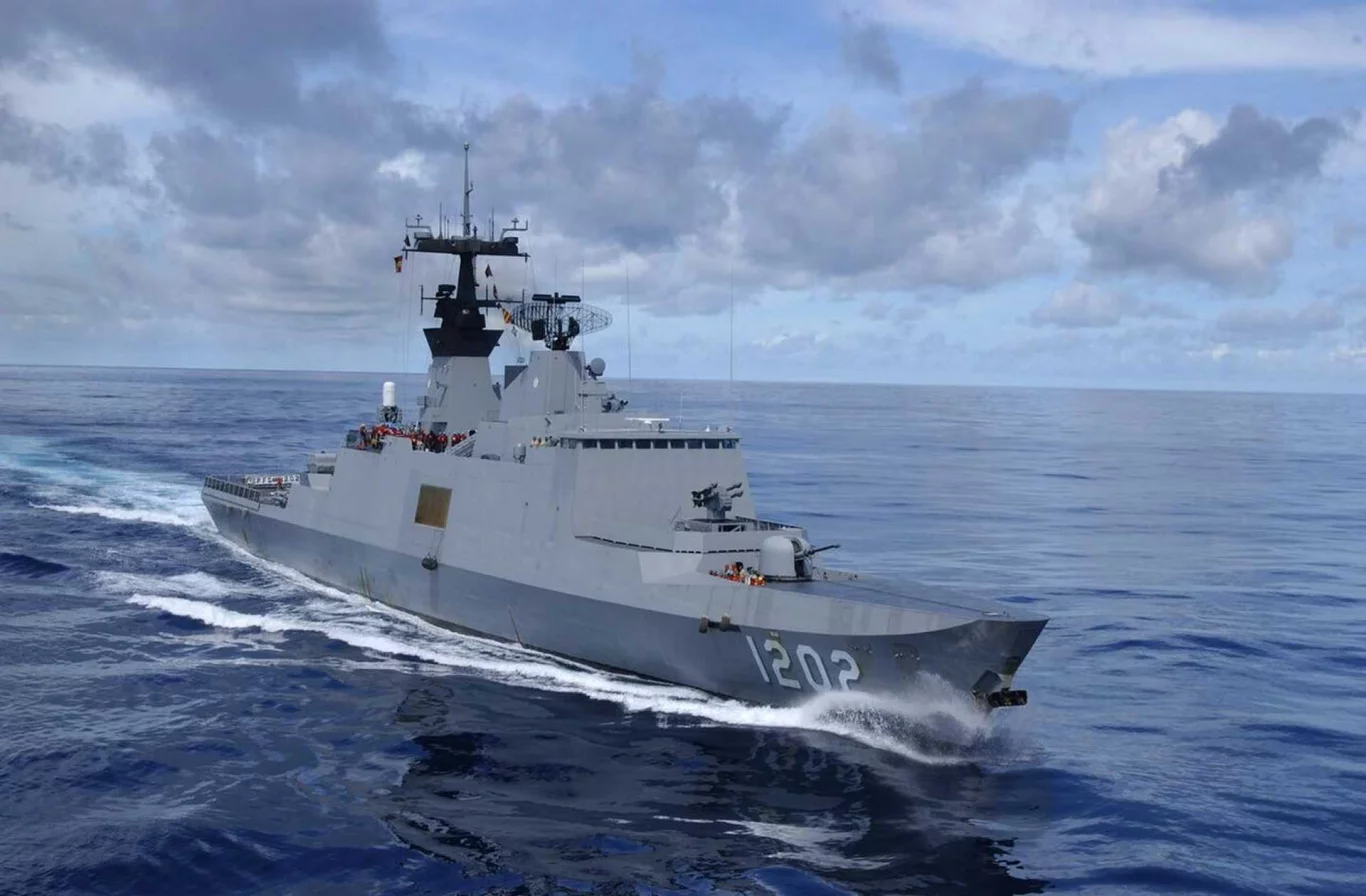
Taiwan’s Kang Ding-class frigate Kang Ding (PFG-1202) entered dry dock in Kaohsiung on January 3, 2026, for a major NT$43.16 billion combat system upgrade across the fleet.
On January 3, 2026, Taiwan’s Kang Ding-class frigate Kang Ding (PFG-1202) entered a CSBC Corporation Taiwan dry dock in Kaohsiung, showing clear signs of pre-refit preparation under the ongoing combat system performance improvement program, according to United Daily News. The NT$43.1599 billion modernization covers all six frigates and is scheduled for completion by 2030. This follows the completion of the Chen De (PFG-1208) modernization, which became the first ship in the class to receive the full upgrade package, including new missile launch architecture, revised sensors, and an updated combat management system. Chen De is expected to soon conduct live-fire verification with the Sea Sword II (TC-2N) surface-to-air missile. With Kang Ding entering the yard, Taiwan is now refitting multiple ships concurrently while maintaining fleet availability.
A key upgrade involves replacing the legacy RIM-72C Sea Chaparral launcher, with its limited 3–4 km range, with the domestically developed Hua Yang vertical launch system (VLS). The eight-cell VLS supports quad-packing, allowing up to 32 Sea Sword II missiles per frigate. The medium-range, active radar-guided Sea Sword II extends engagement ranges to roughly 30 km, enabling the Kang Ding-class to intercept aircraft and missiles far beyond their original point-defense capability.
The radar systems are also being overhauled. Kang Ding’s Hai Shen G (Triton-G) low-altitude search radar has been partially removed to prepare for the new fit, which will replace older two-dimensional DRBV-26D Jupiter II and Triton-G radars with the Type 997 Artisan 3D radar. Artisan provides full 3D air-search capability, enhanced resistance to clutter and electronic interference, and can track hundreds of air and surface targets simultaneously, with a range often cited at over 200 km. These upgrades support the expanded missile capability provided by the Hua Yang VLS.
The program, with a total budget of NT$43.1599 billion, includes combat management system updates, integration of new radars and electro-optical sensors, VLS installation, and full software/hardware integration to ensure compatibility between French-origin hulls and domestically developed weapons. Ships will be refitted sequentially, typically one per year, balancing modernization progress with operational readiness.
The Kang Ding-class frigates were designed in the late 1980s and early 1990s as part of Taiwan’s Kuang Hua modernization program to replace aging surface combatants and enhance anti-submarine and escort capabilities. Based on the French La Fayette-class design, six ships were ordered in 1991, built in France between 1993–1998, and commissioned between 1996–1998. Political restrictions limited the installation of medium-range SAMs, leaving the class with short-range RIM-72C Sea Chaparral missiles. Despite these limitations, the ships have remained active in patrol, escort, and anti-submarine roles.
Kang Ding (PFG-1202), the lead ship, was commissioned in May 1996 and is homeported at Zuoying Naval Base. It has a standard displacement of 3,200 tonnes, full-load displacement of 3,800 tonnes, length of 125 m, beam of 15.4 m, and draught of 4.1 m. Powered by four SEMT Pielstick diesel engines driving two shafts, it can reach 25 knots with a range of approximately 4,000 nautical miles. Originally armed with eight Hsiung Feng II anti-ship missiles, a 76 mm OTO Melara gun, two 40 mm Bofors guns, a Phalanx CIWS, two Mk-32 torpedo tubes, and operating one S-70C(M) helicopter, Kang Ding is now undergoing upgrades to close air-defense and sensor gaps identified over nearly three decades of service.
About The Author