Baykar announced on January 16, 2026, that the Bayraktar Kizilelma unmanned fighter jet successfully achieved a sustained Mach 0.8 cruise speed during a high-performance test flight, underscoring the rapid progress of jet-powered unmanned combat aircraft toward fighter-like speed and operational relevance.
On January 16, 2026, Baykar Technologies announced that the Bayraktar Kizilelma unmanned fighter jet had successfully completed a new performance test flight, achieving a cruise speed of Mach 0.8. The announcement was made through Baykar’s official X account and marks a major step forward for Türkiye’s jet-powered unmanned combat aerial vehicle program. Designed to operate with performance characteristics approaching those of manned fighter aircraft, Kizilelma represents a key element of Ankara’s ambition to reshape future air combat. This latest test highlights the rapid pace at which high-performance unmanned aviation is advancing.
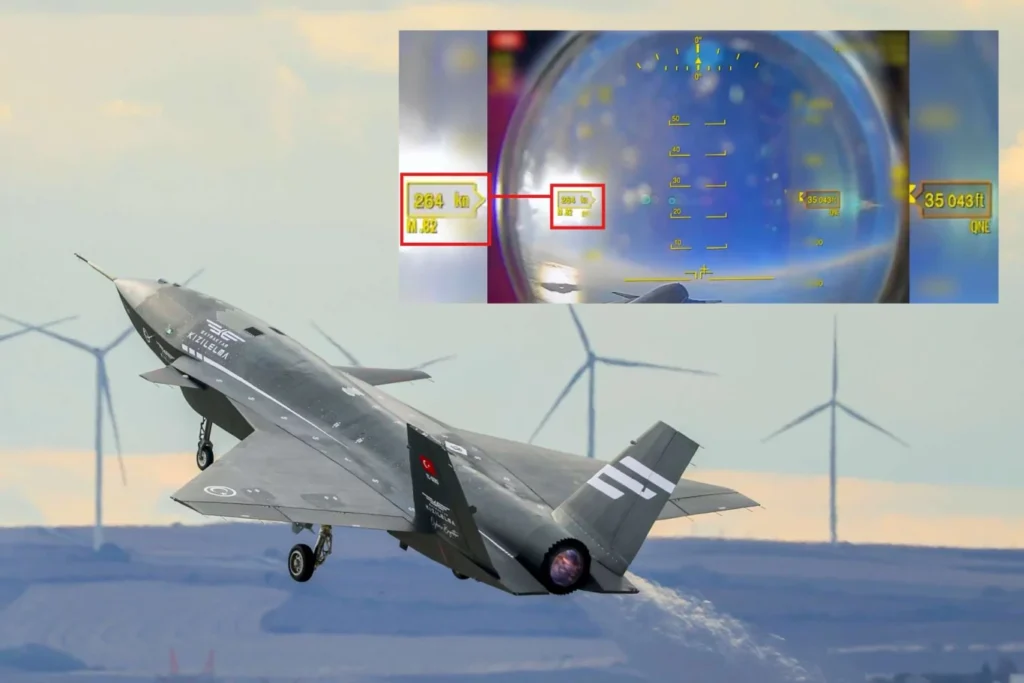
Bayraktar Kizilelma is designed as a stealthy, single-engine, carrier-capable unmanned fighter with an internal and external weapons payload of around 1.5 tonnes and a maximum take-off weight estimated between 6 and 8.5 tonnes, depending on configuration. Earlier data suggested a cruise speed of about Mach 0.6 and a maximum speed close to Mach 0.9. The confirmation of a sustained Mach 0.8 cruise moves the platform well beyond traditional MALE drones and closer to the performance envelope of fourth-generation fighters. Its design features include a low-observable fuselage, canard-delta aerodynamics, twin canted vertical tails and internal weapons bays optimized for operations from short runways and light aircraft carriers such as TCG Anadolu. Advanced sensors, including an AESA radar, infrared search and track and electro-optical targeting systems, provide multi-sensor awareness compatible with beyond-visual-range engagements.
Kizilelma’s development has followed a phased propulsion strategy. Early prototypes were powered by the Ivchenko-Progress AI-25TLT turbofan, producing around 16–17 kN of thrust, allowing Baykar to mature the airframe and flight-control systems. More advanced versions are linked to the AI-322F afterburning turbofan, delivering approximately 24–25 kN of dry thrust and up to about 44 kN with afterburner. This afterburner capability is essential for short-deck take-offs, rapid acceleration near transonic speeds, steep climbs and high-energy manoeuvres. Baykar has already demonstrated afterburner-assisted take-offs, and the recent Mach 0.8 cruise flight confirms that propulsion, flight controls and thermal management are now being tested in regimes comparable to crewed combat aircraft.
Operationally, this milestone builds on a steady progression that began with the MIUS program in the early 2010s. Kizilelma first flew in December 2022 and has since completed a wide range of tests, including autonomous taxiing, take-off and landing, high-speed manoeuvres and repeated sortie cycles. It has flown in formation with an F-16 and demonstrated autonomous close-formation flight between two unmanned fighters, showcasing early “smart fleet” concepts. The platform has also successfully conducted a beyond-visual-range missile firing using the Gökdoğan air-to-air missile guided by its MURAD AESA radar. The Mach 0.8 cruise test is therefore part of a broader, integrated development path rather than an isolated achievement.
From a tactical standpoint, sustained high-subsonic cruise allows Kizilelma to operate within the same time and space framework as modern manned fighters and advanced air defence systems. At this speed, the unmanned fighter can reposition quickly, integrate smoothly into strike packages and operate effectively alongside manned aircraft rather than lagging behind. Its performance aligns with other high-subsonic “loyal wingman” concepts such as the XQ-58 and MQ-28, while offering greater flexibility than traditional drones. Combined with stealth shaping, electronic warfare support and afterburner-enabled acceleration, Kizilelma presents a more complex target for adversary interception.
Strategically, the implications extend well beyond a single test flight. For the Turkish Armed Forces, a high-subsonic unmanned fighter with internal weapons bays and BVR capability offers a powerful complement to manned platforms such as the F-16 and the future KAAN, supporting manned–unmanned teaming and saturation tactics across key maritime and regional theatres. For Türkiye’s defence industry, Kizilelma has become a flagship program integrating advanced aerodynamics, software-driven mission systems and international engine cooperation, with a long-term goal of increasing indigenous content. Internationally, the program places Türkiye among a small group of countries pursuing jet-powered unmanned fighters and strengthens its position as a supplier of advanced air combat solutions.
The confirmation of a Mach 0.8 cruise speed reinforces Bayraktar Kizilelma’s evolution from an ambitious concept into a genuinely fighter-like unmanned platform. Building on achievements in autonomy, formation flying, carrier-style operations and BVR missile engagements, this milestone shows that propulsion, aerodynamics and mission systems are converging into an operationally credible design. For Türkiye and its partners, Kizilelma is emerging as a tool of deterrence, power projection and technological independence, while for global observers it signals that high-performance unmanned fighters operating at fighter-like speeds are becoming a practical reality.
About The Author