South Korean defense firm LIG Nex1 has won a key development contract to integrate an indigenous short-range air-to-air missile onto the KF-21 Boramae, reinforcing Seoul’s drive for weapons self-reliance and enhancing the fighter’s operational credibility.
On December 24, 2025, LIG Nex1 announced that it had signed a major development contract for South Korea’s “Short-Range Air-to-Air Guided Missile-II (SRAAM-II) System Development – System Integration and Guided Missile Integration Prototype” program. The announcement, reported by BusinessKorea and disclosed through Korea’s DART financial reporting system, confirms that the Agency for Defense Development (ADD) has formally awarded LIG Nex1 a key role in developing a domestically produced short-range air-to-air missile for the KF-21 Boramae fighter.
The program is intended to reduce South Korea’s dependence on foreign air-to-air missiles and establish a fully indigenous ecosystem of air-launched weapons centered on the KF-21. Beyond its operational importance, the contract signals Seoul’s broader ambition to secure technological sovereignty in advanced combat aviation while strengthening the export attractiveness of its next-generation fighter.
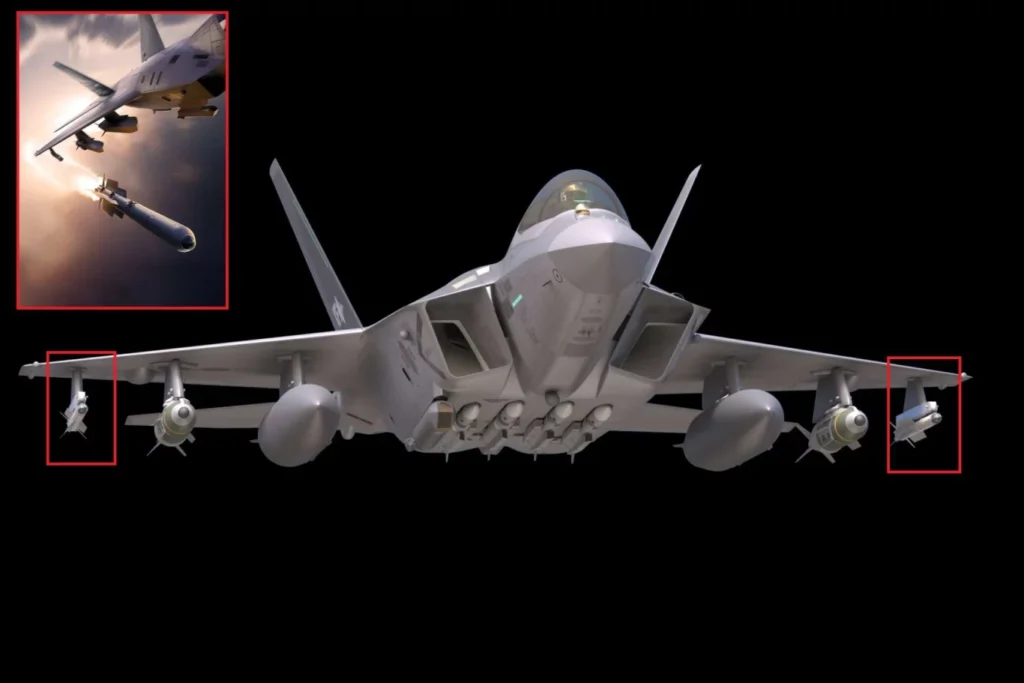
Under the contract, LIG Nex1 will be responsible for overall system integration of the SRAAM-II, development of a guided-missile integration prototype, and the design of critical subsystems. These include the imaging infrared (IIR) seeker, guidance and control unit, inertial navigation system, and missile actuators. Development work is scheduled to continue through 2032, with ADD overseeing the program. The missile will be integrated on the KF-21’s short-range weapon stations and is expected to complement Korea’s domestically developed long-range air-to-air and air-to-ground munitions.
The DART disclosure classifies the agreement as an “other sales or supply contract,” with ADD as the counterparty and the Republic of Korea as the end market. The contract value for LIG Nex1 is 124.27 billion won, equivalent to 3.79 percent of the company’s consolidated 2024 sales, which totaled approximately 3.28 trillion won. The contract period runs from December 24, 2025, to November 30, 2032, with advance and milestone-based payments structured according to defense-industry regulations. The disclosed amount excludes value-added tax and may be adjusted as the program evolves.
Financially, the contract represents a substantial portion of the broader 207-billion-won SRAAM-II development effort cited by BusinessKorea, suggesting that LIG Nex1’s work package covers the missile’s core “intelligent” elements, including seeker technology and guidance software. The company is leveraging experience gained from earlier programs such as the Cheongung (M-SAM) air defense system and other precision-guided weapons.
From an operational perspective, the SRAAM-II is expected to provide the KF-21 with a modern, high-agility within-visual-range weapon optimized for dogfight scenarios. The use of an imaging infrared seeker and advanced guidance architecture should enable high off-boresight engagements, improved resistance to flares and decoys, and seamless cueing from the aircraft’s radar, helmet-mounted sight, and future infrared search-and-track systems. Because the missile’s software and threat libraries will be under national control, the Republic of Korea Air Force will have greater freedom to update and adapt the weapon without relying on foreign approvals.
Strategically, the SRAAM-II program reinforces South Korea’s push toward defense autonomy and export competitiveness. The KF-21 is positioned not only to replace aging F-4 and F-5 fighters but also as an export platform for regional air forces in Asia and the Middle East. Pairing the aircraft with a suite of Korean-made air-to-air and air-to-ground weapons reduces third-party export restrictions and enhances the appeal of the overall package. The long contract duration disclosed on DART indicates that Seoul views the SRAAM-II as a foundational capability rather than a one-off project, with potential follow-on upgrades and technology spin-offs in seekers, actuators, and advanced guidance systems.
Together, the BusinessKorea report and the DART filing confirm that South Korea’s indigenous short-range air-to-air missile program has transitioned from concept into a binding, multi-year development phase. By anchoring the SRAAM-II in a transparent, regulated contract with ADD, Seoul is sending a clear signal that the KF-21 will be supported by a domestic missile ecosystem, strengthening both national deterrence and South Korea’s standing in the global defense market.
About The Author