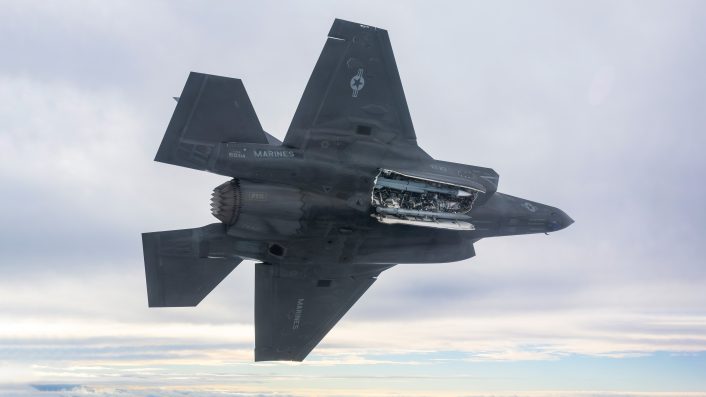
The F-35A underwent ground vibration tests and fit checks at Edwards Air Force Base in preparation for the start of its flight testing phase.
The F-35 Joint Program Office (JPO) has confirmed the completion of several key ground‑based integration tests involving the Meteor missile and the F-35A Lightning II, conducted in partnership with MBDA and Lockheed Martin. These milestones set the stage for upcoming flight tests—only months after flight trials for the F-35B variant also began.
Meteor Integration on the F-35A
Spearheaded by Italy, the Meteor Beyond Visual Range Air-to-Air Missile (BVRAAM) integration effort will enhance the capabilities of both Italy’s and Germany’s F-35As, according to reporting by Janes. Germany, however, was not mentioned in the official statements released by the JPO or MBDA.
The UK, currently sponsoring Meteor integration on the F-35B STOVL variant, may eventually field the missile on its future F-35As as well. The work being done for the F-35B will also benefit Italy’s F-35B fleet.
Ground Testing at Edwards AFB
The JPO said that ground evaluations were carried out at Edwards Air Force Base, California. These trials included vibration tests and physical fit checks to verify the interaction between the aircraft and the missile. This phase is described as a crucial prerequisite before airborne tests can begin.
Engineers thoroughly analyzed collected data to ensure the Meteor can be safely carried and released from the F-35A’s internal weapons bay. Photos show test fits involving both single- and dual‑missile configurations.
One additional ground test remains before flight clearance is granted. Meteor integration is tied to the F-35’s Block 4 upgrade package, with operational fielding planned for the early 2030s, according to the UK Ministry of Defence.
European Weapons on the F-35
In 2019, BAE Systems, Lockheed Martin, and MBDA began upgrading UK F-35 weapon systems to accommodate both the Meteor air-to-air missile and the SPEAR 3 precision-strike weapon. A follow‑on contract in 2021 expanded this work to include integration on Italian and British aircraft.
Italy operates both the F-35A and F-35B, while the Italian Navy, Royal Air Force, and Royal Navy field the F-35B only. The RAF has recently announced its intention to also acquire the F-35A.
Both Italy and the UK selected the same European weapons already used on their Eurofighter Typhoons. The UK employs Meteor as its primary long-range air‑to‑air missile, with Italy set to follow after finalizing its own Meteor testing and beginning operational deployment.
Both countries also plan to field the SPEAR 3 air‑to‑surface missile—now in testing on the Typhoon—which will become the main precision-strike weapon for British F-35Bs. Additionally, the UK equips its F-35s with the AIM‑132 ASRAAM and the Paveway IV guided bomb, both domestically produced. These weapons are not used by Italy.
Italy instead relies on the AIM‑9X Sidewinder, GBU‑12 Paveway II, GBU‑32 JDAM, and GBU‑39 SDB. In the future, Italy will add GBU‑53 SDB II, GBU‑38 JDAM, and GBU‑54 Laser JDAM, none of which are in UK service.
The Meteor BVRAAM
Developed by a consortium of European partners led by MBDA—including the UK, Germany, Italy, France, Spain, and Sweden—the Meteor is considered one of the most advanced long‑range air‑to‑air missiles in service. It uses a throttleable ramjet engine—known as a variable flow ducted rocket—which sets it apart from traditional solid‑rocket motors like that of the AIM‑120 AMRAAM.
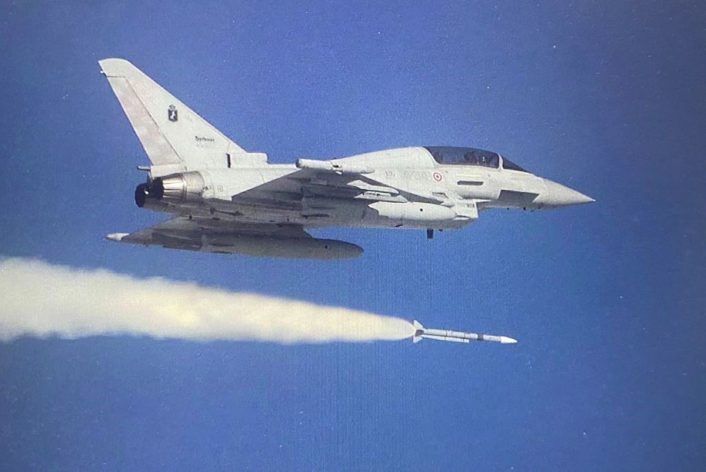
The ramjet allows the missile to conserve energy during cruise and accelerate in the terminal phase, delivering high end‑game energy and an exceptionally large “no‑escape zone.” Mid-course updates are provided via datalink from the launching aircraft, improving kill probability.
Equipped with impact and proximity fuzes and a fragmentation warhead, the Meteor is optimized for maximum lethality. It is already integrated on the Eurofighter Typhoon, Saab Gripen, and Dassault Rafale—and is now progressing toward integration with the F-35.
About The Author