On December 22, 2025, Mitsubishi Heavy Industries launched JS Yoshii, the twelfth and final Mogami-class frigate for the Japan Maritime Self-Defense Force, at its Nagasaki Shipyard, marking the completion of hull construction.
On December 22, 2025, Mitsubishi Heavy Industries (MHI) held a naming and launching ceremony at its Nagasaki Shipyard for JS Yoshii, the twelfth and final Mogami-class frigate for the Japan Maritime Self-Defense Force (JMSDF). The event marked the completion of hull construction, after which the vessel will enter outfitting and trials ahead of its planned delivery in fiscal year 2026. Japan’s Minister of Defense, Shinjiro Koizumi, officially announced the ship’s name during the ceremony, attended by around 200 defense and industry representatives. Commissioning is expected around March 2027 following completion of sea trials and final acceptance.
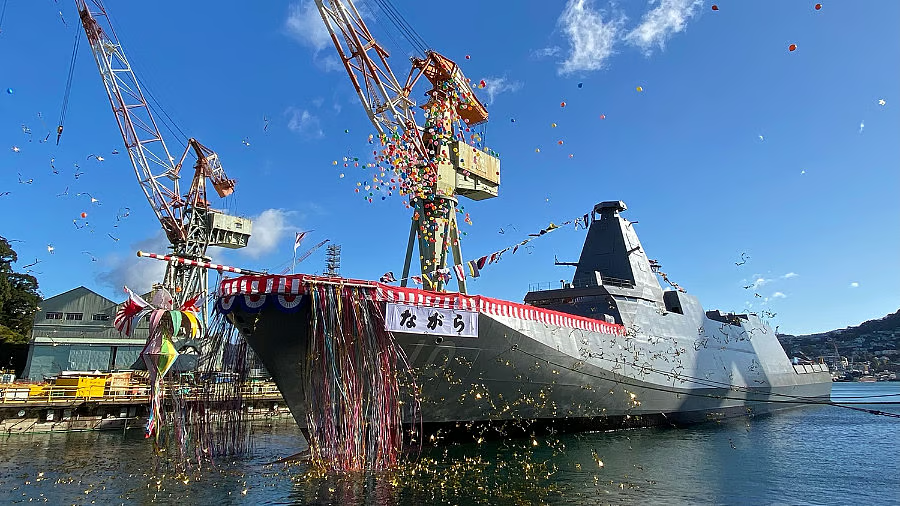
JS Yoshii (FFM-12) closes the initial batch of Mogami-class multi-mission frigates, with construction carried out at MHI’s Nagasaki yard, which built ten of the twelve ships. The program, initiated under budgets from 2018, now transitions from hull construction to final outfitting, signaling a bridge to Japan’s forthcoming New FFM-class, also known as the Upgraded Mogami-class, which Australia selected in August 2025.
The frigate measures 133 meters in length with a 16.3-meter beam, a displacement of roughly 3,900 tonnes, and a hull depth of about 9 meters. It is designed for a crew of approximately 90, emphasizing automation and integrated systems to reduce manpower compared with older Japanese escorts. The ship incorporates low-observable features to complicate detection and targeting, supporting routine surveillance, maritime security, and higher-intensity operations. JS Yoshii is capable of anti-submarine, anti-air, and anti-surface missions while also absorbing tasks previously handled by dedicated mine warfare vessels.
Propulsion is provided via a combined diesel and gas (CODAG) system, producing around 70,000 horsepower. Gas turbines provide high-speed capability, while diesel engines enable economical cruising, with a maximum speed of 30 knots (55.6 km/h). The ship’s integrated combat system merges data from multiple sensors, fire control systems, and communications networks to coordinate weapons engagements and maintain situational awareness.
Armament includes a 16-cell Mk-41 vertical launch system (VLS) for air defense, a Mk-45 Mod-4 62-caliber 5-inch gun for surface engagements and naval gunfire support, two triple torpedo tubes, two quadruple launchers for Type 17 anti-ship missiles, a SeaRAM launcher with 11 missiles for close-in defense, and two 12.7 mm remote-controlled machine guns. JS Yoshii also features a flight deck and hangar for a Mitsubishi SH-60L helicopter, enhancing surveillance and anti-submarine operations.
The Mogami-class integrates mine warfare capabilities, replacing the need for dedicated mine countermeasure vessels. The ship carries an onboard mine countermeasure sonar for detection, classification, and avoidance, along with a simplified mine-laying system. Autonomous systems, including the OZZ-5 unmanned underwater vehicle, extend capabilities for hazardous missions. Future upgrades include a variable depth sonar and a towed array system to improve long-range submarine detection.
JS Yoshii is named after the Yoshii River in Okayama Prefecture, maintaining the Mogami-class tradition of naming ships after Japanese rivers. This is the first JMSDF or Imperial Japanese Navy vessel to carry the name Yoshii, and the first Mogami-class ship named after a river from the Chugoku region. Along with JS Tatsuta, Yoshii completes the final pair of the class, with a combined cost of approximately ¥116.6 billion. Following launch, the frigate will undergo outfitting, harbor trials, and sea trials before assignment to a new Patrol and Defense Group. The completion of all twelve Mogami-class ships prepares Japan to advance with the New FFM-class and fosters future international cooperation through the improved Mogami-derived design selected by Australia.
About The Author