North Korea claims it has formed the first unit of a domestically built nuclear-powered strategic submarine, unveiled during Kim Jong Un’s visit to a shipyard, a move analysts warn could enable the deployment of nuclear-armed ballistic missiles and significantly expand Pyongyang’s sea-based deterrent with implications for U.S. and regional security.
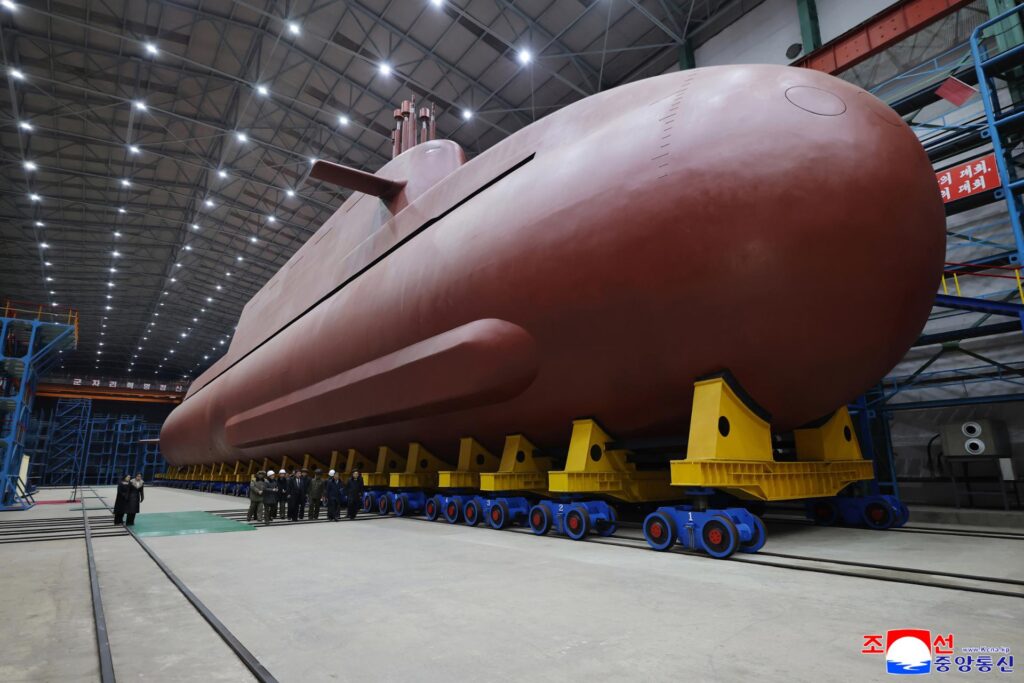
North Korea has revealed what it claims is the first hull of a domestically built nuclear-powered submarine, marking a major step in its long-term naval nuclear ambitions. The announcement was made by the state-run Korean Central News Agency, which said the submarine was unveiled during a visit by leader Kim Jong Un to the Pongdae Shipyard. According to KCNA, the vessel is an 8,700-ton nuclear-powered strategic guided missile submarine that remains under construction.
During the visit, Kim Jong Un reportedly used the occasion to criticize recent military developments involving South Korea and the United States. KCNA stated that Kim argued South Korea’s nuclear submarine development plans, allegedly supported by Washington, would further destabilize the Korean Peninsula. He described the move as an offensive act that violates North Korea’s security and maritime sovereignty and warned that it represents a direct threat that must be countered.
Kim made these remarks while conducting what KCNA described as an on-site inspection of the submarine’s hull and internal structures. The agency also reported that Kim emphasized the urgency of nuclearizing the navy, citing what he called a rapidly deteriorating security environment around the Korean Peninsula.
Analysts quoted by South Korean media suggest that Pyongyang is attempting to legitimize its own nuclear weapons expansion by pointing to Seoul’s plans for nuclear-powered submarines. South Korea has publicly discussed developing submarines that would use nuclear reactors solely for propulsion while carrying only conventional weapons, a distinction Seoul has repeatedly highlighted in communications with its allies.
According to Lim Eul-chul, a North Korea expert at Kyungnam University’s Institute for Far Eastern Studies, the nuclear submarine program first announced at the 2021 Eighth Workers’ Party Congress appears to have made notable progress. He warned that North Korea’s submarines are no longer a theoretical concept but an emerging capability that could pose a threat not only to South Korea but potentially to the U.S. mainland as well.
Photographs released by KCNA show what analysts assess to be a nearly completed pressure hull, with external features consistent with those of a ballistic missile submarine. Experts note that if the submarine is truly an 8,700-ton-class vessel, it would likely be powered by a reactor using highly enriched uranium, with enrichment levels exceeding 90 percent. Such a reactor would not require refueling throughout the submarine’s operational lifespan.
This design approach differs significantly from South Korea’s plans. Seoul is expected to complete its first nuclear-powered submarine around 2035, with U.S. support for nuclear fuel supplies. South Korean designs are expected to rely on low-enriched uranium at approximately 20 percent, requiring reactor refueling roughly every ten years. South Korean officials have consistently stated that their program is focused on improving endurance and stealth rather than deploying nuclear weapons.
North Korea, in contrast, is believed to be developing a platform capable of carrying ballistic missiles armed with nuclear warheads, thereby expanding its sea-based nuclear deterrent beyond its existing fleet of diesel-electric submarines.
About The Author