Pakistan Navy has launched its fourth Hangor-class submarine, PNS Ghazi, at China’s Wuchang Shipbuilding Industry Group Shuangliu Base in Wuhan, marking a key milestone in its undersea fleet expansion.
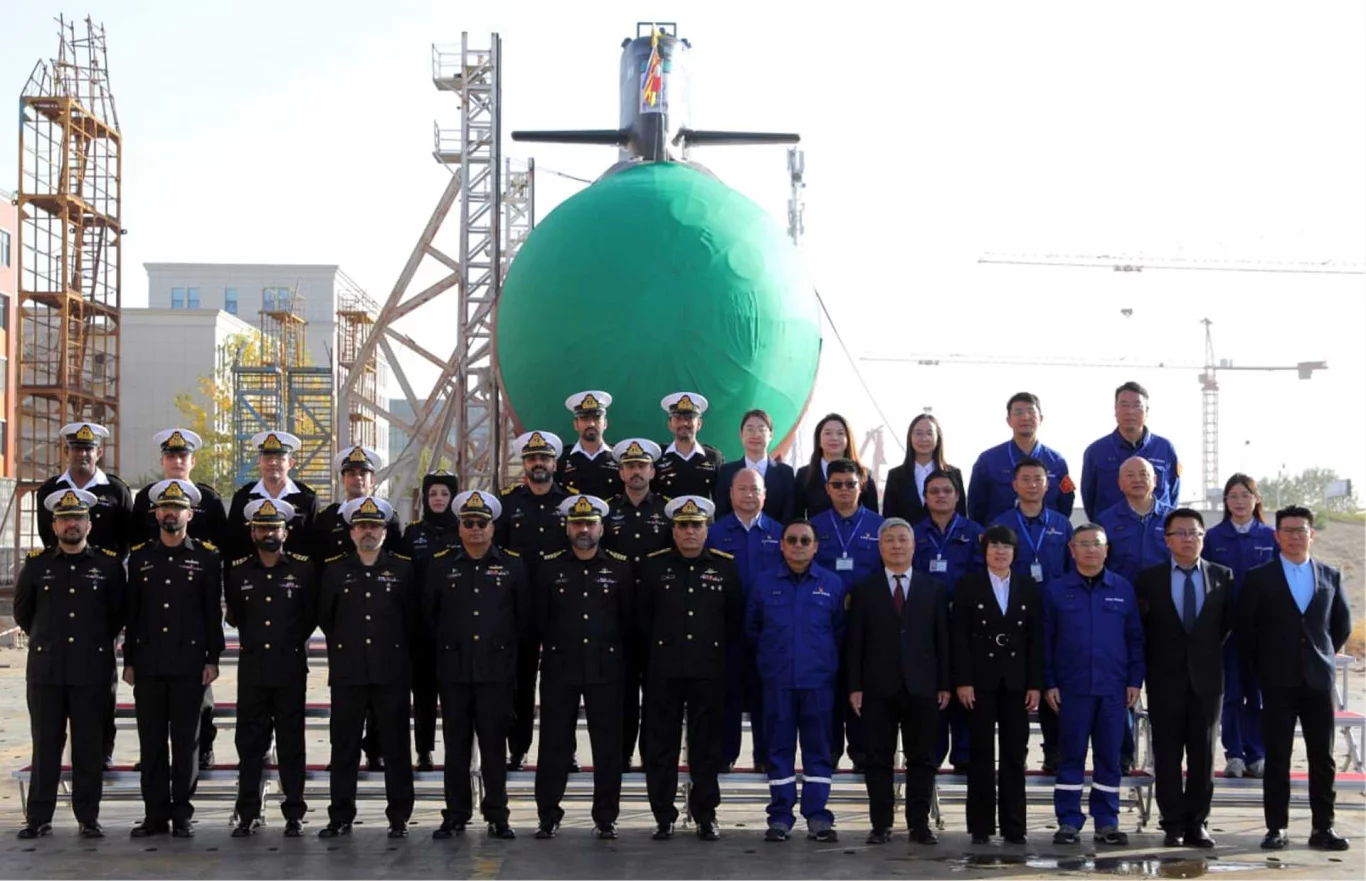
On December 17, 2025, the Pakistan Navy announced the launch of its fourth Hangor-class submarine, PNS Ghazi, at the Wuchang Shipbuilding Industry Group’s Shuangliu Base in Wuhan, China. The ceremony included senior Pakistani naval officials, Chinese shipbuilders, and representatives of the 2015 bilateral eight-submarine program. With the Ghazi entering the water, all four Hangor-class submarines built in China under the current contract have now been launched.
The 2015 Pakistan-China agreement covers a total of eight diesel-electric Hangor-class attack submarines, with four constructed in China and the remaining four to be built domestically at Karachi Shipyard and Engineering Works under a technology-transfer arrangement. Pakistani officials confirmed that the China-built boats are undergoing sea trials and progressing toward handover, while domestic construction has advanced with steel-cutting and keel-laying ceremonies for the first locally-built submarine, PNS Tasnim, highlighting Pakistan’s transition to sustained domestic production.
The sequence of launches in Wuhan began with PNS Hangor on April 26, 2024, followed by PNS Shushuk on March 15, 2025, PNS Mangro on August 15, 2025, and concluded with PNS Ghazi on December 17, 2025. Chief of Naval Staff Admiral Naveed Ashraf stated that the first batch of Hangor-class submarines is expected to enter operational service in 2026, marking a near-term shift from trials to active deployment. This program is part of broader Pakistan-China defense cooperation, alongside developments such as the induction of Chinese-made Z-10ME attack helicopters.
The Hangor-class submarines are diesel-electric vessels equipped with air-independent propulsion (AIP) to extend submerged endurance. Each submarine displaces approximately 2,800 tonnes, measures 76 meters in length with an 8.4-meter beam and 6.2-meter draught, and is powered by four CSOC CHD620 diesel engines coupled with Stirling-powered AIP. Maximum speed is around 20 knots (37 km/h), with a range of approximately 2,000 nautical miles (3,700 km) and an endurance of up to 65 days, while the maximum diving depth reaches around 300 meters.
In terms of armament, the Hangor-class features six 533 mm torpedo tubes in the bow for heavyweight wire-guided torpedoes, submarine-launched missiles, and naval mines. Pakistan has highlighted the potential integration of the Babur-3 submarine-launched cruise missile, a nuclear-capable system with an estimated 450 km range, although operational details have not been fully confirmed. These capabilities allow the Hangor-class to conduct anti-surface, anti-submarine, and sea-denial missions in strategic maritime areas.
The Hangor-class complements Pakistan’s existing submarine fleet, which includes three Agosta-90B AIP submarines and two older Agosta-70 boats. The Agosta-90B fleet has been undergoing mid-life upgrades since 2016 with Turkey’s STM, including new fire control systems, sonar suites, electronic warfare systems, radar, periscopes, and shore support infrastructure such as the PNS Hameed very-low-frequency communications station.
Strategically, the Hangor-class program reinforces Pakistan’s undersea deterrence posture vis-à-vis India and the broader northern Arabian Sea. The submarines carry the historic Hangor name in honor of PNS Hangor (S131), which sank the Indian frigate INS Khukri in 1971. Continuing this tradition, the first domestically built submarine has been named PNS Tasnim, after Vice Admiral Ahmad Tasnim, commander of the original Hangor.
About The Author