Russia has begun combat use of an upgraded Geran-2 one-way attack drone equipped with a significantly heavier 100-kilogram double warhead, increasing its destructive potential against hardened Ukrainian infrastructure and underscoring the rapid evolution of Moscow’s long-range drone campaign.
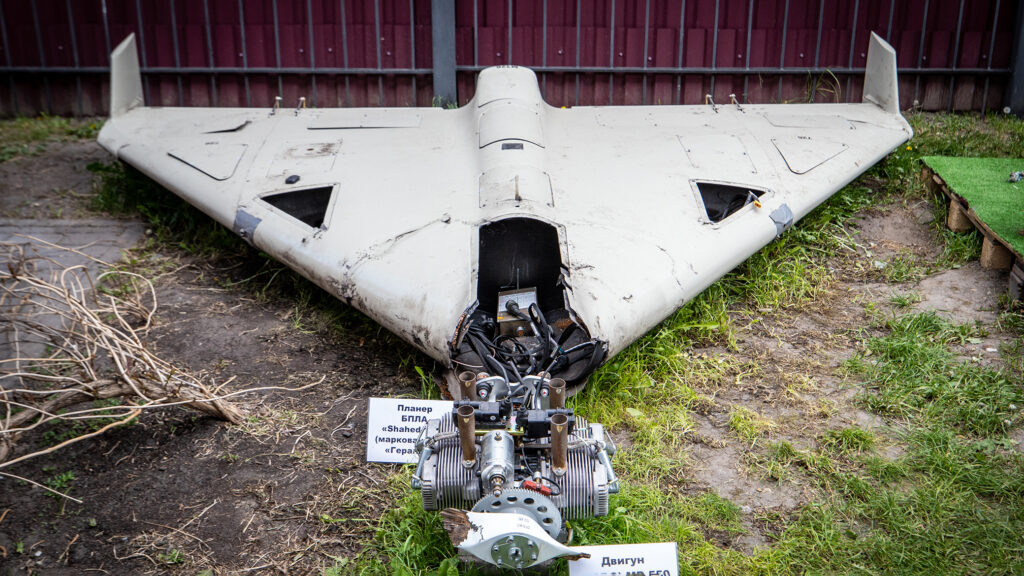
Russian forces have begun operational use of an upgraded Geran-2 one-way attack drone fitted with a significantly heavier payload, according to reporting from Ukraine’s UNN news agency and local open-source intelligence (OSINT) observers. Ukrainian radio-technology specialist Serhiy Beskrestnov, known by the call sign “Flash,” said examination of recovered wreckage indicates the new configuration is no longer experimental and is now being employed routinely in strikes against Ukrainian targets.
The baseline Shahed-136 and early Geran-2 variants are relatively simple, propeller-driven loitering munitions built around a rear-mounted pusher engine and a lightweight airframe optimized for long-range missions. Typical characteristics include a range of up to 1,500 kilometers, cruising speeds of around 180 km/h, and operating altitudes from very low level to several thousand meters. Launch weight is generally close to 200 kilograms, with a high-explosive fragmentation warhead of about 40 kilograms powered by a small piston engine derived from commercial designs. Over time, Russian-produced versions have already shown multiple warhead options and internal rearrangements, including heavier payloads extending deeper into the fuselage.
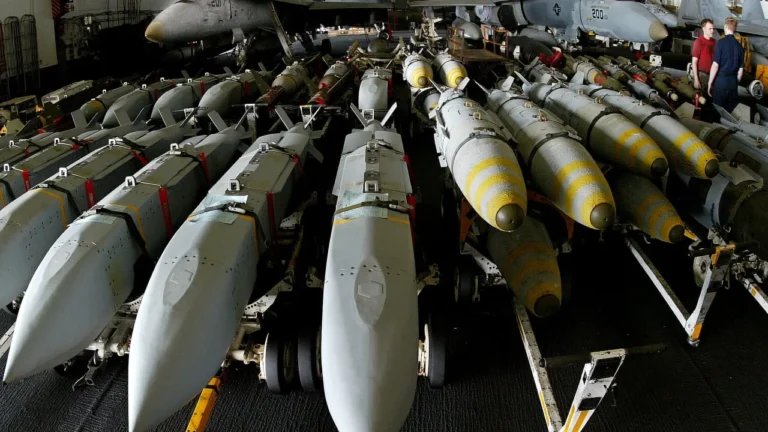
The latest variant reportedly incorporates two identical high-explosive incendiary warhead blocks, each weighing about 50 kilograms, for a combined payload of roughly 100 kilograms. Ukrainian and Russian technical sources describe the blocks as standardized munitions fitted with electronic base fuzes, while noting that the airframe has been rebalanced to maintain flight stability despite the increased forward weight. Ukrainian specialists have released dimensional data on the warheads and highlighted their combined blast and incendiary effects, suggesting an intent to maximize both overpressure and post-impact fire damage.
Doubling the warhead significantly increases the destructive potential of the Geran-2, moving it closer to the lower end of the damage spectrum associated with larger strike weapons, even though it still falls well short of cruise missile payloads. The tactical rationale is clear: after two years of conflict, Ukraine has reinforced critical infrastructure, dispersed key assets, and expanded layered air-defense coverage, increasing the number of drones required to disable a single target. A heavier payload reduces the need for multiple hits on the same transformer yard, fuel storage site, or hardened facility. Analysts have long assessed that Russia seeks more lethal drone warheads with enhanced fragmentation, incendiary effects, and improved structural damage, and the move to a 100-kilogram payload aligns with that trend.
The decision to use two standardized warheads rather than a single custom charge reflects practical engineering and production considerations. Employing existing 50-kilogram blocks simplifies manufacturing, testing, and logistics, while allowing designers to adjust the center of gravity by repositioning fuel and onboard systems instead of redesigning the entire airframe. It also provides flexibility in fuzing and damage mechanisms. Two aligned charges can produce a longer destructive impulse and greater internal structural collapse than a single compact detonation, especially against layered or reinforced structures. The trade-off, however, is reduced range or endurance, meaning these heavier Geran-2 variants are likely optimized for shorter-range or regional strike missions.
On the battlefield, a 100-kilogram warhead sharply increases the consequences of any drone that penetrates air defenses. Even with high interception rates, the drones that evade defenses can shift from causing limited or nuisance damage to disabling critical infrastructure or destroying hardened targets. When combined with mass launches designed to saturate defensive systems, the upgraded Geran-2 highlights the rapid evolution of Russia’s long-range drone program. The emergence of heavier payloads, incendiary-focused warheads, and evolving fuzing concepts indicates a system increasingly defined by lethality rather than low cost alone. For defenders, the challenge is no longer only intercepting large numbers of inexpensive drones, but preventing a smaller number of heavier strikes from generating disproportionate operational and psychological impact.
About The Author