Russia’s Northern Fleet has carried out polar-night aerial refueling drills with Su-24M bombers and Il-78 tankers over the Arctic, highlighting Moscow’s effort to sustain long-range strike capability from the Kola Peninsula as strategic competition in the High North intensifies.
On December 17, 2025, Russia’s Northern Fleet announced that Su-24M frontline bombers had successfully conducted night-time aerial refueling missions over the Far North under complete polar night conditions, according to the state news agency TASS. The exercise, carried out with Il-78 tanker aircraft, focused on one of the most demanding tasks in Russian military aviation: safely linking a strike aircraft with a tanker amid turbulence, low visibility, and extreme Arctic weather. Beyond the technical achievement, the drill highlights Moscow’s continued emphasis on preserving long-range strike capabilities from the Kola Peninsula, as Arctic airspace grows increasingly important in strategic competition. The disclosure follows an 11-hour Tu-160 strategic bomber patrol over Arctic waters, previously reported by Army Recognition, pointing to a sustained pattern of Russian air activity aimed at demonstrating endurance and reach in the High North.
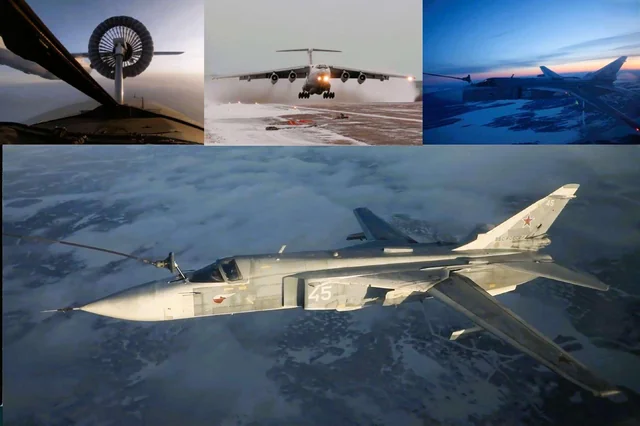
According to the Northern Fleet, Su-24M crews from the Combined Aviation Corps performed the refueling training during a planned flight rotation. Operating in designated airspace, the bombers maneuvered to connect with the Il-78’s hose-and-drogue system in full polar darkness. Crews faced typical Far North hazards, including low cloud cover, turbulence, icing risks, and the absence of a visible horizon—conditions that significantly reduce reaction time and magnify even small alignment errors. Fleet officials stated that all crews completed the mission successfully, allowing each aircraft to substantially extend its combat radius and time on station. For an aircraft designed for deep, low-altitude penetration missions, reliable aerial refueling under such conditions directly strengthens the Northern Fleet’s ability to sustain long-duration sorties over the Barents and Norwegian Seas, and potentially into the wider North Atlantic bastion Russia seeks to defend.
The Su-24M remains an important element of Russia’s strike aviation inventory. This supersonic, all-weather tactical bomber features variable-geometry wings and can carry up to 8,000 kilograms of ordnance across multiple hardpoints. It is optimized for precision attacks against ground and surface targets, supported by a digital navigation and attack system and terrain-following radar that enables low-level flight in poor weather while reducing exposure to enemy air defenses. Modernized variants can employ a wide range of guided weapons, including Kh-25 and Kh-29 missiles, Kh-31 anti-radiation and anti-ship missiles, and KAB-series precision-guided bombs, along with a GSh-6-23 23 mm cannon and short-range air-to-air missiles for self-defense. With aerial refueling support, the Su-24M can project power far beyond its internal fuel limits, enabling sustained strike operations across Arctic and maritime theaters.
The Il-78 tanker is the key enabler of this extended reach. Based on the Il-76MD airlifter, the Il-78 carries additional fuel tanks and is equipped with three refueling points—two underwing pods and one rear fuselage unit—allowing it to refuel multiple aircraft during a single sortie using the probe-and-drogue system. With a transferable fuel capacity exceeding 80 tonnes in its standard configuration, the Il-78 has been in service since the mid-1980s and remains Russia’s only dedicated aerial refueling platform. For Northern Fleet aviation, which operates over vast, sparsely developed Arctic regions with limited diversion airfields, this capability is essential for supporting extended strike missions, long-range bomber movements, and other aircraft transiting between inland bases and Arctic staging areas.
Strategically, the polar-night refueling exercise fits into a broader pattern of Russian activity aimed at reinforcing deterrence and signaling resilience in the Arctic. On November 25, 2025, a Tu-160 “Blackjack” strategic bomber completed an 11-hour patrol over neutral Arctic waters while remaining in international airspace, underscoring Russia’s ability to conduct sustained long-range missions in the region. Together, the Tu-160 patrol and the Northern Fleet’s refueling drills illustrate two complementary aspects of Russia’s air posture: strategic bombers capable of projecting nuclear and conventional power over intercontinental distances, and tactical aviation able to maintain a continuous, combat-ready presence over Arctic maritime approaches. Amid increased NATO activity following Finland and Sweden’s accession and enhanced Alliance focus on Arctic deterrence, these flights reinforce Russia’s bastion defense concept centered on the Kola Peninsula. They signal that, despite modernization pressures and ongoing operations elsewhere, Russia continues to invest in the skills and procedures required to operate effectively in the High North.
About The Author