Russian forces have unveiled the combat use of a previously unseen jet-powered one-way attack drone after releasing footage showing it striking a Ukrainian HIMARS launcher, with the video capturing a fast, arrow-shaped airframe under first-person-view control in its first confirmed operational appearance.
Russia has begun operating a previously unseen jet-powered one-way attack drone, following the release of footage by a Russian military unit showing the system striking a Ukrainian HIMARS launcher earlier this week.
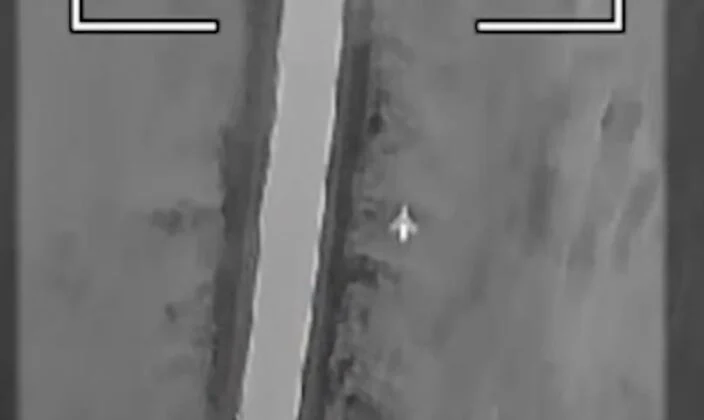
The video, published by the unit responsible for reconnaissance operations, shows a surveillance drone detecting the target and relaying its coordinates to a strike element. Moments later, a high-speed attack drone is seen engaging the launcher.
According to the unit’s description, the reconnaissance drone identified the Ukrainian HIMARS and passed targeting data to a new attack drone that has not previously been documented in the conflict. The footage shows a fast, arrow-shaped unmanned aircraft closing in on the target at high speed under first-person-view (FPV) control before impact. This marks the first confirmed appearance of the jet-powered one-way attack drone.
Visual evidence from the video indicates the drone features swept wings, a compact airframe, and a small jet engine, with a guidance configuration consistent with FPV operation. The Russian unit claimed the system was capable of pursuing a moving target, a capability usually associated with more expensive precision-guided weapons. No official details have been released regarding the drone’s designation, manufacturer, or production scale.
The speed demonstrated in the footage suggests the drone can be launched rapidly after target acquisition, significantly reducing reaction time for Ukrainian forces and complicating attempts to relocate mobile systems such as rocket launchers.
Until now, Russian forces have often relied on costly ballistic missiles, including the Iskander system, to strike time-sensitive or mobile targets. The emergence of a jet-powered one-way attack drone points to a potentially lower-cost alternative capable of engaging similar targets while maintaining a high operational tempo.
The footage aligns with a broader pattern of Russian units unveiling new unmanned systems adapted for battlefield use. Over the past year, Russia has expanded its use of FPV drones, long-range attack UAVs, and improvised strike platforms built from a mix of military and commercial components.
Although technical specifications remain undisclosed, the drone visible in the video appears small and lightweight, with a limited wingspan. Its jet propulsion offers significantly higher speeds than propeller-driven FPV drones, increasing the probability of successfully engaging moving assets such as missile launchers, vehicles, and radar systems.
While the origin, production status, and availability of the system remain unclear, its apparent combat use suggests Russian forces are actively testing new high-speed unmanned strike platforms in operational conditions.
About The Author