Ukrainian monitoring sources say Russia has fielded the UMPB-5 glide bomb, an upgraded evolution of the UMPK-500 kit with aerodynamic changes extending range to roughly 160 km.
A powered UMPB-5R version fitted with a small turbojet engine is assessed to reach up to 200 km, further enhancing stand-off strike capability.
Russia has revealed an updated winged glide bomb for combat aircraft, evolving the UMPK-500 guidance kit into a new variant designated UMPB-5, according to recently circulated photos and video. The munition is described in Russian sources as a unified modular gliding bomb and represents a further development of the UMPK family widely used in the war against Ukraine.
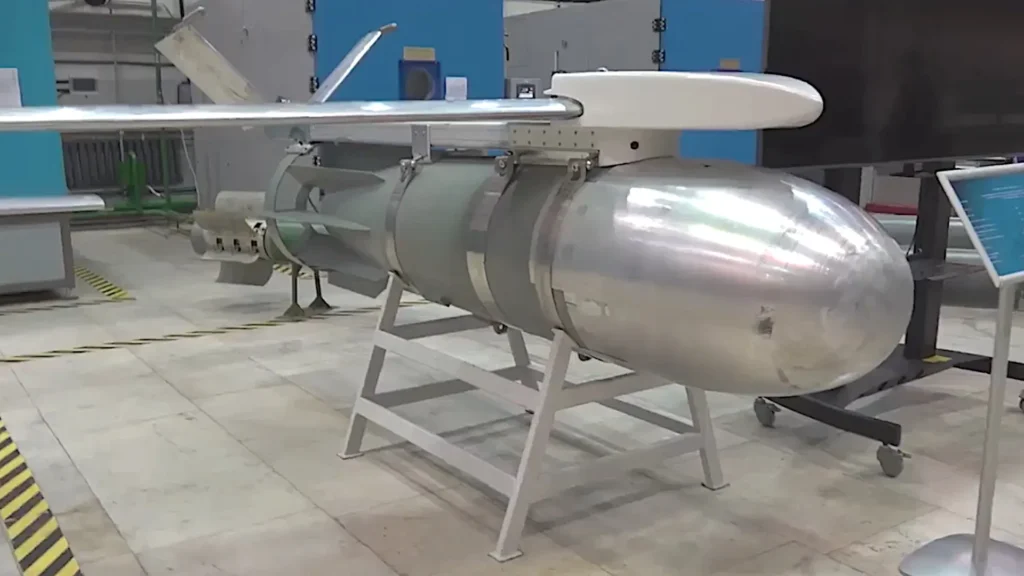
The updated design introduces changes to the airframe and wing configuration aimed at extending strike range while retaining the existing guidance architecture. Ukrainian sources say the UMPB-5 uses the same navigation suite as earlier variants, combining satellite navigation and inertial correction systems known as SMART and Kometa-M12, allowing release from outside many air-defense engagement zones while maintaining accuracy against fixed targets.
A powered variant, identified as UMPB-5R, has also been reported. Ukrainian assessments indicate it integrates a small turbojet engine, giving the munition a claimed range of up to 200 kilometers by sustaining flight after release rather than relying solely on glide performance.
Monitoring sources further suggest that even the unpowered UMPB-5 benefits from improved aerodynamics and increased wing surface area, extending glide range by an estimated 40–50 kilometers. Under suitable launch conditions, the weapon may reach distances of around 160 kilometers.
The bombs are designed for use by Russian tactical aircraft, including Su-34 fighter-bombers operating from Russian airspace or occupied territory. Their extended range enables launch aircraft to stay farther from frontline air defenses while striking targets deep inside Ukrainian-controlled areas.
Russia has increasingly relied on modular glide bomb kits as a cost-effective way to convert older unguided bombs into precision stand-off weapons. This approach simplifies production and logistics while expanding strike reach and reducing aircraft exposure to short- and medium-range air-defense systems.
About The Author