The dawn of January 17, 1991, marked the beginning of Operation Desert Storm, a monumental air campaign designed to liberate Kuwait from Iraqi occupation. As the skies over Iraq and Kuwait became a battleground, one aircraft emerged as the undisputed king of the air: the McDonnell Douglas (now Boeing) F-15C Eagle. Its performance during the conflict wasn’t just impressive; it was legendary, cementing its status as arguably the greatest air superiority fighter in history and forever etching its name into the annals of aerial warfare.
A Legacy Forged in the Cold War
The F-15 Eagle was born out of the crucible of the Cold War, a direct response to the perceived threat of advanced Soviet fighters like the MiG-25 “Foxbat.” Designed with a singular, uncompromising mission – to gain and maintain air superiority – the F-15 featured a powerful radar, long-range missiles, and exceptional maneuverability. Its “no compromise” design philosophy meant that every aspect, from its twin engines delivering immense thrust to its sophisticated avionics, was geared towards one goal: to defeat any aerial adversary.
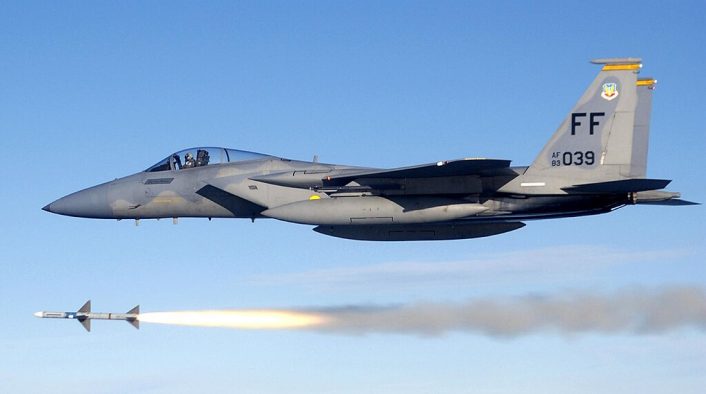
By the time Desert Storm erupted, the F-15C represented the pinnacle of this design philosophy. It was equipped with the AN/APG-63(V)1 pulse-Doppler radar, capable of detecting targets at extreme ranges, and carried a potent mix of AIM-7 Sparrow medium-range radar-guided missiles, AIM-9 Sidewinder short-range infrared-guided missiles, and an internal M61 Vulcan 20mm cannon for close-in engagements. Critically, its pilots were among the most highly trained in the world, having honed their skills over decades of rigorous exercises against the best the West had to offer.
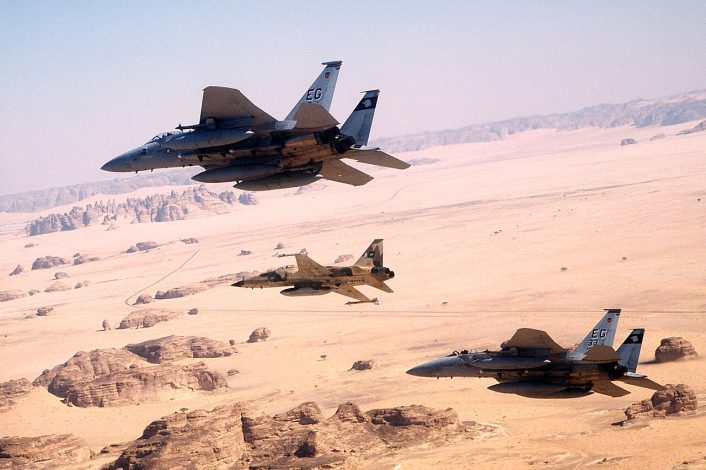
The Opening Salvo: Sweeping the Skies
When Desert Storm began, the coalition’s primary objective was to quickly dismantle Iraq’s air force, which, on paper, was one of the largest and most capable in the region. This was where the F-15C truly shone. In the very first hours of the conflict, F-15Cs led the charge, penetrating Iraqi airspace ahead of strike packages, acting as the “air superiority shield.” Their mission was clear: eliminate any Iraqi fighter daring to challenge the coalition’s air dominance.
The Iraqi Air Force, equipped primarily with Soviet-built MiG-21s, MiG-23s, MiG-25s, MiG-29s, and French-built Mirage F1s, was formidable on paper. However, they were about to face an adversary that was not only technologically superior but also operated by pilots with a vast qualitative edge.
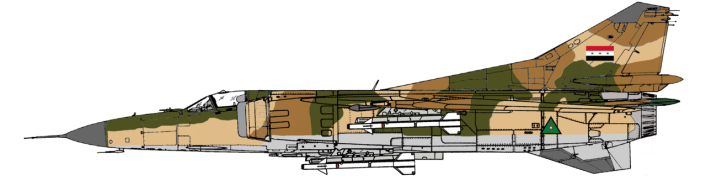
The Hunt is On: Eagle vs. Foxbat, Fulcrum, and Flogger
The engagements that followed were swift and decisive. F-15C pilots, utilizing their superior radar and beyond-visual-range (BVR) missile capabilities, often detected Iraqi aircraft long before the Iraqis were even aware of their presence. The AIM-7 Sparrow missile, launched from impressive distances, proved devastatingly effective, accounting for the majority of the F-15C’s kills.
One of the most notable encounters involved the formidable MiG-25 “Foxbat.” Previously a source of concern for Western intelligence due to its incredible speed and high altitude capabilities, the Foxbat proved no match for the F-15C’s integrated weapon system. Several MiG-25s were shot down by Eagles, dispelling much of the mystique surrounding the Soviet interceptor. Similarly, the advanced MiG-29 “Fulcrum,” another potent Soviet design, suffered significant losses against the F-15C, highlighting the Eagle’s superior avionics and pilot training.
Throughout the conflict, F-15C pilots executed textbook intercepts, demonstrating tactical brilliance and precise missile employment. They often operated in pairs or flights, using teamwork and communication to achieve overwhelming local air superiority. The Iraqi pilots, despite their courage, were often outmaneuvered, outranged, and outfought.
The Scorecard: Unblemished Dominance
By the time the air campaign concluded, F-15C Eagles had achieved an astounding record: 36 confirmed aerial victories against Iraqi aircraft, with zero losses to enemy air-to-air engagements. This perfect record is unparalleled in modern aerial combat and speaks volumes about the aircraft’s design, its weapon systems, and the unparalleled skill of its pilots. The F-15C was responsible for more than half of all coalition air-to-air kills during Desert Storm.
This dominance wasn’t just about statistics; it had a profound psychological impact. The Iraqi Air Force, facing such an overwhelming and seemingly invincible adversary, quickly became reluctant to engage. Many Iraqi aircraft were either destroyed on the ground or fled to Iran, effectively neutralizing their threat. This air superiority, largely established by the F-15C, allowed coalition strike aircraft to operate with relative impunity, devastating Iraqi command and control, infrastructure, and military targets.
Beyond Desert Storm: A Lasting Legacy
Operation Desert Storm wasn’t the end of the F-15C’s operational life, but it was undoubtedly its defining moment. The conflict validated every design decision and every hour of pilot training. It demonstrated unequivocally that air superiority is not merely desirable but absolutely essential for the success of any modern military operation.
The F-15C Eagle continues to serve with distinction in various air forces around the world, albeit in increasingly modernized forms. Its legacy, however, will forever be intertwined with the skies over Iraq and Kuwait in 1991, where it proved, beyond any doubt, that it was truly the “Ultimate Fighter.” Its performance in Desert Storm continues to be a benchmark against which all future air superiority fighters are measured, a testament to its timeless design and the unwavering dedication of the men and women who flew and maintained it.
About The Author