Turkish defense company ASELSAN and Malaysian shipyard NAVAMAS have partnered to develop a mission-ready Unmanned Surface Vessel for Malaysian maritime agencies, enhancing surveillance, patrol endurance, and operational capabilities in the country’s surrounding waters.
On December 22, 2025, ASELSAN and Malaysian shipyard NAVAMAS signed a Teaming Agreement to jointly develop a mission-ready Unmanned Surface Vessel (USV) for Malaysian end users, including the Royal Malaysian Navy and the Malaysian Maritime Enforcement Agency (MMEA), as announced on ASELSAN Malaysia’s official LinkedIn page. The agreement places unmanned maritime systems at the center of regional sea control, where endurance and persistent presence are increasingly critical alongside firepower. For Malaysia, this comes at a time when routine maritime security operations overlap with grey zone challenges, offshore energy protection, and high-tempo law enforcement missions.
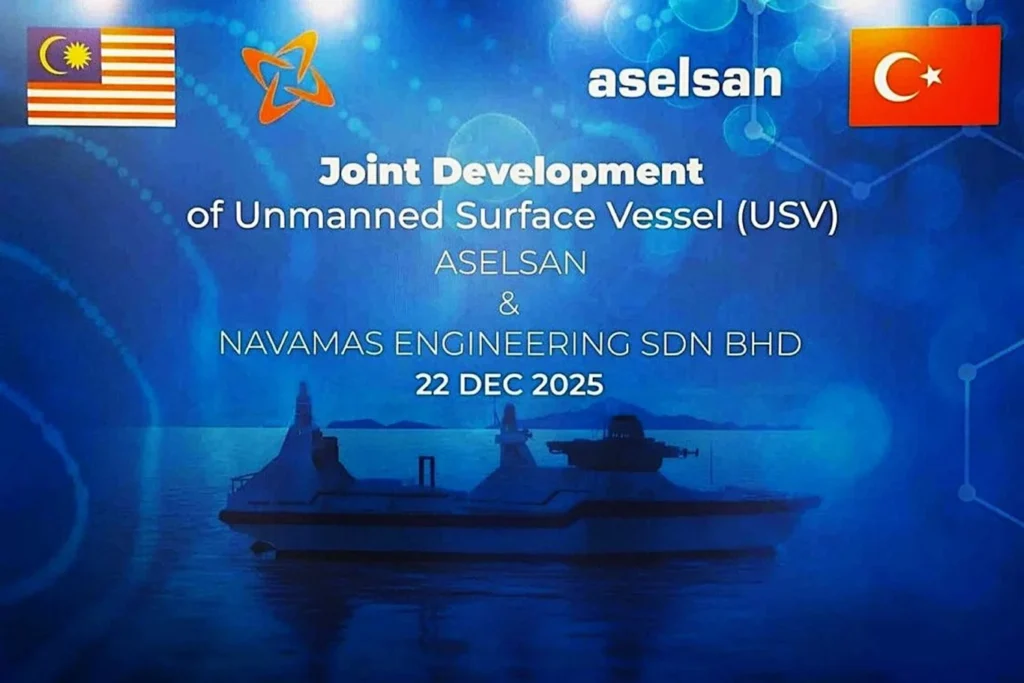
The agreement envisions a locally supported USV combining ASELSAN’s payload, sensor, and autonomy technologies with NAVAMAS’s shipbuilding and integration capabilities. “Mission-ready” implies a fully integrated system, including navigation, mission management, sensors, communications, and potentially modular effectors tailored for naval or coast guard missions. Technology transfer and workforce development are core objectives rather than secondary considerations.
ASELSAN’s role focuses on enabling the platform to function as an operational asset. This includes autonomous navigation, command-and-control systems, mission management software, and integration of sensors and communications into a cohesive maritime operational picture. The USV is intended to be interoperable with manned platforms and shore-based command centers, supporting surveillance, patrol, and maritime security operations. Platform design, sensor selection, endurance, and communications requirements will be progressively validated through staged sea trials before operational deployment.
A well-integrated USV offers Malaysia persistent maritime awareness without dedicating large crews or high-value platforms to routine missions. For enforcement, this allows monitoring of suspicious small craft, illegal activities, and evidentiary gathering in a cost-effective manner. For naval operations, the USV enhances maritime domain awareness by screening, cueing manned units, and providing early detection in congested littoral areas with compressed reaction times. This aligns with the MMEA’s mandate to ensure peace, safety, and security at sea.
The teaming agreement reflects two strategic goals: expanding operational options at sea and building sovereign industrial capacity in unmanned maritime systems. Operationally, it addresses challenges from Malaysia’s offshore energy operations and South China Sea dynamics, including encounters with foreign vessels in the EEZ. Industrially, local construction, integration, and support aim to reduce reliance on external sustainment while developing domestic skills to maintain and adapt the system.
Overall, the ASELSAN-NAVAMAS agreement represents a capability pathway rather than a single platform announcement. It seeks to deliver a locally built and supported USV for naval and maritime enforcement users while institutionalizing technology transfer and sustainable industrial participation. Successful integration of autonomy and payload systems into Malaysian command networks could transform how crewed patrols are allocated, freeing high-end platforms for deterrence and response while unmanned systems provide persistent surveillance.
About The Author