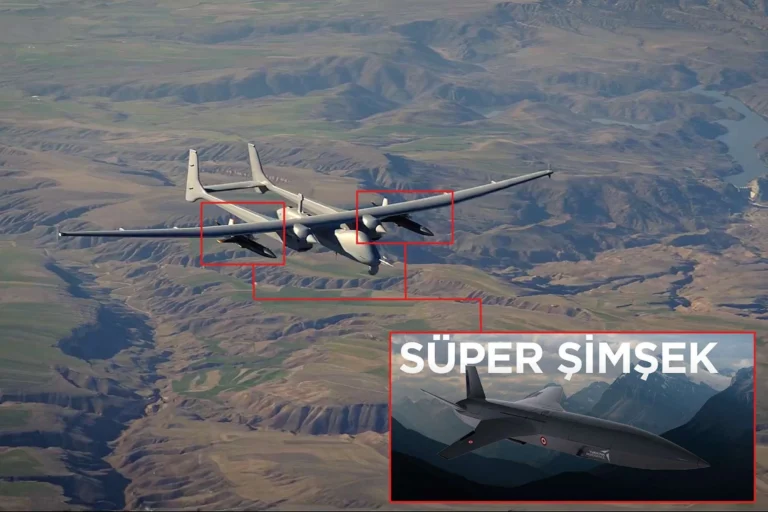
Türkiye has revealed a new step in the evolution of drone warfare after releasing footage of its Aksungur unmanned combat aerial vehicle flying with two jet-powered Super Simsek drones under its wings. The test highlights a growing shift toward modular and networked unmanned systems where larger endurance drones act as airborne carriers for smaller expendable UAVs designed for strike, electronic warfare, and decoy missions.
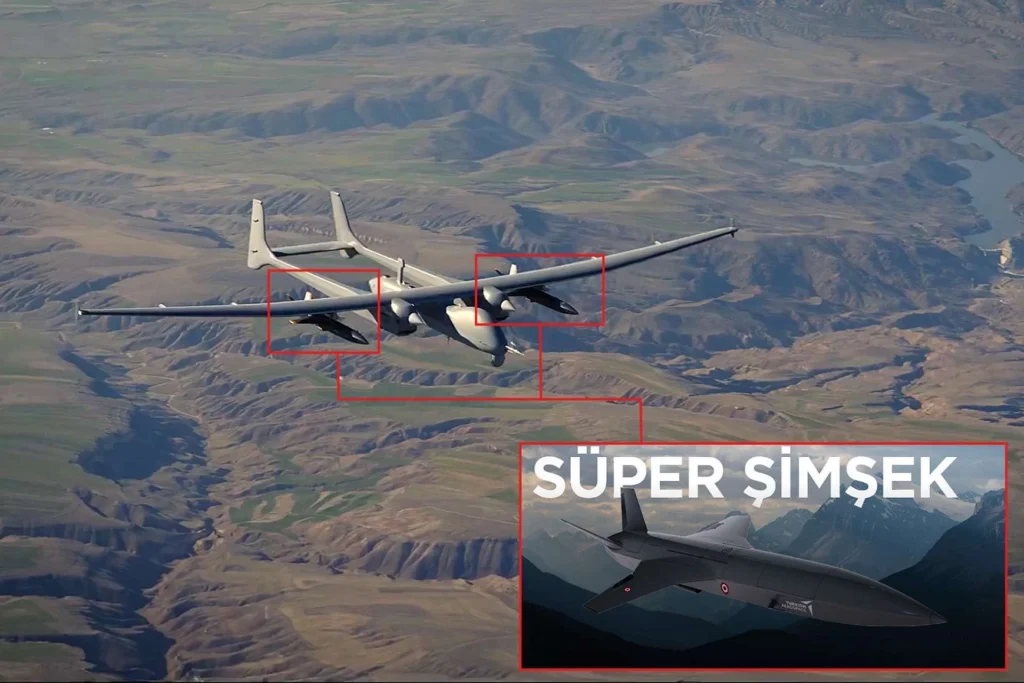
Türkiye’s defense industry has showcased another advancement in unmanned aerial warfare after releasing footage of an Aksungur unmanned combat aerial vehicle operating with two Super Simsek tactical drones mounted beneath its wings. The flight test, made public in March 2026, provides a glimpse into Ankara’s evolving strategy of combining long-endurance drones with smaller high-speed unmanned systems.
The images show the twin-engine Aksungur taxiing and taking off with a Super Simsek drone attached to each wing. While the test appears focused primarily on carrying and integration trials, it represents a step toward a concept in which larger unmanned aircraft serve as launch platforms for multiple smaller drones.
This approach reflects a broader shift in modern air combat doctrine. Instead of relying solely on single large drones or traditional aircraft, militaries are increasingly exploring layered drone ecosystems where different types of unmanned systems operate together during a mission.
At the center of the concept is the Aksungur platform itself. Developed from the earlier Anka drone family, Aksungur is designed as a medium-altitude, long-endurance unmanned aircraft capable of carrying heavy payloads and remaining airborne for extended periods.
The aircraft has a wingspan of roughly 24 meters and a maximum takeoff weight of more than three tons. Powered by twin turbo-diesel engines, the drone can operate at high altitudes and stay airborne for up to two days during certain mission profiles.
Its payload capacity allows it to carry a wide variety of sensors and weapons. Electro-optical cameras, radar systems, signals intelligence equipment, and guided munitions can all be mounted on its multiple under-wing hardpoints. This flexibility has already made the drone suitable for missions such as surveillance, maritime patrol, and precision strike operations.
The addition of Super Simsek drones introduces a new dimension to its capabilities.
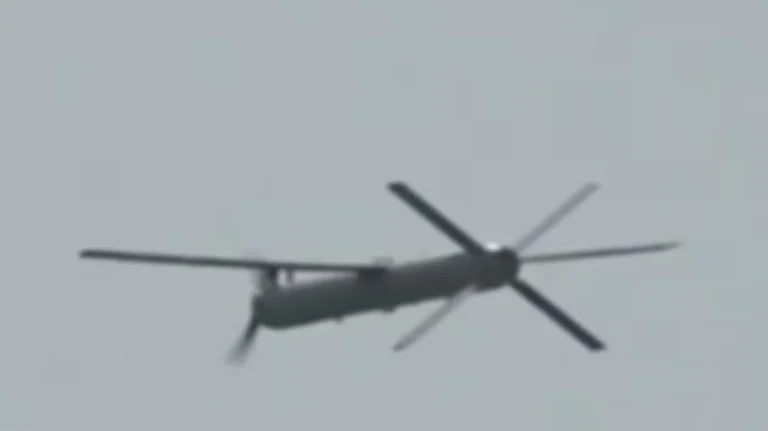
Originally developed as a high-speed target drone for training air defense units, the Simsek platform has gradually evolved into a versatile unmanned system capable of performing operational roles. The upgraded Super Simsek variant is powered by a small turbojet engine, allowing it to reach speeds approaching Mach 0.85.
Despite its relatively compact size, the drone can carry a meaningful payload. Depending on the configuration, it can be equipped with electronic warfare equipment, sensor packages, or even a small warhead for direct attack missions.
When launched from the air by a carrier drone such as Aksungur, the system gains a significant increase in operational reach. Once released, the drone can travel hundreds of kilometers while executing pre-programmed mission tasks.
Military planners see particular value in using such drones during suppression of enemy air defense operations. In this type of mission, smaller expendable drones can be sent ahead of larger aircraft to probe hostile radar networks and trigger defensive responses.
Some drones can act as decoys, deliberately imitating the radar signature of larger aircraft to draw attention and force the activation of enemy air defense systems. Others may carry electronic warfare equipment designed to jam radar signals or disrupt communications.
In certain configurations, the drones could also perform one-way strike missions against radar installations or command centers.
Because these systems are relatively inexpensive compared with manned aircraft or cruise missiles, they can be deployed in greater numbers. This allows military planners to saturate defended areas with multiple targets, increasing the likelihood that at least some drones will reach their intended objectives.
The latest Aksungur test also highlights the growing emphasis on swarm technology. Advanced control systems allow multiple drones to share information and coordinate their actions while approaching a target area.
In future scenarios, groups of smaller drones launched from larger carriers could work together, distributing tasks such as surveillance, electronic attack, and direct strike.
Türkiye’s defense industry has been investing heavily in this type of architecture as part of a wider strategy to build integrated unmanned combat networks. These networks are designed to link drones with manned aircraft, ground control stations, and other battlefield systems.
Within such a framework, large drones like Aksungur could serve not only as strike platforms but also as command and relay nodes that help manage groups of smaller unmanned systems.
The concept also aligns with Türkiye’s long-term plans for next-generation air combat. Future projects envision advanced fighters operating alongside a range of autonomous drones, each performing specialized roles during a mission.
Developing drones that can be launched from different platforms — including ground launchers, ships, and other aircraft — adds flexibility to this approach. The same type of drone could be used in training exercises, reconnaissance missions, or combat operations depending on the payload it carries.
For Türkiye, demonstrating the ability to combine a long-endurance drone with high-speed tactical UAVs also strengthens its position in the international defense market. Many countries are now seeking integrated unmanned systems rather than individual drone platforms.
The Aksungur–Super Simsek combination offers a glimpse into how such systems might operate in the future. A large drone capable of remaining in the air for many hours could deploy multiple smaller drones into contested airspace, extending the reach of surveillance and strike operations without risking valuable crewed aircraft.
As testing continues, engineers are expected to move beyond basic carriage trials toward live launch demonstrations and operational evaluations.
Each stage of development will help determine how effectively the system can perform in real combat scenarios.
The recent footage therefore represents more than just a technical demonstration. It signals the growing importance of modular drone warfare, where networks of unmanned systems work together to achieve complex military objectives.
In this evolving battlefield environment, the combination of endurance platforms like Aksungur and fast expendable drones like Super Simsek could play an increasingly important role in future air operations.
About The Author