Türkiye has introduced a new long-range kamikaze drone designed to operate in coordinated swarms and strike high-value targets deep behind enemy lines. Developed by Turkish defense manufacturer Baykar, the newly revealed K2 loitering munition combines extended endurance, a heavy warhead, and autonomous swarm coordination—capabilities that could significantly expand the country’s growing unmanned warfare ecosystem.
Türkiye’s drone industry has grown rapidly over the past decade, and Baykar has been at the center of this transformation. After achieving global recognition with combat drones such as the Bayraktar TB2 and the heavy-class Akıncı UAV, the company has now introduced a new concept designed specifically for long-range loitering strike missions.
The newly revealed K2 drone represents a different approach compared with many existing loitering munitions. Most kamikaze drones are relatively small and are typically launched from tubes, rails, or portable catapults. The K2, however, is significantly larger and takes off from a runway like a traditional aircraft. This design choice allows the platform to carry a far heavier payload while also extending its operational range.
During the public reveal, several K2 aircraft were seen conducting formation flights at the Keşan Flight Training and Test Center located in Türkiye’s Edirne province. In demonstration footage, multiple drones flew in tight formations above the Saros Gulf, performing coordinated maneuvers while maintaining stable positioning relative to each other. The aircraft executed various formation patterns including right echelon, line, and V formations, highlighting the precision of their autonomous flight systems.
These flight demonstrations were particularly notable because they showed the drones operating without direct pilot intervention. Instead, onboard sensors and software systems allowed the aircraft to maintain their positions automatically, suggesting a strong emphasis on swarm-based operations.
According to available information, the K2 has a maximum takeoff weight of around 800 kilograms. Within that weight limit, the drone is capable of carrying a warhead of approximately 200 kilograms. This is a substantial payload for a loitering munition and places the K2 in a much heavier category compared with most similar systems currently in service.
The drone is reportedly capable of flying at speeds exceeding 200 kilometers per hour and can remain airborne for more than 13 hours. Combined with an operational range that may exceed 2,000 kilometers, these characteristics allow the aircraft to perform deep strike missions far beyond the immediate frontline.
Such endurance gives the system the ability to search for targets over long distances before striking them directly. Potential targets could include radar stations, command posts, logistics hubs, or naval vessels operating in contested waters.
One of the most interesting features demonstrated during the reveal was the platform’s swarm capability. Multiple drones were shown flying together and later landing on the same runway in coordinated fashion. Baykar states that the K2 includes artificial-intelligence-assisted systems that allow multiple drones to communicate and cooperate during missions.
In a real combat scenario, a group of these drones could approach a target area from multiple directions while sharing targeting information with each other. This cooperative approach could overwhelm air defense systems by presenting defenders with numerous simultaneous threats.
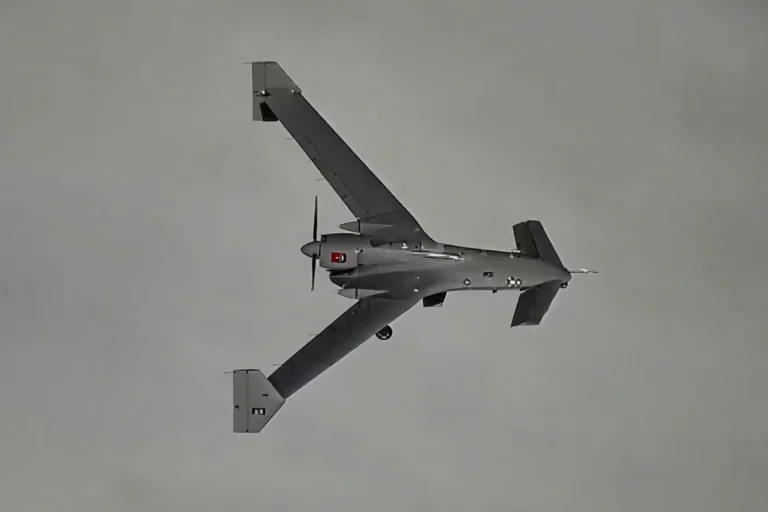
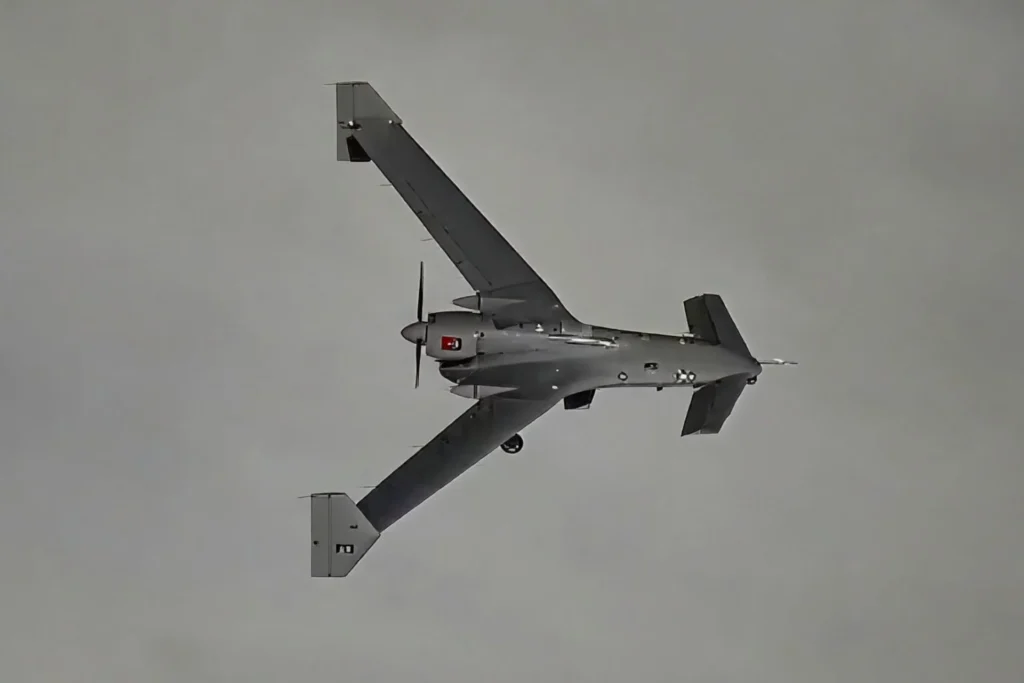
The design of the K2 also appears to share some similarities with the well-known Bayraktar TB2 drone, although the aerodynamic layout is quite different. The TB2 uses straight wings and a distinctive inverted V-tail configuration. In contrast, the K2 adopts a tailless layout with swept wings and forward canards.
These forward canards appear larger than typical control surfaces and may play an important role in shortening the aircraft’s takeoff distance. This feature suggests the drone was specifically designed to operate from short or improvised runways, making it easier to deploy from forward operating bases.
Mounted beneath the fuselage is a stabilized electro-optical sensor turret, which serves as the drone’s primary targeting system. This sensor allows the aircraft to detect and track potential targets during flight while also providing guidance during the final attack phase. Additional night-vision capable cameras allow the system to operate effectively in low-light conditions.
Another important aspect of the K2 is its ability to operate in environments where satellite navigation signals are disrupted. Modern battlefields increasingly involve electronic warfare systems designed to jam or disable Global Navigation Satellite System signals.
To counter this threat, the K2 reportedly uses its onboard optical sensors to analyze terrain features and determine its position visually. By comparing real-time imagery with stored map data, the drone can continue navigating toward its target even if satellite signals become unavailable.
Although Baykar has not officially confirmed the propulsion system used in the K2, analysts believe the drone likely relies on an engine within the 100-horsepower class. This would be similar to the engines used on existing Bayraktar TB2 aircraft. The company has also been developing its own indigenous engine known as the TM100, which could potentially power the new platform in the future.
Observers also noticed an unusual configuration during the demonstration flights. One of the drones in the formation carried an external pod mounted beneath its fuselage, while the others did not. This detail has led to speculation that the drone may have been acting as a command or coordination node within the swarm.
Such a leader drone could manage communications between aircraft, assign targets, and maintain connectivity with ground control stations. This distributed command approach would be particularly useful in large swarm operations where multiple drones must coordinate their actions.
The concept behind the K2 fits into a broader global trend in modern warfare. Many military planners are now focusing on large numbers of relatively inexpensive autonomous drones capable of overwhelming traditional defense systems.
Instead of relying on a single expensive weapon system, swarm tactics allow multiple platforms to approach a target simultaneously. Even advanced air defenses may struggle to intercept dozens of incoming drones at once.
With its heavy payload and long operational range, the K2 expands the potential target set for loitering munitions. Hardened infrastructure, radar installations, military bases, and even ships operating near coastal regions could become potential targets.
Another interesting possibility involves naval operations. Some scenes from the demonstration video show the K2 operating near facilities associated with testing the Bayraktar TB3 unmanned combat aircraft. The TB3 was designed specifically to operate from the Turkish Navy’s amphibious assault ship TCG Anadolu.
This has led analysts to speculate that the K2 could eventually work alongside naval UAVs in maritime strike missions. In such a scenario, reconnaissance drones could identify targets while groups of K2 drones launch long-range attacks from ships positioned far from hostile defenses.
This concept would allow naval forces to conduct stand-off strikes against coastal targets without exposing manned aircraft to high-risk environments.
The introduction of the K2 also reflects Türkiye’s long-term strategy of expanding its domestic defense industry. Over the past decade, the country has invested heavily in indigenous drone technology, engines, and electronic systems.
These efforts have already produced widely used platforms such as the Bayraktar TB2 and the Akıncı high-altitude UAV, both of which have been exported to numerous countries and deployed in several conflicts.
By adding a heavy long-range loitering munition to its portfolio, Baykar is further expanding its ecosystem of unmanned combat systems. The K2 could eventually become an important component of future drone-centric warfare strategies where autonomous aircraft operate together as coordinated strike networks.
As global military competition increasingly shifts toward unmanned systems and artificial intelligence, platforms like the K2 demonstrate how drone technology is continuing to evolve beyond simple reconnaissance roles into complex and highly coordinated combat operations.
About The Author