Türkiye is preparing to integrate ASELSAN’s MURAD AESA radar onto the ANKA III stealth unmanned combat aerial vehicle, a move that will enable future air-to-air combat capability. This step signals Ankara’s intention to expand its low-observable drone fleet beyond strike missions and into dominance of contested airspace.
On 30 November 2025, Türkiye’s jet-powered Kızılelma unmanned fighter showcased the beyond-visual-range air-to-air capability of ASELSAN’s MURAD AESA radar during a landmark test over the Black Sea, as reported by Army Recognition. Building on this achievement, ASELSAN confirmed in early January 2026 through its official channels that the MURAD 100-A AESA nose radar is now being prepared for integration on Turkish Aerospace’s ANKA III stealth UCAV. This radar has already flown on the F-16 Özgür modernization program, Baykar’s AKINCI UCAV, and Kızılelma, making ANKA III the next platform to join Türkiye’s advanced radar-equipped unmanned fleet. The move connects a high-performance, nationally developed AESA radar family with a low-observable flying-wing drone designed for deep strike and electronic warfare missions.
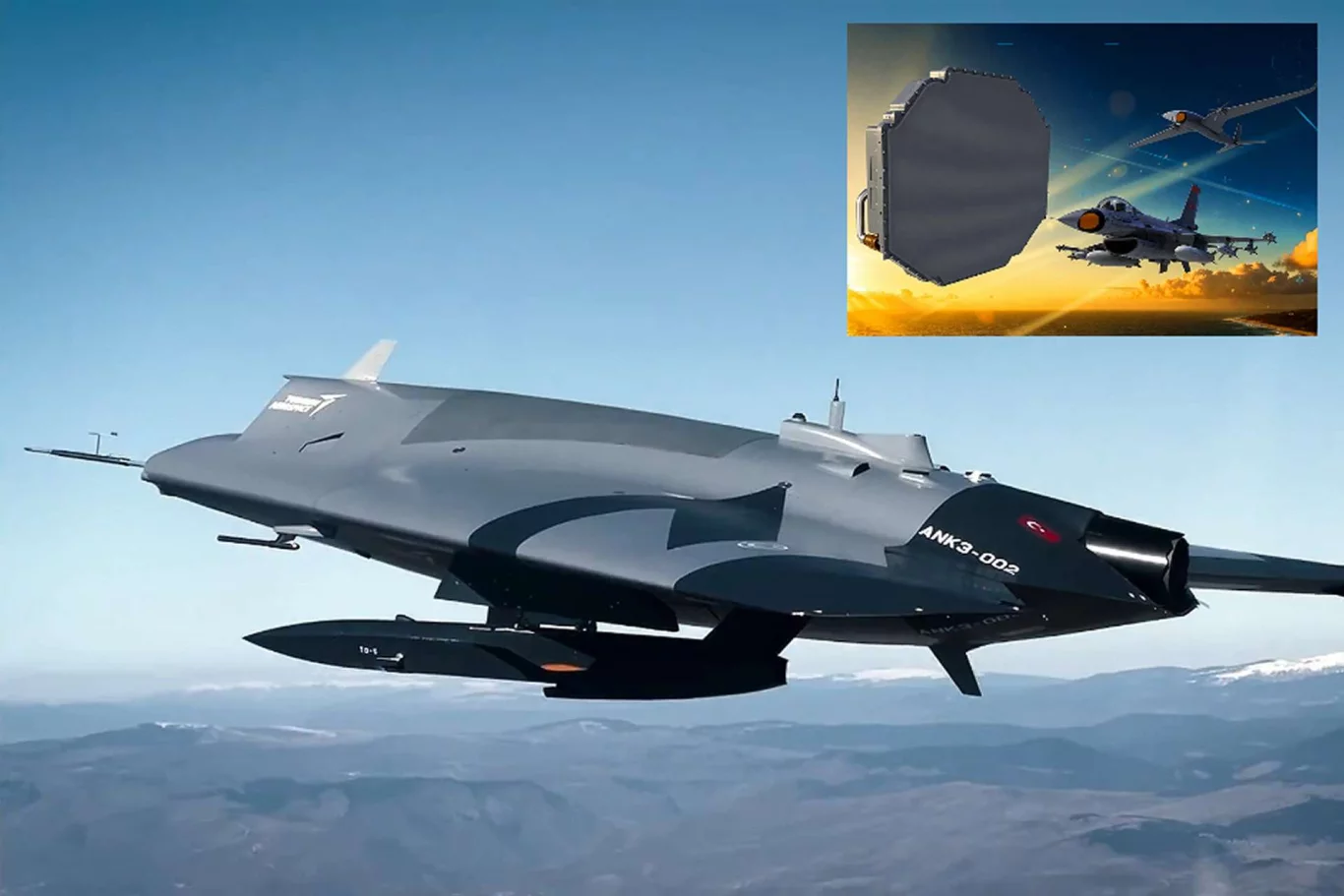
At the core of this development is the MURAD radar family. The MURAD 100-A is the nose-mounted variant designed for fighters and UAVs, while the MURAD 110-A represents the reference fire-control configuration described by ASELSAN. According to the company, MURAD is engineered to combine surveillance and fire-control functions in a single system, delivering situational awareness, threat detection, target prioritization, engagement capability, and missile guidance. The radar operates across a wide frequency band, offers high aspect-angle coverage, uses gallium nitride power amplification, and employs digital beamforming with time-interleaved operation to manage air-to-air and air-to-ground tasks simultaneously.
ASELSAN states that MURAD supports beyond-visual-range missile guidance, all-aspect and high-aspect target search, agile multi-target tracking, helicopter detection, and weather modes on the air-to-air side. These capabilities are complemented by high-resolution stripmap and spotlight SAR imaging, ground moving-target indication and tracking, ground mapping, fixed-target tracking, and precision air-to-ground ranging. The radar’s solid-state transmit-receive module architecture minimizes the impact of individual component failures, ensuring high reliability and availability, which is especially critical for unmanned platforms designed for long-duration missions.
For Baykar’s AKINCI UCAV, the integration of MURAD 100-A represents a major capability enhancement. With a payload capacity of approximately 1.5 tonnes, a service ceiling near 40,000 feet, and endurance exceeding 24 hours, AKINCI was already a capable ISR and strike platform. The addition of an AESA fire-control radar allows it to generate and maintain its own air and surface tracks, provide mid-course guidance updates to precision weapons, and contribute to electronic support and electronic attack missions through agile beam steering and adaptive waveforms.
As ASELSAN’s AESA radar line enters serial production, the same hardware can receive incremental software upgrades to introduce new operational modes, including higher-resolution SAR mapping, improved moving-target indication, and cooperative targeting algorithms. This approach enables AKINCI, Kızılelma, and ANKA III to evolve together, sharing radar modes and threat libraries without major structural changes, effectively creating a unified sensor ecosystem across manned and unmanned platforms.
ANKA III itself has progressed through a rapid yet structured development cycle. The flying-wing UCAV entered its design phase in 2022 and completed its first flight in December 2023. According to Turkish Aerospace, ANKA III has a length of 8.9 meters, a wingspan of 13.1 meters, and a maximum take-off weight of 7,250 kilograms, with a payload capacity of 1,600 kilograms carried on internal and external stations. Powered by a turbofan engine, it has a service ceiling of 40,000 feet, a maximum speed of Mach 0.7, and a combat radius of over 1,000 kilometers depending on mission configuration. The platform emphasizes low observability, multirole capability, common avionics architecture, manned-unmanned teaming, and AI-supported swarm operations.
ANKA III is designed to carry AESA radar, electro-optical targeting systems, infrared search-and-track sensors, a wide range of guided air-to-ground munitions, radar- or infrared-guided air-to-air missiles, and electronic warfare payloads including COMINT, ELINT, electronic support, and electronic attack systems. Integrating a powerful AESA radar into the flying-wing design may involve either a refined nose-mounted array or distributed arrays along the leading edges, enabled by the modular nature of AESA technology and well suited for wide-area SAR and electronic warfare missions.
The operational benchmark for MURAD’s combat potential remains Kızılelma. During flight tests in autumn 2025, the unmanned fighter operated with the MURAD radar and TOYGUN electro-optical system, simulating engagements against F-16-class targets using Gökdoğan beyond-visual-range missiles. The subsequent live-fire engagement on 30 November 2025 demonstrated that a jet-powered UAV could independently detect, track, and destroy an aerial target beyond visual range, highlighting the radar’s effectiveness in high-intensity air combat scenarios.
On ANKA III, MURAD will be used less for high-speed interception and more for endurance-focused missions, including long-range detection, persistent SAR mapping, electronic support, and cooperative targeting for other platforms such as Kızılelma, AKINCI, and manned fighters. Strategically, integrating MURAD 100-A onto ANKA III strengthens Türkiye’s ambition to build a sovereign, layered airpower and air-defense architecture. A stealth UCAV equipped with an AESA fire-control radar can operate deep in contested airspace, support networked engagements, and conduct electronic warfare without risking a pilot.
By extending the MURAD 100-A from the F-16 Özgür, AKINCI, and Kızılelma to the ANKA III stealth UCAV, ASELSAN and Turkish Aerospace are transforming individual test programs into a coherent, multi-platform radar ecosystem. This integration signals that Türkiye’s unmanned airpower is entering a new phase, where drones are no longer limited to ISR or strike roles but are becoming full contributors to air superiority, electronic warfare, and long-range precision combat in future conflicts.
About The Author