Washington has approved a potential $111.8 million Foreign Military Sales package for South Korea, enabling the acquisition of 624 GBU‑39B Small Diameter Bombs and enhancing Seoul’s precision strike capabilities amid rising regional tensions and growing interoperability requirements.
On 5 December 2025, the U.S. Defense Security Cooperation Agency confirmed approval for a new shipment of GBU-39B Small Diameter Bombs (SDBs) to the Republic of Korea. This new tranche builds on an earlier case that stayed under the congressional threshold, bringing Seoul’s planned total to over 1,000 munitions when combined with previously contracted stocks. South Korean defense officials describe the package as a practical step that maintains alignment with U.S. standards while giving planners greater flexibility for long-range strike operations across the Indo-Pacific.
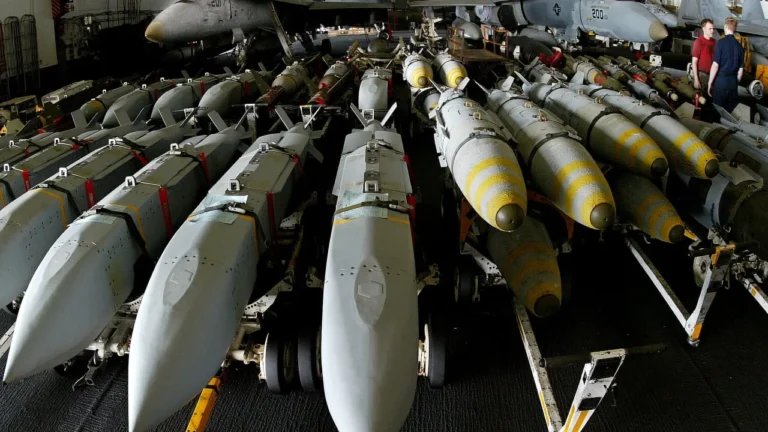
The GBU-39/B SDB is a compact, 250-pound (113 kg) precision-guided bomb, employing GPS and inertial navigation systems to operate in all weather conditions, day or night. Developed in response to a 1997 Air Combat Command requirement for a miniaturized weapon capable of multiple effects per sortie, the program accelerated in 2001, with Boeing producing the system from 2003. Initial service entry was in 2006. Its design allows up to four SDBs per 1760 store station using a dedicated Bomb Rack Unit, enhancing smart weapon carriage without compromising aerodynamics or fighter performance. The unit cost of roughly $40,000 supports bulk procurement while remaining within allied budgets.
The SDB has a range exceeding 40 nautical miles (74 km), depending on mission profile. Its controlled glide enables engagement of fixed or stationary targets while keeping launch platforms outside hostile surface-to-air threat envelopes. The AFX-757 warhead is optimized for penetrating hardened structures, enabling strikes on key access-denial targets. Target coordinates can be loaded on the ground or in flight, allowing the bomb to strike autonomously with high accuracy and minimal collateral damage.
The system is compatible with multiple platforms, including F-15E, F-16, B-1, B-2, F-22, and F-35 aircraft. For South Korea, which operates F-15K and modernized F-16s, integration is straightforward, requiring minimal modification to software, cabling, or mission systems. The compact size also eases logistical handling and increases sortie generation.
SDBs allow aircrews to engage multiple targets in a single sortie, combining extended range, precise terminal effects, and modular employment. In contested airspace, the ability to launch from beyond enemy air defenses enhances operational flexibility, enabling route adjustments, coordinated strikes, and rapid neutralization of multiple targets. The use of compact munitions also supports controlled saturation strategies in high-intensity scenarios.
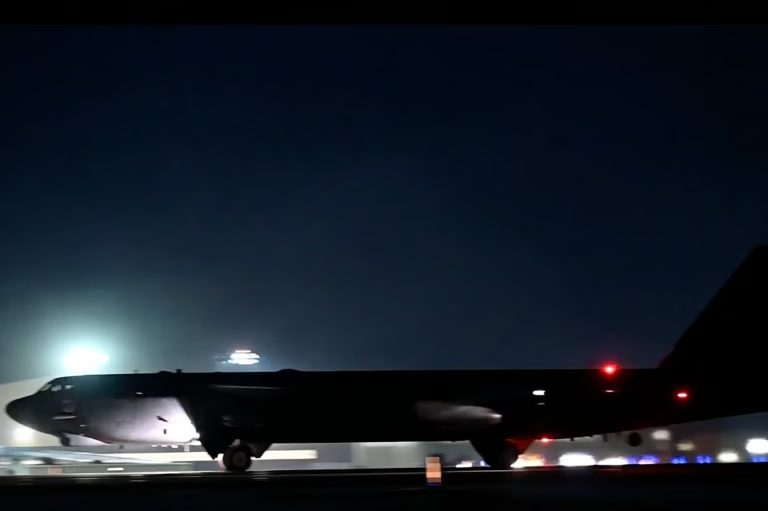
Storage and handling practices at bases such as Al Udeid Air Base demonstrate the system’s maturity. SDBs are integrated into U.S. war reserve stocks, with dedicated carriages holding four munitions each. This organization reflects a focus on standardization and networked employment in modern air operations.
The U.S. approval for South Korea strengthens regional security by enhancing strike capabilities and improving interoperability with allied forces. As a central player in Northeast Asian stability, Seoul’s improved precision strike capacity contributes to a credible deterrence posture and helps manage risks of escalation in the Indo-Pacific security environment.
About The Author