The United States has approved a $100.2 million Foreign Military Sale to Japan to sustain and upgrade the Japan Maritime Self-Defense Force’s Aegis-equipped destroyers, reinforcing their readiness for air, missile, and undersea warfare amid rising security pressures in the Western Pacific.
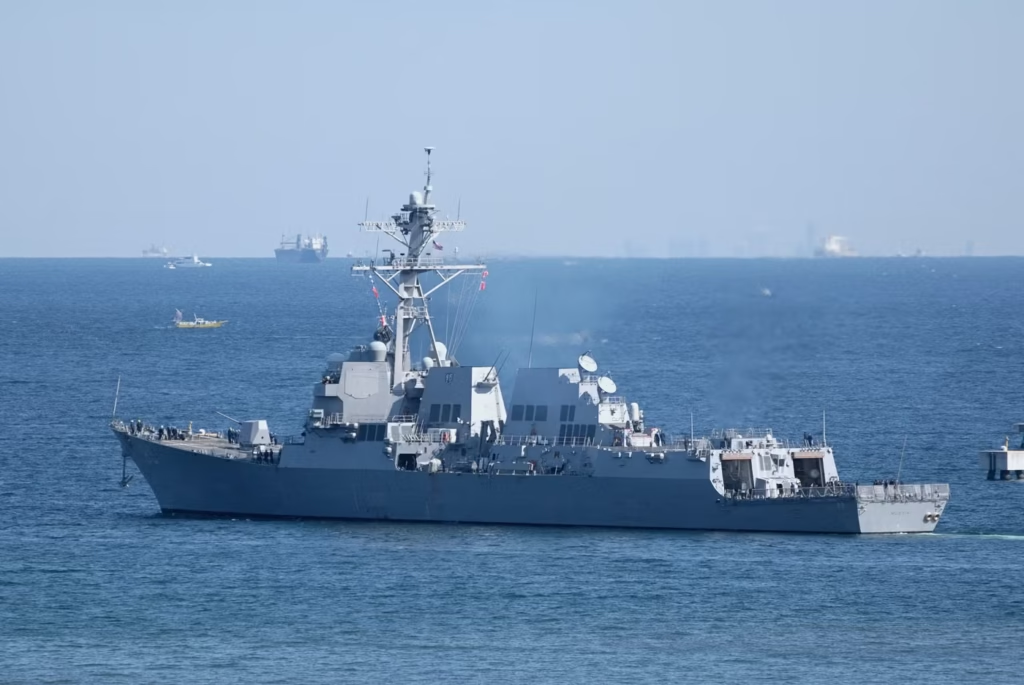
The U.S. State Department has approved a potential $100.2 million Foreign Military Sale to Japan for sustainment and technical support of the Japan Maritime Self-Defense Force’s Aegis-equipped destroyers, according to a Defense Security Cooperation Agency (DSCA) announcement dated December 16, 2025. Submitted to Congress under case number 26-10, the proposed sale focuses on combat system trials, software upgrades, engineering services, and systems integration, with Lockheed Martin of Moorestown, New Jersey, designated as the prime contractor.
The DSCA notification outlines follow-on technical assistance centered on Combat Systems Sea Qualification Trials (CSSQT), test and evaluation support, Aegis combat system software updates, integration and testing activities, in-country engineering support, urgent technical assistance, system refurbishments, and the development, testing, and installation of software patches and adaptation data. No offset agreements are currently planned, and the implementation does not require the deployment of additional U.S. government personnel to Japan.
For the JMSDF, sustainment support is directly tied to operational credibility, as the Aegis Weapon System functions as a software-driven, integrated kill chain. Japanese Aegis destroyers play a central role across air defense, ballistic missile defense, and escort missions, making readiness essential. The request emphasizes maintaining the safety and effectiveness of the Aegis Combat System through rigorous CSSQT services, which validate crew proficiency and system performance following upgrades, repairs, or new configuration baselines.
The operational stakes are significant. Japan’s Aegis destroyers are equipped with Mk 41 Vertical Launch Systems configured for layered, multi-mission defense, typically combining Standard Missile variants for air and ballistic missile defense with RUM-139 ASROC for anti-submarine warfare. Atago-class destroyers, for instance, feature 96-cell Mk 41 launchers capable of deploying SM-2, SM-3, and ASROC munitions, all coordinated through the Aegis architecture built around the AN/SPY-1D phased-array radar and ballistic missile defense-capable software.
Undersea warfare is equally critical amid growing concern over China’s expanding and more assertive submarine operations. The support package reinforces Japan’s ability to employ the AN/SQQ-89A(V)15J undersea warfare combat system, which integrates hull-mounted sonar, multi-function towed arrays, and open-architecture processing while interfacing directly with Aegis. This integration enables Aegis destroyers to maintain air or missile defense missions while simultaneously detecting and prosecuting submarine threats using shipboard weapons and embarked helicopters.
From an industrial and strategic perspective, the sale strengthens interoperability between the JMSDF and the U.S. Navy at a time when integrated air and missile defense is being pursued as a combined operational concept. Lockheed Martin’s Aegis technical enterprise in Moorestown continues to anchor this effort, supporting systems integration, testing, and operational evaluations across U.S. Navy, Missile Defense Agency, and allied platforms. For Japan, this ensures continued compatibility with U.S. digital architectures that support cooperative tracking, coordinated engagements, and rapid software adaptation as threat environments evolve.
Japan’s decision comes amid heightened regional tensions. Over the past year, Tokyo has faced increased friction with China around contested maritime areas, including persistent Chinese coast guard activity near the Senkaku Islands and expanded Chinese naval and air operations near Japan’s southwestern approaches. High-profile Chinese carrier deployments have prompted sustained JMSDF surveillance missions, reinforcing concerns over escalation management and early warning in a potential crisis.
These pressures have accelerated Japan’s defense spending trajectory. The government has moved to fast-track its goal of raising defense expenditures to 2% of GDP, supported by supplementary budgets approved in late 2025. This reflects a growing political consensus that deterrence in the Western Pacific requires sustained and immediate investment rather than gradual increases.
Within this broader context, the $100.2 million Aegis sustainment case represents a focused investment in readiness. While new ships and missiles attract attention, combat credibility ultimately depends on system availability, software integrity, and trained crews. By prioritizing engineering support, rigorous trials, and continuous software sustainment, Japan is ensuring that its Aegis destroyers remain capable of operating effectively within the compressed decision and engagement timelines that would characterize any future Western Pacific contingency.
About The Author