The U.S. Air Force’s Stand-in Attack Weapon program advanced significantly on December 11, 2025, as an F-16 at Eglin Air Force Base completed the first successful separation test of Northrop Grumman’s new strike missile. The milestone marks SiAW’s transition from digital design to real-world flight testing, paving the way for future integration with fifth-generation fighters like the F-35.
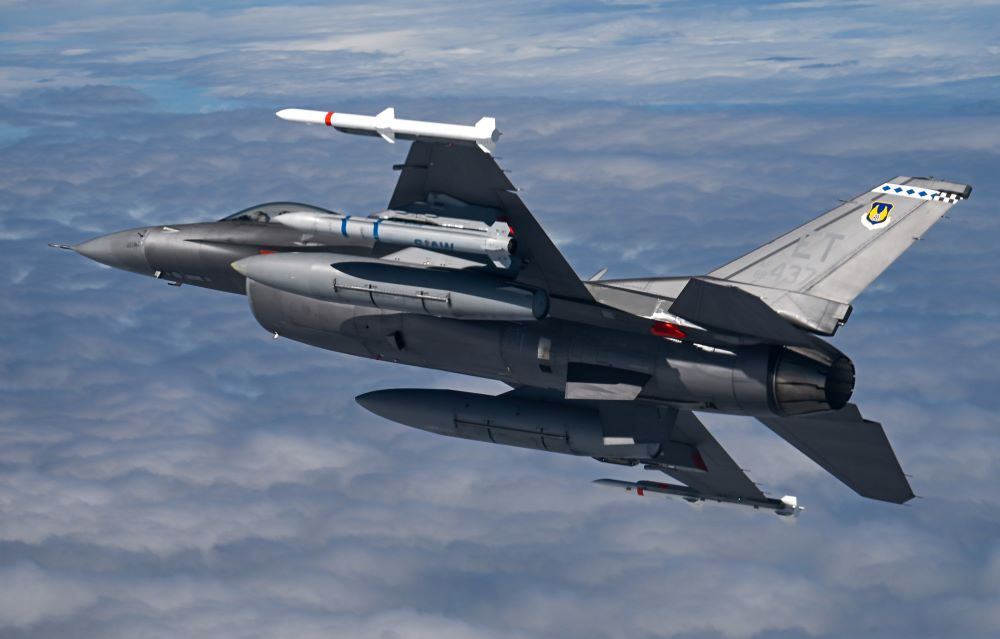
On December 11, 2025, only days after the U.S. Air Force announced a new ceiling-value contract to accelerate development of next-generation strike weapons, the Stand-in Attack Weapon (SiAW) program achieved a major test milestone. At Eglin Air Force Base, an F-16 Fighting Falcon successfully released Northrop Grumman’s SiAW during a separation test that verified safe carriage and a clean, stable release. This marks SiAW’s transition from digital design and captive-carry planning into real aerodynamic testing—an essential step toward eventual integration with fifth-generation aircraft. Northrop Grumman confirmed the achievement the same day, following earlier contracting developments reported by Army Recognition
The separation test focused on validating safe release characteristics and capturing aerodynamic and flight-dynamics data at the moment the weapon leaves the aircraft. This step is often decisive, as it determines whether a program can confidently progress from captive-carry evaluations to guided flight tests. According to officials from the Air Force Life Cycle Management Center, the test served both as a safety check and as an opportunity to gather performance data to refine post-release behavior. Northrop Grumman characterized the milestone as proof of design maturity and a necessary step toward fielding an operational system.
SiAW supports a mission area the Air Force has prioritized for contested environments: a precision air-to-ground weapon designed to strike time-sensitive, high-value targets protected by advanced air defense networks. Northrop Grumman describes it as a tool to counter anti-access/area-denial architectures by rapidly engaging mobile or relocatable threats. Its development leverages digital engineering and an open-architecture framework to enable fast updates as adversary systems evolve. The weapon is intended to expand the set of targets that stealth and survivable aircraft can engage inside defended airspace.
Although the F-16 isn’t SiAW’s final operational platform, it remains an ideal testbed. Its well-understood flight profile and mature instrumentation make it valuable for analyzing weapon separation before moving to the more complex challenge of integration with stealth aircraft. Earlier reporting noted multiple F-16-based drop trials at Eglin, capturing separation imagery, telemetry, and diagnostics. This phased approach reduces risk and establishes the aerodynamic baseline required for eventual internal-bay integration with fifth-generation aircraft like the F-35.
SiAW’s development timeline reflects the Air Force’s broader shift toward faster acquisition cycles. After launching early competition in 2022, the Air Force awarded Northrop Grumman a roughly $705 million contract for the next development phase, with work centered in Northridge, California and scheduled to conclude by late fiscal year 2026. A test article delivered in 2024 began captive-carry and separation preparations, including F-16 release events over the Gulf of Mexico. These steps paved the way for the 2025 separation milestone, which in turn supports future F-35 integration.
Operationally, SiAW is not intended to replace all air-to-ground weapons. Instead, it is designed for the most demanding phase of high-end conflict, when forces must rapidly strike critical mobile targets protected by modern air defenses. While standoff cruise missiles can attack from afar, they are often unsuitable for fleeting, relocatable targets. Conventional guided bombs, though effective, require aircraft to get within threat rings. SiAW’s “stand-in” concept enables survivable aircraft to operate closer to contested zones, maintain low observability, and engage time-sensitive targets without forcing planners into choosing between high-risk approaches or expensive standoff salvos. Its open-architecture design supports rapid modernization against evolving air defense networks.
Strategically, the SiAW program reflects a shift in airpower planning toward environments defined by layered air defenses, electronic warfare, and mobile precision-fire systems. Public reporting has linked its target set to key nodes supporting anti-access/area-denial systems. Northrop Grumman’s broader strike portfolio illustrates how allied requirements increasingly converge around similar operational challenges. For coalition planners, SiAW represents a way to shorten the kill chain against mobile assets, bridging the gap between suppressing enemy air defenses and dismantling their supporting infrastructure.
Financially, SiAW is a major acquisition priority rather than an experimental effort. The initial $705 million development award set the stage for a prototyping phase valued at around $1.14 billion. The Air Force plans to procure roughly 400 missiles by FY2028, with long-term purchases likely numbering in the thousands. Complementary contract details highlight a $100 million ceiling agreement supporting SiAW and AARGM-ER work, funded through fiscal 2025 R&D accounts. Northrop Grumman remains the central lead driving the program through separation testing, integration, operational evaluations, and future fielding.
The F-16 separation milestone demonstrates a central truth of weapons development: progress is proven through safe release mechanics, repeatable data, and validated flight behavior—not program concepts or artwork. By pairing major contracts with disciplined test events, the Air Force is guiding SiAW through critical decision points that determine whether a fast-track program can become a fully fieldable and upgrade-ready capability. If upcoming tests reaffirm these early results, SiAW will be positioned for integration with low-observable platforms and for delivering a flexible strike option across the future force.
About The Author