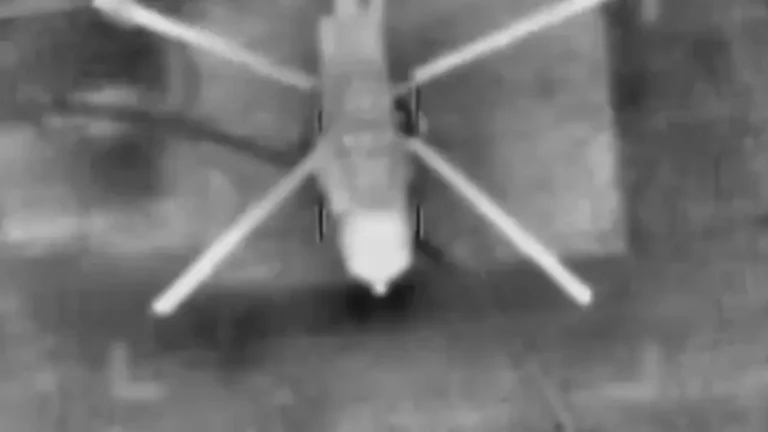
Marine AH-1Z Viper crews from HMLA-267 carried out close-air-support drills during Steel Knight 25 at Camp Pendleton on 2 December 2025, training that takes on added significance as U.S. forces track rising tensions around Venezuela and prepare for rapid crisis response in the Caribbean.
On 2 December 2025, AH-1Z Viper crews from Marine Light Attack Helicopter Squadron 267 (HMLA-267) at Marine Corps Air Station Camp Pendleton carried out a close-air-support mission during the Steel Knight 25 exercise, according to images released by DVIDS. The sortie practiced rapid, precise fires in support of a Marine Air-Ground Task Force operating in contested terrain. With tensions between the United States and Venezuela escalating—and U.S. naval and Marine forces already positioned in the Caribbean—the training links routine operations in California to potential real-world crisis-response missions off Venezuela.
At Camp Pendleton, the Steel Knight 25 scenario is designed to test 3rd Marine Aircraft Wing’s ability to deliver time-sensitive, accurate strikes for maneuvering ground forces. Flying AH-1Z Vipers under Marine Aircraft Group 39, pilots White and Bianco train to absorb last-second target changes, coordinate with forward air controllers and unmanned aircraft, and fire from simulated small, dispersed expeditionary bases. The focus is on operating as they would in a distributed fight: rapid rearm-and-refuel cycles, shifting command-and-control nodes, and aviation fires synchronized with infantry and artillery so the MAGTF can advance or disengage. Recent Steel Knight iterations have expanded to include long-range strikes, sea-denial missions, and complex air-tasking, effectively turning southern California into a proving ground for multi-domain operations envisioned in both the Pacific and the Caribbean.
At the center of this approach is the AH-1Z Viper. Derived from the Cobra family but upgraded with a four-bladed rotor, modern avionics, and an integrated sensor-weapons suite, the Viper is optimized for littoral and ship-to-shore missions. Armed with a 20 mm cannon, guided rockets, and precision weapons such as the AGM-114 Hellfire or, in some setups, the Joint Air-to-Ground Missile, the Viper can engage armored vehicles, small vessels, or fortified positions from stand-off ranges. Operating from amphibious assault ships or forward bases, AH-1Zs conduct armed reconnaissance, escort MV-22B Ospreys and CH-53K heavy-lift helicopters, and provide rapid close-air support to Marines ashore. During Steel Knight, the helicopters connect into a broader kill web that may include fixed-wing aircraft, naval surface fires, and ground sensors—refining tactics to track and engage mobile maritime and land targets across wide areas. The work is less about isolated crew drills and more about integrating Vipers into Navy and joint C2 networks in environments where communications may be degraded or contested.
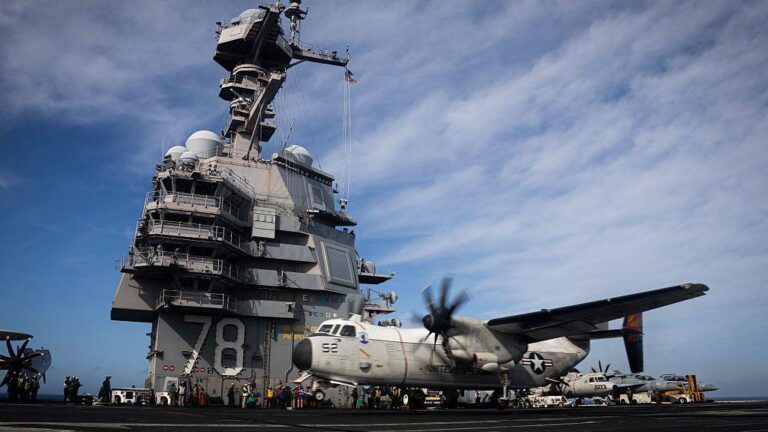
These efforts unfold as the U.S. mounts its largest naval and Marine posture in the Caribbean in decades. Since late summer 2025, Washington has deployed warships and Marine units to the southern Caribbean as part of an operation targeting “narcoterrorist” networks linked to Venezuela’s leadership. By late September, the force included about ten major vessels—an amphibious assault ship, amphibious transport docks, several guided-missile destroyers, and a cruiser—supported by a fast-attack submarine and the special operations ship MV Ocean Trader. Many of these platforms can launch Tomahawk cruise missiles, giving U.S. commanders deep-strike options inside Venezuela. With the arrival of the carrier USS Gerald R. Ford and its escorts, U.S. personnel in the region have grown to roughly 15,000—a concentration of air and sea power not seen since the 1989 Panama intervention.
Caracas has countered with its own exercises and sovereignty-focused statements, adding to the tense security climate. Against this backdrop, the deployment of amphibious ships and Marine aviation units—including AH-1Z detachments capable of close-air support from sea-based platforms—highlights the practical value of the drills in California. Steel Knight 25 demonstrates how crews trained at Camp Pendleton could be tasked with delivering tailored fire support, armed overwatch, and escort missions in a Caribbean contingency, using procedures already rehearsed under realistic conditions.
The image of HMLA-267’s Viper crews stepping out for a Steel Knight mission reflects the unit’s strong readiness posture. Each flight sharpens close-air-support, armed-reconnaissance, and littoral-strike techniques while stress-testing the AH-1Z’s sensors, weapons, and communications in a simulated contested environment. Through rapid turnarounds, tight coordination with ground controllers, and integration into broader command-and-control networks, 3rd Marine Aircraft Wing keeps its Viper pilots prepared to transition from training in California to potential real-world missions in the Caribbean with well-established tactics, techniques, and procedures.
About The Author