Deep in the humid dark of a Yamaguchi prefecture runway, the scream of a Pratt & Whitney F135 afterburner rips the silence at 2:17 a.m. An F-35C Lightning II—call sign “Vader 11”—drops like a stone from 1,200 feet, hook scraping the painted “meatball” on the mobile carrier deck simulator. Tailhook snags the wire. The jet yanks to 0–150 knots in 2.1 seconds. The pilot’s head snaps forward, visor flashing green in the HUD. Another “OK 3” trap logged. Multiply that by 400+ arrests over four sleepless nights, and you’ve got the U.S. Navy’s 7th Fleet turning Marine Corps Air Station Iwakuni into the sharpest knife in the Indo-Pacific drawer.
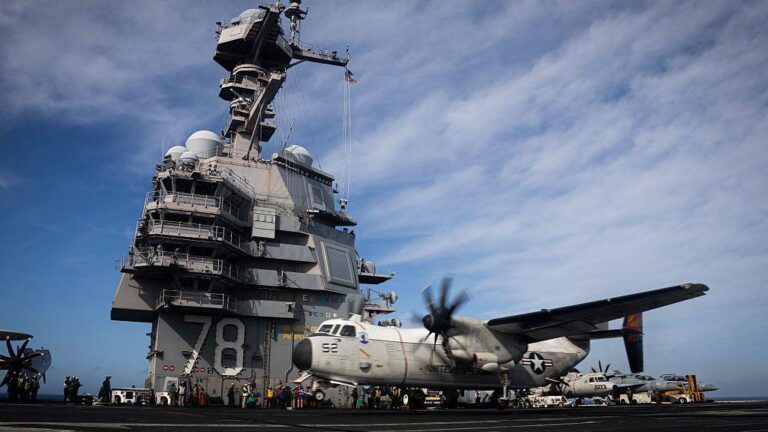
This wasn’t a routine field carrier landing practice (FCLP) evolution. From November 10–14, pilots from VFA-147 “Argonauts” and VFA-115 “Eagles”—both forward-deployed to Iwakuni with Carrier Air Wing 5 aboard USS George Washington—executed the most intense night carrier qualification syllabus seen outside a war zone. Day ops ran 0800–1600; night ops kicked off at 2200 and wrapped at 0400. No weekends, no weather days, no mercy. The goal: certify 18 new pilots and refresh 12 veterans for full-cycle carrier ops in the Philippine Sea, where Chinese J-15s and H-6K bombers have been probing the First Island Chain daily.
The setup at Iwakuni is a masterclass in expeditionary realism. Runway 02L/20R is marked with a 300-foot “flight deck” complete with arresting wires, fresnel lens optical landing system (FLOLS), and even simulated catapult spools. Mobile LSO shacks—basically shipping containers on steroids—house the same paddles and PLAT cameras used on a Nimitz-class deck. Add in the roar of ground-run F135s echoing off the Seto Inland Sea hills, and you’d swear you were 200 miles offshore. The only giveaway? No pitch, no roll, no 30-knot wind over deck. Everything else is identical, right down to the green deck lights and the salty banter on UHF Guard.
Each pilot faced a gauntlet: 6 day touches, 6 night touches, 4 “no-radio” emergency patterns, and 2 bolters per session. Night traps are the great equalizer—visibility drops to 500 feet, the meatball becomes a pinprick, and the runway lights vanish into Japan’s coastal haze. One Argonaut pilot, Lt. “Bambi” Chen, logged his 100th lifetime trap at 0332 on Wednesday, earning the traditional “century club” patch and a bottle of sake from the squadron skipper. “It’s like threading a needle while someone shakes the table,” he laughed post-flight, still in his G-suit. “But do it 400 times, and the jet becomes an extension of your spine.”
The F-35C’s tech stack is the secret sauce. The Delta Flight Path system auto-throttles to maintain perfect glideslope; the helmet-mounted display overlays a ghostly “highway in the sky” even when the real runway is blacked out. DAS infrared pods give a 360-degree God’s-eye view, spotting the LSO waving off a bad pass before the human eye registers. And the auto-land mode—still classified for carrier use—lets the jet grease the deck within 18 inches of centerline 99.7 % of the time in tests. None of that replaces stick-and-rudder feel, though. As one grizzled LSO put it: “The computer can fly the jet. We teach the pilot to fight the jet.”
Why Iwakuni, why now? Timing is everything. George Washington chopped to 7th Fleet in August after a brutal RCOH, and CVW-5 needed a surge before the carrier’s next patrol. The Philippine Sea has seen 40+ unsafe intercepts since June—PLA fighters buzzing P-8s, J-10s locking up Japanese F-15Js over the Senkakus. Add North Korea’s new solid-fuel IRBM tests and Russia’s Tu-95s transiting the Tsushima Strait, and the region’s air picture looks like a hornet’s nest. The Navy’s answer: compress the entire CQ syllabus into one week, ashore, so the carrier can steam fully combat-ready.
The numbers are brutal. 42 pilots, 28 jets, 1,200+ arrested landings, zero mishaps. Fuel burn: 1.2 million pounds of JP-5 trucked in from Sasebo. Ordnance: none live, but every jet carried a full CATM loadout—captive air training missiles—to simulate weight and balance. Maintenance crews worked 18-hour shifts, swapping LRUs under floodlights while monsoon rain hammered the flight line. One F-35C threw a hydraulic caution at 0200; the jet was back airborne by 0515. That’s the kind of turnaround that wins wars.
The ripple effects are already hitting the region. JASDF F-35As from Misawa flew dissimilar air combat training (DACT) against the Navy birds on Thursday, practicing beyond-visual-range merges with AIM-120D-3s. ROKAF F-35As joined via Link 16 from Osan, sharing a common tactical picture that stretched from Hokkaido to Busan. Even the Aussies sent a Wedgetail E-7 over the East China Sea, feeding radar tracks to the LSOs in real time. It’s JADC2 in action—joint all-domain command and control—and Iwakuni just became the proving ground.
For the pilots, the payoff is simple: confidence. When George Washington launches its first night cycle in December, these aviators won’t be thinking about the ball or the burble. They’ll be hunting. And somewhere over the horizon, a PLAN carrier group will feel the heat.
About The Author