Why the US Is Deploying the Merops Counter-Drone System Now
The United States is strengthening its air-defense posture in the Middle East by deploying a new counter-drone system designed specifically to stop waves of low-cost attack drones. The system, known as Merops, is expected to provide American forces and regional partners with a cheaper and more flexible way to intercept Iranian-style drones that have become a major threat in modern conflicts.
Military planners say the move reflects a growing realization: traditional missile defenses are extremely effective against ballistic missiles but are far less efficient when facing large swarms of inexpensive unmanned aircraft.
A New Layer in Air Defense
The deployment comes amid ongoing tensions following Operation Epic Fury, which began on February 28 and targeted critical Iranian military infrastructure. The strikes focused on command networks, naval assets, and missile facilities in an effort to weaken Iran’s ability to coordinate regional attacks.
In response, Iran reportedly relied heavily on waves of drones and missiles aimed at targets across the Middle East, including energy facilities, ports, and airbases. Several Gulf states reported intercepting hundreds of incoming drones in a short period of time.
The growing use of drone swarms has forced Washington to rethink its defensive strategy. Instead of relying solely on expensive missile systems like Patriot Missile System and THAAD Missile Defense System, the United States is now introducing a lower-cost interception layer that can deal with mass drone attacks more efficiently.
That role is now expected to be filled by the Merops counter-UAS system.
How the Merops System Works
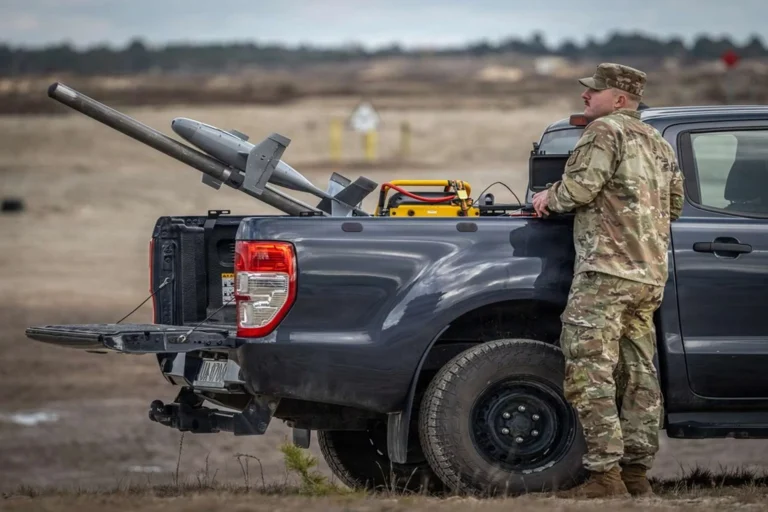
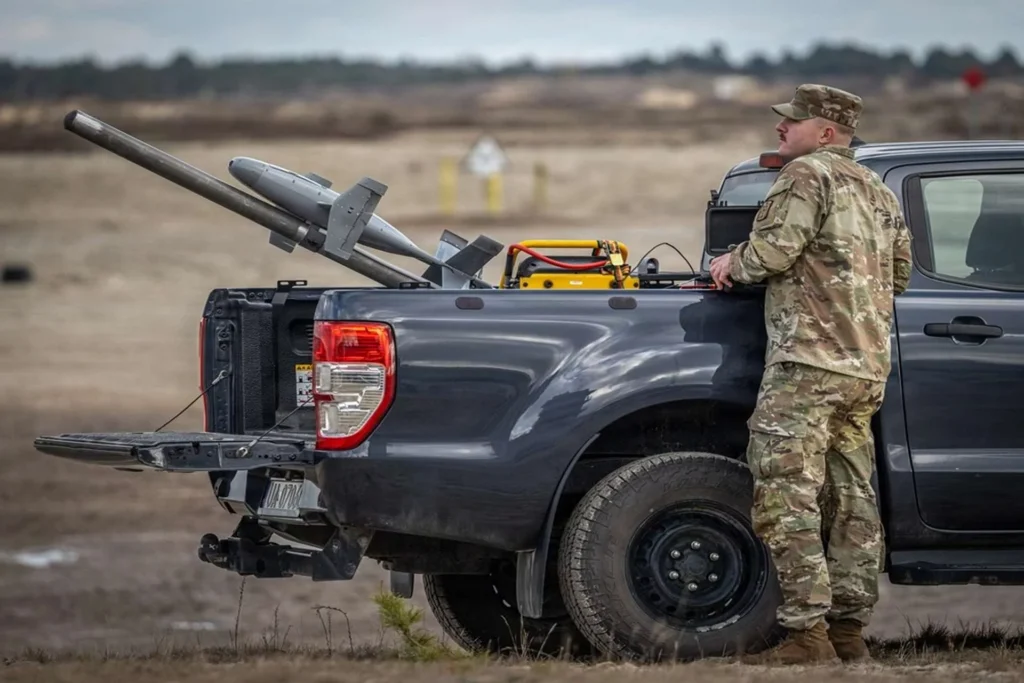
Merops is a compact anti-drone platform built around a high-speed interceptor aircraft known as Surveyor. The system includes launch equipment, a mobile control station, and connections to radar or sensor networks that provide targeting data.
One of the system’s biggest advantages is mobility. Merops can be launched from a simple rail mounted on the back of a pickup truck, allowing it to be deployed quickly at temporary bases, ports, or critical infrastructure sites.
Once launched, the Surveyor interceptor can track enemy drones using multiple guidance methods, including radio-frequency detection, radar cues, and thermal signatures. This flexibility makes it effective even in environments where electronic warfare disrupts GPS or communication signals.
During demonstrations with NATO forces in Poland, the system was integrated with the Italian RPS-42 radar, proving that it can operate within a wider air-defense network rather than functioning as a standalone weapon.
Designed for the Economics of Drone Warfare
One of the biggest challenges facing modern air defenses is cost imbalance.
High-end missiles used by systems like Patriot can cost hundreds of thousands or even millions of dollars per shot. When those missiles are used against inexpensive drones, defenders quickly run into economic and logistical problems.
Merops is designed specifically to solve that issue.
Each Surveyor interceptor reportedly costs roughly $14,500 to $15,000 and can travel at speeds exceeding 175 miles per hour. The interceptor can destroy a drone either by direct collision or by detonating a small proximity warhead near the target.
If the interceptor does not engage a target, it can descend by parachute and be recovered for reuse.
This cost structure is particularly important when defending against drones such as the Shahed‑136, which are estimated to cost between $20,000 and $50,000 each.
By using relatively inexpensive interceptors, defenders can maintain a sustainable cost balance during prolonged drone attacks.
Combat Experience in Ukraine
The Pentagon’s confidence in the Merops system is partly based on its operational record in the war in Ukraine.
Reports from NATO and defense analysts suggest the system has already intercepted large numbers of Russian-operated Shahed-type drones. Some estimates claim that more than 1,000 drones have been destroyed using the system or similar interceptors.
Field reports suggest interception success rates approaching 95 percent against large one-way attack drones.
The system has also been deployed in Eastern European NATO states such as Romania and Poland after Russian drones occasionally crossed into alliance airspace.
Those deployments demonstrated that the technology is mature enough for real-world defensive operations.
Why Iran’s Drones Are a Serious Threat
Iran’s Shahed-series drones have become a key element of modern drone warfare.
The drones typically fly at speeds around 180 kilometers per hour, carry roughly 40 kilograms of explosives, and can travel distances approaching 2,000 kilometers. This combination allows them to threaten military bases, airports, and energy infrastructure across large areas.
Because they are relatively inexpensive and easy to mass-produce, they can also be launched in large numbers to overwhelm air defenses.
This “swarm attack” strategy forces defenders to expend large numbers of expensive interceptors, which is exactly the problem Merops is intended to solve.
Not a Perfect Solution
While Merops is effective against larger drones, analysts note that it is not designed to counter every type of unmanned threat.
Very small quadcopter-style drones, particularly fast first-person-view (FPV) drones flying at low altitude, remain difficult to detect and intercept using this type of system.
For that reason, Merops is expected to operate alongside other defensive tools, including radars, optical sensors, and electronic warfare systems.
Together, these layers form a more comprehensive defense network capable of responding to multiple types of aerial threats.
A Strategic Shift in Air Defense
The decision to deploy Merops highlights a broader shift in military thinking.
Conflicts in Ukraine and the Middle East have demonstrated that modern warfare increasingly relies on large numbers of inexpensive drones, which can exhaust even advanced air-defense systems.
By introducing a lower-cost interceptor layer, the United States hopes to preserve high-end missile systems for more dangerous threats such as ballistic missiles or advanced aircraft.
For commanders on the ground, the arrival of Merops could provide something that has been missing during recent drone attacks: time and breathing room to respond before defenses are overwhelmed.
About The Author