The U.S. Navy unveiled specifications for its new FF(X) frigate at the Surface Navy Association (SNA) symposium 2025, highlighting a design focused on reduced complexity, faster acquisition, and restoring fleet capacity after the cancellation of the Constellation-class frigate.
On January 15, 2026, Chris Cavas reported that the U.S. Navy released an official concept graphic for the FF(X) frigate during the Surface Navy Association symposium, outlining a new small surface combatant planned for contract award in 2026. The graphic confirms that the FF(X) design is based on the Legend-class National Security Cutter hull with limited structural changes to reduce technical risk and accelerate acquisition. It also provides the first set of specifications for the new U.S. Navy frigate.
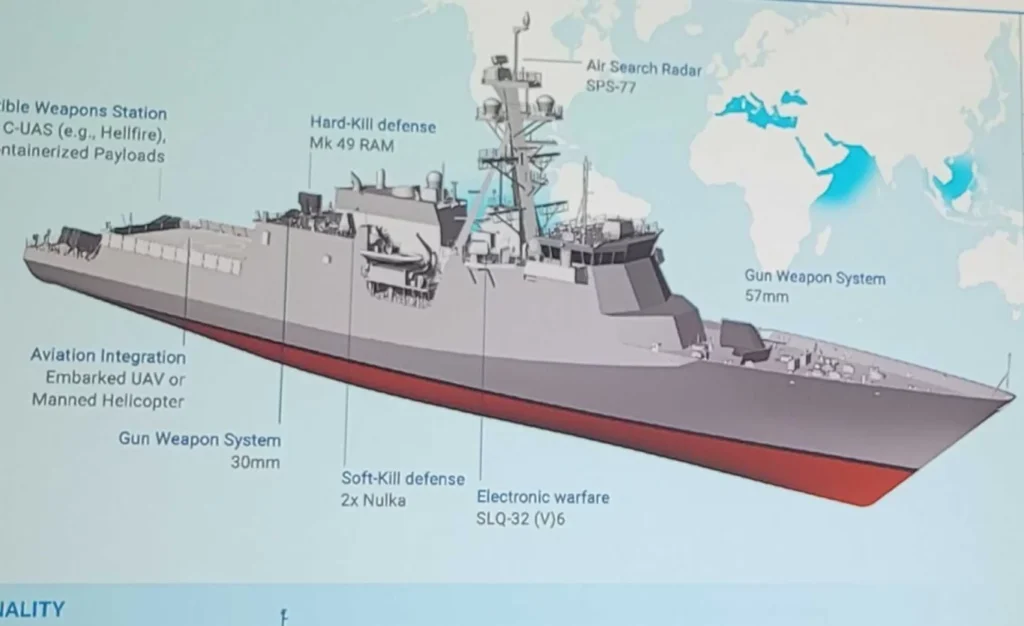
The FF(X) is positioned as a rapid replacement following the termination of the Constellation-class frigate program, while remaining smaller and less complex than an Arleigh Burke-class destroyer. The overall concept suggests a ship focused on restoring fleet numbers and endurance rather than replicating the high-end combat role of destroyers.
The FF(X) layout emphasizes a Flexible Weapons Station located aft, which can carry Naval Strike Missiles, counter-unmanned systems such as Hellfire missiles, or containerized payloads depending on mission needs. This modular approach differs from the Arleigh Burke-class and Constellation-class, which are built around a traditional vertical launch system for air defense, anti-submarine warfare, and strike missions. Compared with the Coast Guard’s Legend-class cutter, which has limited armament, the FF(X) shifts toward surface strike, escort defense, and layered self-protection missions.
The graphic lists the FF(X)’s missile load as up to 16 Naval Strike Missiles or, alternatively, a 48-cell Hellfire counter-UAS load, paired with a single 21-cell Rolling Airframe Missile launcher.
Defensive and sensor systems shown include the SPS-77 air search radar, the SLQ-32(V)6 electronic warfare suite, two Nulka active decoy launchers, and a Mk 49 RAM launcher for hard-kill defense. This combination aligns with escort support, maritime interdiction, and counter-unmanned missions rather than the area air defense role of a destroyer. The FF(X) concept reduces system complexity in favor of faster production and modular growth, while adding dedicated missile defense and electronic warfare systems compared with the Legend-class cutter, indicating a shift toward contested environments.
The FF(X) gun armament includes a 57mm main gun and a 30mm secondary gun, supporting close-in defense and maritime security. The design balances guns with a configurable missile fit, unlike Arleigh Burke destroyers that rely mainly on missiles. The Constellation-class was expected to feature a more complex weapons suite tied to larger displacement, whereas the FF(X) focuses on a simpler configuration for faster serial production. The inclusion of containerized mission packages further supports capability changes between deployments without structural redesign.
Aviation and unmanned integration are central to the FF(X) concept, with capacity for either a manned helicopter or unmanned aerial vehicles. The mission set includes unmanned command-and-control, suggesting the frigate is intended to act as a coordination node for unmanned systems. While Arleigh Burke-class ships and Constellation-class ships also support aviation and unmanned assets, the FF(X) places unmanned coordination more prominently. Compared with the Legend-class cutter, the FF(X) assigns aviation directly to combat escort, interdiction, and counter-UxS tasks, reflecting a shift toward manned-unmanned teaming in surface warfare.
The specifications panel lists a length of 421 ft (128.3 m), beam of 54 ft (16.5 m), draft of 22 ft (6.7 m), and displacement of 4,750 tons, with a maximum speed of 28 knots, endurance of 60 days, and range of 12,000 nautical miles. These figures place the FF(X) below the size of an Arleigh Burke destroyer and smaller than the Constellation-class estimates near 8,000 tons, while closely matching the Legend-class cutter baseline. The listed crew of 148 supports aviation and mission packages while maintaining manageable manning. The optionality section defines the FF(X) size range as 350 to 450 ft, alongside unmanned vessels from 75 to 250 ft as part of a mixed manned-unmanned force structure.
The program’s notional class size is 50 to 65 ships across multiple flights, indicating an ambition to make the frigate a major component of the surface fleet. This scale differs from the smaller Constellation-class effort and complements Arleigh Burke destroyers for high-end missions. The mission set includes surface warfare, offensive surface strike, maritime interdiction, escort support, counter-UxS, and unmanned command-and-control, allowing the frigate to shift between anti-submarine and strike roles across different configurations. By combining a cutter-derived hull, modular weapons stations, and distributed mission concepts, the FF(X) is positioned as a volume platform to restore endurance and coverage across theaters. It sits below destroyers in capability, below the original Constellation vision in complexity, and above the Legend-class cutter in combat orientation, forming a distinct layer within the U.S. Navy surface force.
About The Author