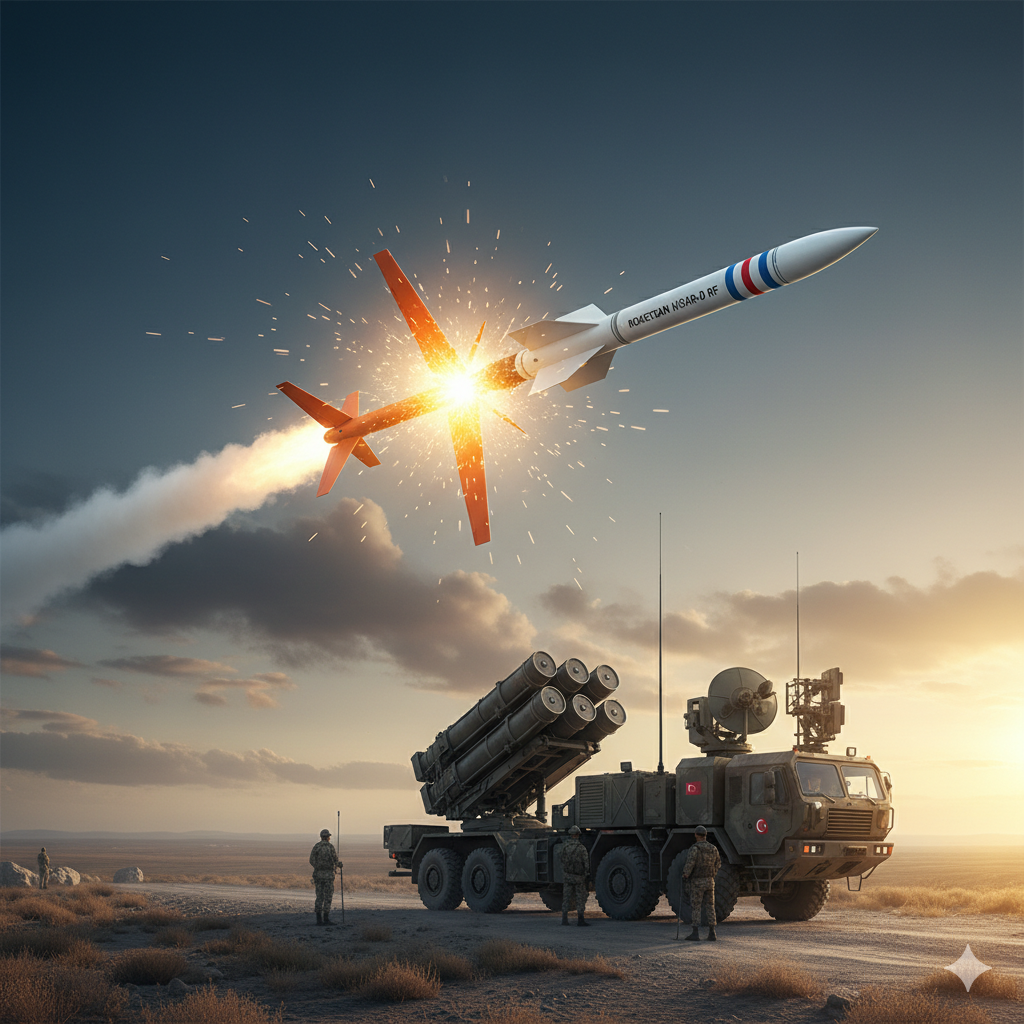
Meta Description: Discover how Roketsan’s Hisar-D RF missile achieved a direct hit in a recent live-fire trial, marking a significant leap forward for Turkish air defense capabilities and showcasing its prowess against advanced aerial threats.The skies over Turkey recently witnessed a groundbreaking achievement in national defense, as Roketsan’s Hisar-D RF (Radio Frequency) air defense missile system successfully completed a demanding live-fire intercept trial. The event, which saw the Hisar-D RF score a direct hit against a high-speed target, represents a monumental leap forward for Turkey’s burgeoning defense industry and underscores the nation’s commitment to securing its airspace against an increasingly complex array of aerial threats.
This latest success is not just a testament to Roketsan’s engineering prowess but also a strong indicator of Turkey’s growing self-sufficiency in critical defense technologies. The Hisar family of air defense systems, which includes the Hisar-A (low altitude) and Hisar-O (medium altitude) variants, has been a cornerstone of the Turkish Armed Forces’ modernization efforts. The Hisar-D RF, however, elevates these capabilities to new heights, particularly with its advanced radio frequency seeker, designed to provide enhanced accuracy and resilience in contested environments.
A Direct Hit, A Clear Message
The live-fire exercise was meticulously planned to simulate a realistic threat scenario, pushing the Hisar-D RF system to its operational limits. From target acquisition to missile launch and interception, every phase of the mission was executed flawlessly. The moment of impact, a definitive direct hit, resonated not only with the engineers and military personnel present but also sent a clear message to potential adversaries: Turkey’s air defense shield is stronger and more sophisticated than ever.
Understanding the “RF” Advantage
What makes the Hisar-D RF so significant? The “RF” in its designation refers to its Radio Frequency (active radar) seeker. Unlike infrared (IR) guided missiles that rely on heat signatures, an RF seeker actively emits radar waves to detect and track its target. This provides several crucial advantages:
- All-Weather Capability: RF seekers are less susceptible to adverse weather conditions like rain, fog, or smoke, which can degrade the performance of IR systems.
- Enhanced Accuracy: Active radar guidance often provides superior accuracy, especially against agile targets or those employing countermeasures designed to spoof IR seekers.
- ECM Resilience: While not entirely immune, RF seekers can be designed with advanced algorithms to counter electronic countermeasures (ECM) that attempt to jam or deceive radar signals.
- Longer Range Potential: Radar systems can typically detect targets at greater distances than passive IR systems, allowing for earlier engagement opportunities.
The integration of this advanced seeker into the Hisar-D platform means the Turkish Armed Forces will possess a more versatile and robust air defense capability, capable of engaging a wider spectrum of threats with higher probability of kill.
A Pillar of Turkish Defense Innovation
This achievement is a direct result of years of dedicated research, development, and investment by Roketsan and the broader Turkish defense ecosystem. The Hisar project, initiated to reduce foreign dependency in air defense, has not only met its ambitious goals but has also become a showcase for Turkish engineering and manufacturing capabilities. From the initial design phase to the production of critical components and rigorous testing, the entire process has been a testament to national industrial strength.
The Hisar-D RF’s success solidifies Turkey’s position as a significant player in the global defense technology arena. It demonstrates the nation’s capacity to develop, produce, and deploy cutting-edge military systems that are competitive with, and in some cases surpass, those developed by more established defense powers.
Looking Ahead: The Future of Air Defense
The implications of the Hisar-D RF’s successful trial extend far beyond this single event. It paves the way for the full-scale integration of the system into Turkey’s layered air defense network, significantly bolstering its protective umbrella. This will provide critical defense against a variety of airborne threats, including combat aircraft, helicopters, cruise missiles, and unmanned aerial vehicles (UAVs).
Furthermore, the experience and knowledge gained from the Hisar-D RF project will undoubtedly inform the development of future Turkish missile systems, pushing the boundaries of what is possible in air defense technology. It underscores a strategic vision: to build a self-reliant and technologically advanced national defense capability that can safeguard Turkey’s interests in an ever-evolving geopolitical landscape.
In conclusion, Roketsan’s Hisar-D RF missile has not just scored a direct hit; it has scored a victory for Turkish innovation, national security, and strategic independence. As the nation continues to invest in its defense industry, the skies over Turkey will remain secure, protected by the ingenuity and dedication of its own people.
About The Author