In a significant declaration for NATO and a proud moment for the British Royal Navy, the HMS Prince of Wales Carrier Strike Group (CSG) has officially achieved combat-ready status. This pivotal certification, confirmed on November 17, 2025, follows an intensive maritime air exercise in the Mediterranean, aptly named Exercise Falcon Strike, which rigorously tested the group’s capabilities across a spectrum of modern warfare scenarios. Royal Navy officials have proudly announced that the carrier, its formidable F-35B Lightning II air wing, and its accompanying escort ships successfully met all stringent requirements for Full Operating Capability (FOC). This includes demonstrating consistent sortie generation rates, seamless layered air defense integration, and absolutely reliable command and control systems, all essential for high-end military operations. With this crucial certification now complete, the UK task group officially joins NATO’s elite ready forces, poised for rapid deployment in times of crisis or conflict.
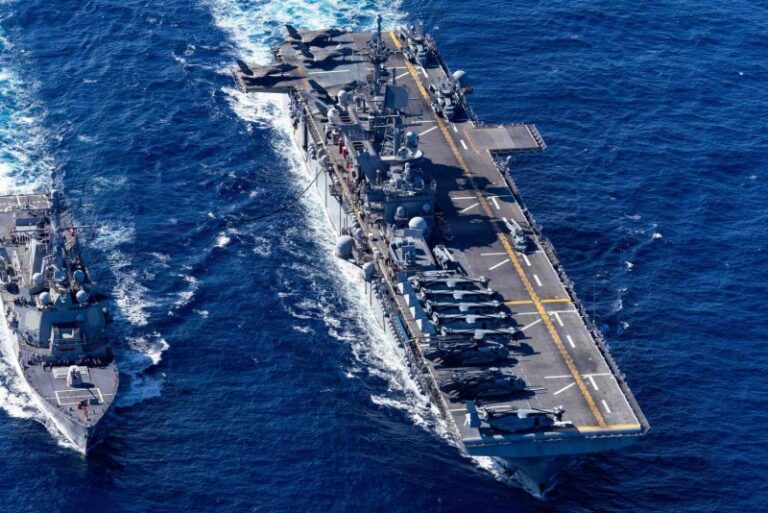
Exercise Falcon Strike was a true showcase of alliance strength and technological prowess. At its heart was the HMS Prince of Wales, operating from the central Mediterranean, which integrated an impressive 24 fifth-generation F-35B stealth fighter jets. This marked the largest concentration of such advanced aircraft ever deployed aboard a UK carrier, a testament to Britain’s commitment to cutting-edge air power projection. These F-35Bs executed nearly 50 coordinated strike and defense sorties, working in tandem with vital NATO allies including Italy, France, Greece, and the United States. The missions undertaken spanned a wide array of combat tasks, from deep strike operations and air interdiction to critical anti-ship defense, pushing the air wing’s capabilities across the full spectrum of contemporary combat.
The performance of the F-35Bs aboard HMS Prince of Wales during these exercises was exceptional. They demonstrated integrated sensor fusion, enabling pilots to gain an unparalleled understanding of the battlespace, distributed lethality across the strike group, and stealth penetration roles in both highly contested and denied environments. Sorties included realistic simulations of suppression of enemy air defenses (SEAD), intricate low-altitude maritime strike scenarios, and robust defensive counter-air missions designed to protect high-value units within the Carrier Strike Group. Crucially, extensive night operations and multinational data-link integration confirmed the aircraft’s readiness to undertake 24/7 NATO tasking, ensuring continuous operational capability regardless of time or conditions.
A particularly vital outcome of these exercises was the validation of seamless interoperability among NATO’s fifth-generation aircraft operating from a British flattop. This was vividly demonstrated as Italian F-35Bs cross-decked with their British counterparts, engaging in shared mission planning and launching synchronized strike packages directly from the deck of HMS Prince of Wales. Such collaborative operations served as a powerful and unambiguous demonstration of alliance combat cohesion within a European theater increasingly characterized by hybrid threats and the presence of near-peer adversaries. This level of integration is not just about sharing technology; it’s about building trust, shared understanding, and a common operational picture that enhances the effectiveness of the entire alliance.
Falcon Strike also meticulously tested the full naval architecture of the UK-led Carrier Strike Group. The formidable task force included the Type 23 frigate HMS Richmond, the Type 45 destroyer HMS Dauntless, and Norway’s Roald Amundsen frigate. These essential escorts provided comprehensive layered air defense, critical anti-submarine warfare coverage, and advanced cooperative engagement capability through NATO’s Link 16 and Cooperative Engagement Capability (CEC) systems. Even HMS Dauntless, while actively engaged in parts of the exercise, maintained its broader commitment by continuing patrols with Standing NATO Maritime Group 2 (SNMG2), ensuring a persistent maritime presence in the vital eastern Mediterranean.
The culmination of Exercise Falcon Strike signifies far more than just another exercise milestone; it represents the operational maturing of HMS Prince of Wales as a full-spectrum NATO asset. Unlike her esteemed sister ship, HMS Queen Elizabeth, which led the groundbreaking 2021 global Carrier Strike deployment, HMS Prince of Wales has now definitively proven her combat integration not only within the framework of UK forces but also as a central and indispensable node within NATO’s joint maritime strike capability. This dual operational validation significantly enhances the alliance’s collective defense posture.
This declaration of Full Operating Capability follows an extensive eight-month global voyage for the UK Carrier Strike Group. During this period, operations included complex and multinational engagements in the Indo-Pacific, working alongside forces from Japan, South Korea, and Australia, underscoring the carrier’s far-reaching operational scope. The strategic return to Europe for a NATO-led exercise highlights the carrier’s dual strategic orientation: simultaneously projecting power and influence in the Indo-Pacific while vigorously reinforcing European security in light of Russia’s continuing aggression in Ukraine. This global reach and flexibility make HMS Prince of Wales an invaluable asset.
HMS Prince of Wales represents more than just a potent symbol of British maritime resurgence; it now functions as a high-readiness, fifth-generation strike platform, possessing the unparalleled agility to deploy globally and conduct joint, combined-arms operations at scale. Designed with an innovative twin-island architecture, future electromagnetic aircraft launch compatibility (though not yet fully implemented), and advanced digital command suites, this 65,000-ton warship offers a future-proofed hub for coalition air power, complex amphibious operations, and the seamless integration of unmanned systems. Its capabilities are designed to evolve with the changing nature of modern warfare.
As NATO confronts a complex array of simultaneous challenges across the Baltic, Black Sea, and Eastern Mediterranean regions, HMS Prince of Wales stands ready not only as a formidable deterrent asset but also as a crucial warfighting centerpiece in any joint task force. The successful deployment of 24 F-35Bs, meticulously integrated into allied kill chains and fused with NATO sensor networks, unequivocally affirms the carrier’s enduring strategic relevance within the alliance’s evolving concept of operations. It is a powerful embodiment of collective defense.
With Exercise Falcon Strike successfully completed and Full Operating Capability definitively confirmed, HMS Prince of Wales now proudly enters the frontline inventory of NATO’s high-readiness force pool. It is strategically positioned to lead future strike missions, critical crisis response operations, and complex joint air-maritime campaigns, bringing with it an unmatched level of airpower integration within the European theater. The United Kingdom’s substantial investment in carrier-enabled power projection has now unequivocally paid significant operational dividends. With the British Royal Navy’s HMS Prince of Wales UK Carrier Strike Group officially declared combat-ready, NATO gains a truly formidable tool for both deterrence and defense amidst a landscape of rising strategic competition.
About The Author