The global defense landscape is constantly evolving, with unmanned aerial vehicles (UAVs) playing an increasingly pivotal role. At the prestigious Dubai Airshow 2025, a significant revelation from China’s Aviation Industry Corporation of China (AVIC) captured the world’s attention: the full-scale model of its new Wing Loong X. This isn’t just another drone; it’s being heralded as the world’s first UAV capable of independently detecting, tracking, and engaging submarines. This bold claim, backed by AVIC and Chinese state media, signifies a potential paradigm shift in anti-submarine warfare (ASW).
The Wing Loong X is meticulously configured for sophisticated ASW operations. It boasts an impressive array of specialized equipment, including sonobuoy dispensers, crucial for acoustic detection of submarines, and lightweight torpedoes for offensive engagement. Beyond these direct combat capabilities, the drone integrates advanced maritime surveillance sensors, providing a comprehensive picture of the underwater environment. This combination of detection, tracking, and strike capabilities in an unmanned platform marks a substantial leap forward, challenging the traditional dominance of manned aircraft and naval vessels in this critical domain.
The introduction of the Wing Loong X has not gone unnoticed by U.S. defense analysts. They view this development as a clear signal of China’s burgeoning ambition to directly challenge Western naval dominance in both undersea and surface warfare. For decades, Western navies have held a significant edge in ASW, relying on highly specialized ships, submarines, and aircraft. The Wing Loong X, if its capabilities are fully realized, could begin to erode this long-held advantage, forcing a reassessment of global naval strategies.
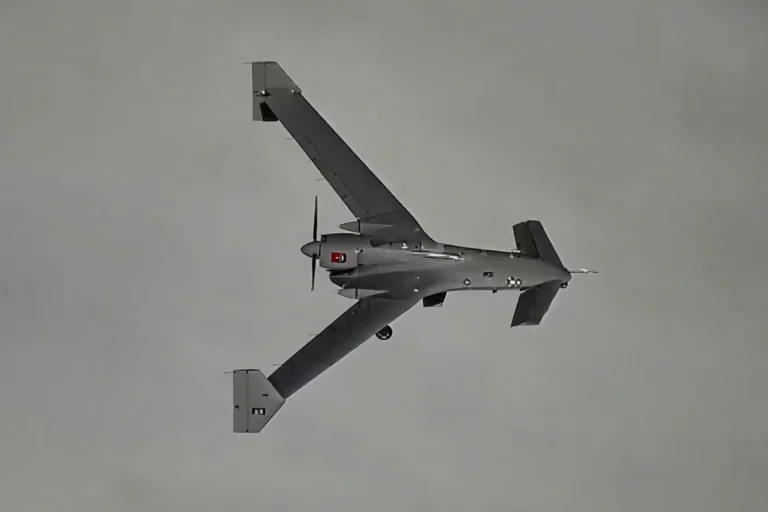
Physically, the Wing Loong X is a formidable machine. With a wingspan exceeding 20 meters, it currently stands as China’s largest and heaviest armed reconnaissance and strike UAV. Its design prioritizes high-altitude, long-endurance (HALE) missions, a characteristic vital for persistent maritime surveillance. The drone boasts a remarkable maximum flight ceiling of 10,000 meters and an operational endurance of up to 40 hours. This extended loitering capability is a critical advantage, allowing the Wing Loong X to maintain an uninterrupted watch over vast maritime zones, from expansive blue-water environments to complex littoral areas, far longer than most manned aircraft.
While its ASW capabilities are groundbreaking, the Wing Loong X is designed as a truly multi-mission unmanned system. Equipped with advanced sensor payloads, it can:
- Deploy sonar buoys: Essential for creating an acoustic net to detect submerged vessels.
- Conduct acoustic analysis: Processing data from sonobuoys to identify and classify submarine signatures.
- Coordinate with other platforms: Real-time data sharing with other airborne or naval assets, enhancing situational awareness and collaborative targeting.
Beyond ASW, its modular armament configuration allows for a diverse range of weaponry, including air-to-air missiles, precision-guided bombs, and, of course, lightweight torpedoes. This versatility positions the Wing Loong X as a genuine multi-domain asset, capable of prosecuting threats across underwater, aerial, and surface environments. AVIC engineers have confirmed that the drone can operate both autonomously and as part of a networked swarm, leveraging artificial intelligence to fuse sonar and radar inputs and execute targeting decisions with minimal human intervention.
The concept behind the Wing Loong X represents a clear and significant strategic pivot for China’s UAV doctrine. Earlier iterations of the Wing Loong series primarily focused on land-attack roles and held significant appeal for export markets. The “X” model, however, reflects an integrated maritime warfare philosophy. Its capacity for persistent presence and networked operations suggests a future where drone formations act as powerful force multipliers, continuously patrolling vital sea lanes and strategic chokepoints. Regions like the South China Sea, the Taiwan Strait, and the Western Pacific are prime examples where the ability to detect and engage submarines from the air, without relying on costly and vulnerable manned patrol aircraft, could profoundly impact the balance of undersea dominance.
While Chinese defense firms have often prioritized capability over transparency, the Wing Loong X appears to introduce a genuine technological inflection point. It successfully blends the impressive endurance and modularity characteristic of Western HALE platforms with a mission set that few other UAVs have even attempted. Chinese media outlets affiliated with the People’s Liberation Army have hinted that the system incorporates onboard AI for real-time target classification and engagement. If these AI capabilities are operationally validated, the Wing Loong X could potentially surpass current NATO unmanned anti-submarine warfare capabilities, which, for the most part, remain limited to sensor deployment and passive tracking.
The unveiling of the Wing Loong X at the Dubai Airshow was met with a mix of interest and scrutiny from international defense observers. The idea of an unmanned aerial platform autonomously detecting and engaging submarines undoubtedly presents a disruptive shift in naval warfare dynamics. However, critical questions persist regarding the system’s maturity, its seamless integration with existing naval command structures, and its ability to function reliably in the inherently complex and unforgiving maritime environments. China’s historical tendency to present advanced systems before their full operational capability has instilled a degree of caution among Western analysts. Until the Wing Loong X is observed in real-world maritime operations, its true effectiveness remains a matter of speculation.
Nonetheless, the introduction of this platform unequivocally underscores Beijing’s determined intent to contest not only the skies but also the depths of future battlefields. By pushing unmanned systems into the traditionally stealth-dominated undersea domain, China is actively challenging established doctrines and accelerating a technological race that has the potential to redefine how navies around the world monitor, deter, and strike beneath the waves.
About The Author