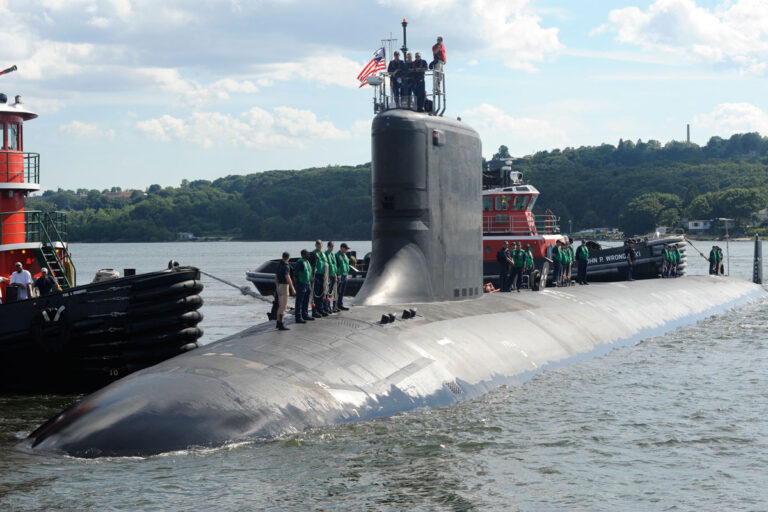
For decades, the United States Navy has prided itself on a “Buy American” philosophy, relying exclusively on a domestic industrial base to forge the steel backbone of its maritime dominance. However, a stark reality check regarding production timelines and capacity shortages is forcing a historic pivot. Faced with mounting delays in critical submarine and destroyer programs, naval leadership is now looking across the Pacific, initiating high-level discussions with shipbuilding titans in South Korea and Japan to help alleviate the bottleneck threatening American naval readiness.
The urgency of this shift cannot be overstated. A recent comprehensive 45-day review ordered by Secretary of the Navy Carlos Del Toro laid bare the uncomfortable truth: the U.S. shipbuilding sector is struggling. Key programs, including the Virginia-class fast-attack submarines, the Columbia-class ballistic missile submarines, and the Constellation-class frigates, are years behind schedule. The domestic shipyards—General Dynamics Electric Boat, Huntington Ingalls Industries, and others—are battling a “perfect storm” of skilled labor shortages, supply chain fractures left over from the pandemic, and an aging infrastructure that simply cannot keep pace with the demand.
In response, the Pentagon is exploring a strategy that would see allies stepping in to shoulder some of the burden. South Korea and Japan are natural partners in this endeavor. Both nations possess world-class shipbuilding capabilities that dwarf current U.S. capacity in terms of speed, efficiency, and modernization. Companies like South Korea’s Hanwha Ocean and HD Hyundai Heavy Industries, along with Japan’s Mitsubishi Heavy Industries, have caught the eye of U.S. officials. These yards are not only churning out commercial mega-vessels but are also producing advanced Aegis-equipped destroyers and diesel-electric submarines that rival the best in the world.
The immediate focus of this collaboration appears to be Maintenance, Repair, and Overhaul (MRO). By outsourcing the maintenance of forward-deployed vessels to Japanese and Korean yards, the U.S. Navy hopes to free up its own clogged domestic dry docks to focus solely on new construction. For instance, if a destroyer based in Yokosuka can be repaired by local Japanese engineers rather than sailing back to the West Coast or Hawaii, it saves time, money, and industrial capacity. Secretary Del Toro has been vocal about this “maritime statecraft,” visiting these Asian shipyards personally to assess their digitalized production lines and modular construction techniques, which are often generations ahead of American practices.
There is also the potential for more direct industrial support. While U.S. law (specifically the Jones Act and various defense statutes) currently restricts the construction of U.S. warships in foreign yards, the conversation is shifting toward the production of modules or specific components. There is even speculation about investing in American subsidiaries of these Asian giants to revitalize dormant U.S. shipyards, effectively importing their management style and technology to American soil.
This strategic realignment is driven by the looming shadow of China. The People’s Liberation Army Navy (PLAN) is expanding at a breakneck pace, aided by a shipbuilding sector that is the largest in the world. Beijing can produce surface combatants at a rate the U.S. currently cannot match. To maintain a credible deterrence in the Indo-Pacific, the U.S. Navy realizes it can no longer go it alone. It must leverage the industrial might of its alliances, treating the shipbuilding capacity of Tokyo and Seoul as an extension of its own defense industrial base.
While the political optics of outsourcing naval work are sensitive, the operational necessity is overriding the hesitation. The integration of Korean and Japanese industrial power into the U.S. supply chain represents a new era of naval cooperation—one where the collective ability to build and repair ships becomes just as important as the ability to fight them.
About The Author