The morning of November 28, 2025, at Skrydstrup Air Base in Denmark marked the beginning of a new chapter in South American aviation history. As the gray dawn broke over the Scandinavian airfield, the roar of six Pratt & Whitney turbofans shattered the silence, signaling the departure of Argentina’s first batch of F-16 Fighting Falcons. These aircraft, once the guardians of NATO’s northern flank, are now embarking on a long, transoceanic journey to their new home in the Southern Hemisphere. For the Argentine Air Force (Fuerza Aérea Argentina, or FAA), this flight is more than just a delivery; it is the culmination of years of negotiation, the restoration of a lost supersonic capability, and a definitive step toward modernizing a military that has long struggled with obsolescence.
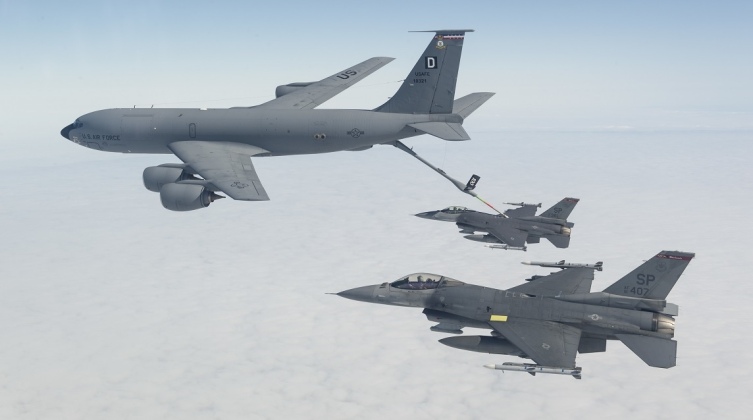
The ferry flight itself is a logistical ballet, requiring precise coordination across three nations. The six jets—comprising four two-seat F-16BMs and two single-seat F-16AMs—took off in two waves, using the callsigns CONDR11 through CONDR16. Their route is a classic Atlantic crossing, but for Argentina, it represents a level of operational complexity not seen in decades. The first leg took them south to Zaragoza, Spain, a familiar waypoint for NATO aircraft, where they touched down for refueling and technical checks. From there, the journey continues to Gando Air Base in the Canary Islands, before the daunting leap across the open ocean to Natal, Brazil. The final leg will see them descend into Área Material Río Cuarto in Córdoba, Argentina, where reception teams are waiting. Supporting this trek is a multinational tanker force, including a U.S. Air Force KC-135 Stratotanker to keep the thirsty jets fed over the water, and Argentina’s own KC-130H Hercules and Boeing 737 transport aircraft, which are ferrying support crews and equipment.
The significance of this acquisition cannot be overstated. Since the retirement of the legendary Mirage III fleet in 2015, Argentina has lacked a true supersonic interceptor, leaving its vast airspace vulnerable and its pilots without a high-performance platform. The F-16s, purchased from Denmark, are set to fill that void. While these are “used” airframes, they are far from worn out. The Royal Danish Air Force maintained these jets to impeccable standards, putting them through rigorous Mid-Life Updates (MLU) that kept their avionics, radars, and weapons systems relevant in a modern battlespace. These are the same aircraft that patrolled the Baltic states, monitored the Arctic, and flew combat sorties over Libya and Afghanistan. Now, they will bring that combat pedigree to the Andes and the South Atlantic.
The package secured by Buenos Aires is substantial. The initial deal, signed in April 2024, covers 24 operational aircraft and one ground-training airframe, at a cost of roughly $340 million. But the hardware doesn’t stop at the jets. A separate $310 million weapons and support package includes AIM-120 AMRAAM missiles for beyond-visual-range combat, AIM-9 Sidewinders for dogfighting, and precision-guided munitions like the GBU-12 Paveway II. This transforms the F-16 from a simple patrol aircraft into a multi-role powerhouse capable of precision strikes and air superiority missions. For Argentine pilots accustomed to the aging A-4AR Fightinghawk, stepping into the cockpit of an MLU F-16 is like trading a vintage sports car for a modern Formula 1 racer—it demands a complete rethinking of tactics, training, and operational philosophy.
To accommodate these new birds, Argentina is undertaking a massive infrastructure overhaul. The Área Material Río Cuarto in Córdoba is being transformed into a state-of-the-art maintenance hub, with reinforced runways, new arresting gear, and expanded hangars. Meanwhile, the VI Brigada Aérea at Tandil, the future operational home of the fleet, is receiving simulator centers and modernized shelters. The arrival of the first non-flying F-16 airframe earlier this year allowed technicians to get a head start on understanding the complex anatomy of the Fighting Falcon. It is a steep learning curve, but one that is being smoothed by training programs in the United States and Denmark, where Argentine personnel are learning everything from 9G centrifuge tolerance to the intricacies of the Link-16 data network.
However, the path forward is not without its hurdles. The F-16 is a notoriously expensive aircraft to fly, with operating costs hovering around $20,000 per flight hour. For a country with Argentina’s well-documented economic challenges, sustaining a fleet of 24 high-performance fighters will require disciplined budgeting and consistent political will. There is also the issue of aerial refueling. The F-16 uses a “flying boom” receptacle, which is incompatible with Argentina’s existing probe-and-drogue tankers. To solve this, the government is pursuing the purchase of KC-135 Stratotankers from the U.S., a move that would not only support the F-16s but also dramatically extend the reach of the entire air force.
As the first six jets make their way south, landing in Brazil before their final hop to Córdoba around December 5, 2025, the mood in Buenos Aires is one of cautious optimism. The arrival of the “Vipers” is a morale booster for the armed forces and a signal to the region that Argentina is serious about reclaiming its status as a capable military power. The sight of the F-16 silhouette over the pampas will be a powerful symbol of renewal, marking the end of a decade of decline and the beginning of a new era of supersonic vigilance.
About The Author