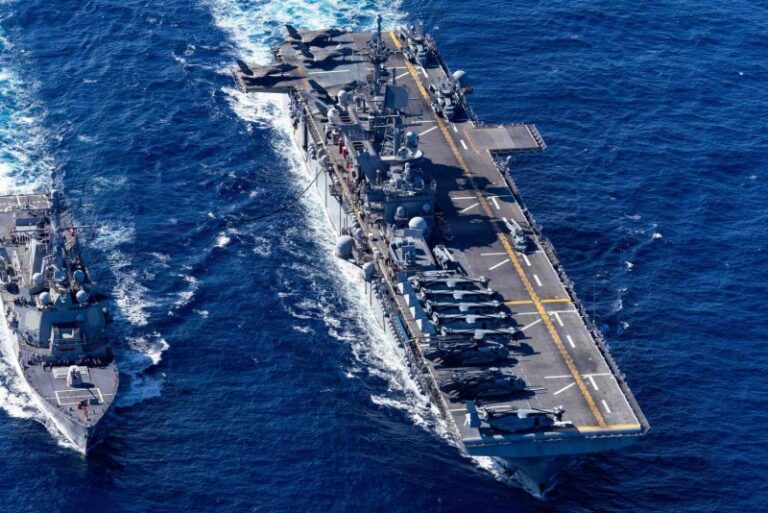
The U.S. Navy has concluded its investigation into the loss of three F/A-18 Super Hornets and a collision with a merchant vessel during the USS Harry S. Truman’s recent Middle East deployment.
The U.S. Navy has completed its investigation into the loss of three F/A-18 Super Hornets and a collision with a merchant vessel during the USS Harry S. Truman’s recent Middle East deployment. In a public statement, the Navy emphasized that each investigation was “conducted independently and thoroughly” and noted that “appropriate accountability actions have been taken.” Vice Chief of Naval Operations, Adm. Jim Kilby, stressed the service’s commitment to learning from these events: “The Navy is committed to being a learning organization… These investigations reinforce the need to continue investing in our people to ensure we deliver battle-ready forces.”
The Navy highlighted that the incidents occurred during a nine-month deployment featuring sustained high-tempo combat operations as part of Operation Rough Rider, with the Carrier Strike Group (CSG) operating under constant threat from ballistic missiles, anti-ship missiles, and one-way attack drones from Houthi forces. Despite the operational pressures, officials emphasized that each of the four mishaps was preventable.
Dec. 22, 2024 – Gettysburg Friendly Fire
The first investigation addressed the Dec. 22, 2024 incident, in which the Ticonderoga-class cruiser USS Gettysburg misidentified a U.S. Navy F/A-18F from Carrier Air Wing One over the Red Sea and fired an SM-2 missile, downing the aircraft. Both aircrew ejected safely. Investigators determined the firing decision was “neither reasonable nor prudent” and placed significant blame on the Gettysburg’s commanding officer, although no mechanical failures contributed.
The report cited systemic issues, including insufficient integrated training between the cruiser and the CSG, lack of backup on the cruiser, and poor cohesion across the strike group. Over the 45 days preceding the incident, the Gettysburg operated with the strike group only 15% of the time, and a planned 10-day integrated sail had been cut to two days due to logistical constraints.
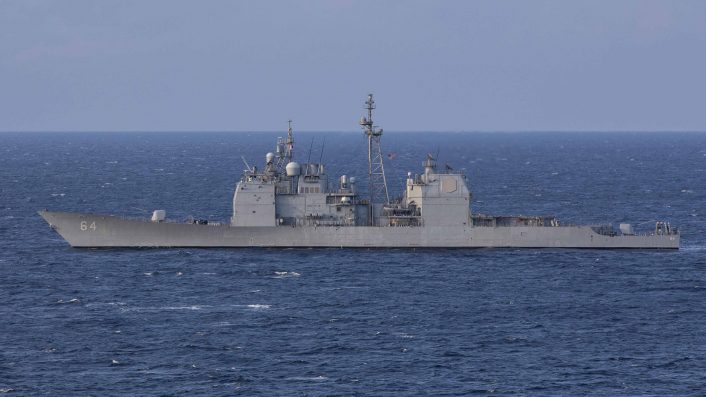
Additional factors included a helicopter landing reducing radar coverage, malfunctions in the AN/SPY-1 IFF system, and an E-2D Hawkeye radar outage, which led the Super Hornets to appear as “unknown” contacts. Corrective actions for Aegis Weapon System deficiencies cost $55 million.
Feb. 12, 2025 – Collision with Merchant Vessel
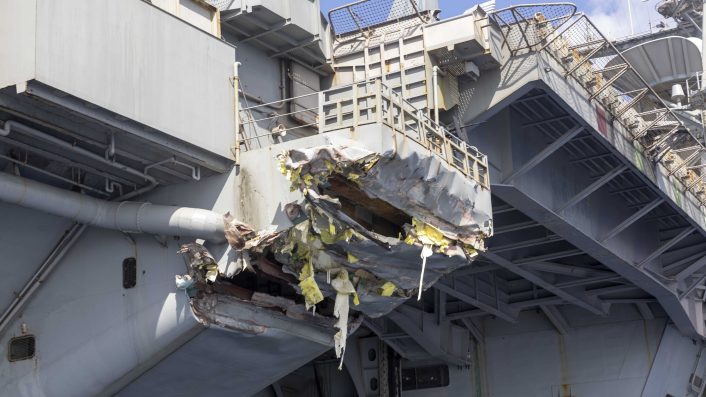
The Feb. 12, 2025 collision with the merchant vessel Besiktas-M near Port Said, Egypt, was judged “avoidable.” The carrier’s bridge team failed to safely navigate congested waters while transiting at 19 knots. Investigators cited a “just get it done” culture and crew fatigue as contributing factors.
Rear Adm. Todd Whalen emphasized that a small change in trajectory could have caused catastrophic loss of life. The carrier’s commanding officer, Capt. Snowden, was relieved due to “abdication of responsibility,” although his corrective actions during the collision—ordering a hard right rudder—likely prevented greater damage. Temporary repairs were made at Souda Bay, Crete, costing $685,000, with full repairs planned during the upcoming Refueling and Complex Overhaul.
Apr. 28, 2025 – Hangar Bay Loss
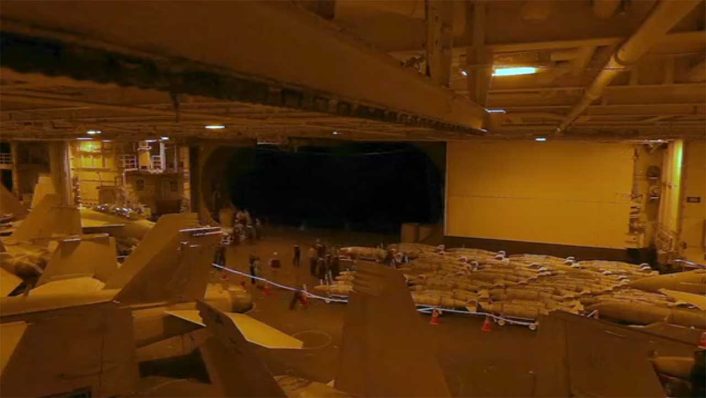
On Apr. 28, 2025, an F/A-18E from VFA-136 and a tow tractor were lost overboard while the carrier executed evasive maneuvers in response to an inbound ballistic missile. The F/A-18E was being moved in the hangar bay when it slipped, due to a brake system failure, poor communication between the bridge, flight deck, and hangar control, and slippery hangar surfaces.
A Sailor was in the cockpit acting as a “brake rider” and another operated the tractor; both safely jumped. The lost aircraft, assigned to the “Knighthawks,” was valued at $36 million, and the tow tractor at $61,000. The Navy praised the crew’s quick actions, which prevented injuries or further damage.
May 6, 2025 – Arresting Gear Failure
The third Super Hornet loss occurred on May 6, 2025, when an F/A-18F from VFA-11 was lost due to a failure of the #4 arresting wire, caused by a malfunctioning #4 starboard sheave damper missing a washer. The pilot and weapons systems officer ejected safely with minor injuries.
The investigation highlighted maintenance shortcomings, limited operator knowledge, low manning, and insufficient training, with high operational tempo and combat conditions in the Red Sea exacerbating the risk. The lost F/A-18F was valued at $60 million, with $207,000 in arresting system repairs and $47,000 for a life raft.
About The Author