The agreement involves the acquisition of 100 AGM‑158B/B2 JASSM‑ER cruise missiles intended to arm Italy’s F‑35 fighter jets, with the potential for integration onto additional platforms in the future.
The U.S. Defense Security Cooperation Agency (DSCA) has confirmed that the U.S. State Department has approved a potential Foreign Military Sale (FMS) to Italy for Joint Air-to-Surface Standoff Missile – Extended Range (JASSM‑ER) weapons. The proposed package includes 100 AGM‑158B/B2 missiles, along with associated support equipment, engineering assistance, and technical and logistical services, with an estimated total value of $301 million.
Although the missiles are mainly intended to equip the Italian Air Force’s F‑35 Lightning II fleet, the DSCA notification indicates that the weapon’s use may extend beyond fifth-generation fighters. According to the notice, the sale would enhance Italy’s ability to counter current and future threats by providing advanced long-range stand‑off strike capabilities for use on Italian fighter aircraft, including but not limited to the F‑35.
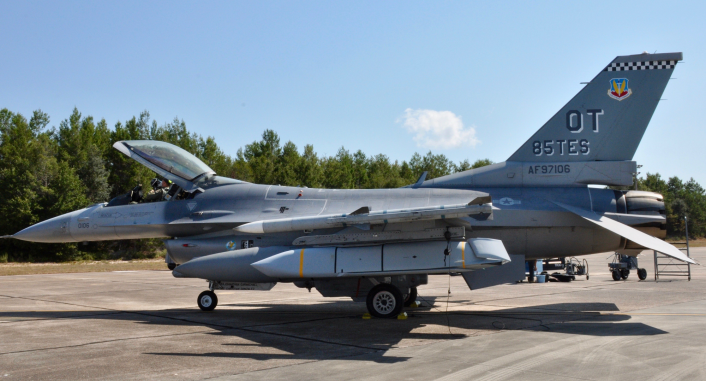
At present, it remains unclear which additional platforms might be selected to carry the JASSM in Italian service. Italy’s Tornado aircraft already operate the Storm Shadow cruise missile, and with the platform nearing retirement, integration of JASSM is considered unlikely. No delivery timeline for the missiles has been publicly disclosed.
The Eurofighter Typhoon could be another potential candidate, although it is generally expected to continue using the Storm Shadow, similar to the Royal Air Force’s approach. Italy also operates C‑130J transport aircraft, which in U.S. service have been paired with the Rapid Dragon palletized launch system capable of deploying JASSM from the cargo bay. However, there is currently no indication that Italy plans to pursue a comparable capability.
The AGM‑158 Joint Air‑to‑Surface Standoff Missile and its extended‑range variant, the AGM‑158B JASSM‑ER, form the backbone of the U.S. Air Force’s long‑range precision strike arsenal. Designed to penetrate sophisticated air defense systems, these low‑observable cruise missiles are intended to accurately engage high‑value targets from significant stand‑off distances.
Developed by Lockheed Martin, the baseline AGM‑158A entered operational service in the mid‑2000s. It features a 1,000‑pound WDU‑42/B penetrating warhead, GPS/INS navigation combined with an imaging infrared seeker for terminal guidance, and an operational range of approximately 370 kilometers. The missile is built to survive in heavily defended environments.
The AGM‑158B JASSM‑ER significantly expands on these capabilities, offering a reported range exceeding 900 kilometers. This increased reach is achieved through an improved engine and greater internal fuel capacity, while maintaining the same external dimensions as the original variant.
JASSM variants are already integrated on a wide range of aircraft, including the B‑1B, B‑52H, F‑16, F‑15E, and F‑15EX, with further integration underway for platforms such as the F‑35 across U.S. and allied air forces. The missile family has also evolved into the AGM‑158C Long‑Range Anti‑Ship Missile (LRASM) and the future AGM‑158D JASSM‑XR, designed for extreme‑range missions.
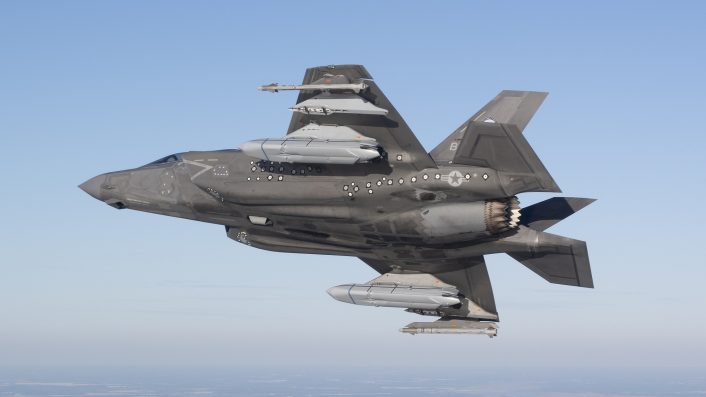
In 2024, Lockheed Martin, together with the F‑35 Pax River Integrated Test Force, began flight testing the AGM‑158 on the F‑35B and F‑35C variants. These tests support the integration of both the JASSM land‑attack missile and the LRASM anti‑ship variant as part of the F‑35 Block 4 modernization effort.
According to Lockheed Martin, integrating the AGM‑158 family will significantly enhance the F‑35’s multi‑role combat capabilities by extending its reach and increasing lethality against heavily defended and strategic targets, further strengthening its role as a centerpiece of modern air combat operations.
About The Author